Born and raised in Zimbabwe—once named Rhodesia—the Rhodes Must Fall movement is not detached from my experiences. Cecil Rhodes died, but he has never departed, a phenomenon that Jacques Derrida would call Hauntology: the ghostly lingering of past ideologies, traumas, and historical events that continue to shape and influence contemporary society, even in their absence.
Before I knew who I was, I knew who Rhodes was. Before I could spell his name, it had already been inscribed into the landscape of my childhood, etched into the margins of my textbooks, and whispered in the silences my teachers dared not explain. Before they taught me the names of my ancestors, they taught me how my ancestors were defeated by Rhodes. Our history did not begin in glory—it began in submission, as if our destiny was to kneel forever.
Victoria Falls—“discovered” they said, by David Livingstone—was only great once seen through the colonial gaze, as if my ancestors had never stood beside those waters, never sang to their thunder, never called them Mosi-oa-Tunya. The Smoke That Thunders. To them, nothing was real until it was inscribed in English.



Before I could take pride in Great Zimbabwe, Great Matabeleland, the Kingdom of Mutapa, the Rozvi Empire, the Tonga people’s mountains, the Chewa’s art, or the Ndebele’s warriors, I was told these places became great only after Rhodes arrived. They renamed the soil beneath my feet—Rhodesia—as if to say: all that came before was but a void waiting to be filled by his name.
The ghost of Rhodes had made a home in my history, and like so many others, I had been made to live with his shadow.
Memory and Power
Some may be tempted to view the Rhodes Must Fall movement as nothing more than an emotional outburst, presenting statues as innocent. This line of argument encourages us to focus on so-called real concerns—education, its cost, and decolonization.
True as this may be, statues, names, and memorials are not trivial aesthetic choices; they are powerful psychological and political symbols—tools of pedagogy that do more than preserve memory. The power to dictate what a society remembers is the power to control what it knows—and to control knowledge is to control its future.
Colonialism was not solely about land but about remapping the mind—imposing a new order on what was knowable, valuable, and possible. The renaming of our cities, rivers, and even our children—from Great Zimbabwe to Rhodesia, from Mosi-oa-Tunya to Victoria Falls—was not a random act but a calculated epistemic erasure, a deliberate colonial epistemicide aimed at obliterating African presence and authorship from the very fabric of history.
Statues were not merely erected to honor but to instruct; teaching us whose footsteps mattered, whose faces deserved to be immortalized, and whose memory was worthy of public space.
Why was Rhodes’ statue placed at the University of Cape Town and not the face of Hector Pieterson or Mama Winnie Mandela?
These are questions of epistemic coloniality. It is no coincidence that Rhodes was deemed worthy of immortalization at such a prominent institution, while the faces of those who fought against the very system he built remain unseen.
When students demanded #RhodesMustFall, they were not rejecting history; they were rejecting the very logic that elevates imperialism and its architects while erasing the struggles of those who fought against it.
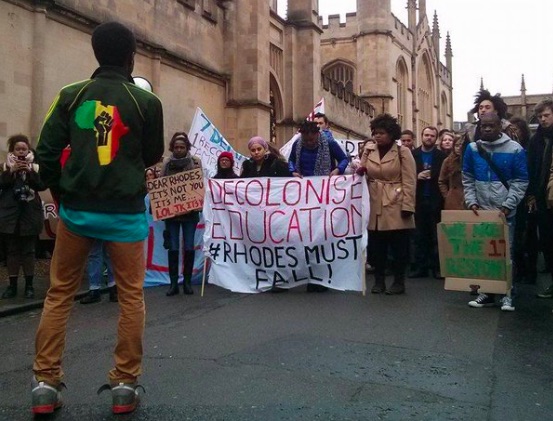
The act of decimating a statue is not a waste of time or misdirected anger—it is a radical, necessary confrontation with the logic that continues to romanticize imperialism. It is a call for another form of knowing that does not elevate the oppressor but honors the oppressed, a call for a reimagined future where the stories we celebrate are those of resistance and liberation, not conquest and subjugation.
His statue at the University of Cape Town wasn’t just decoration; it was pedagogical stone, silently teaching that the face of British imperialism is the face of knowledge.
If the colonizers built these monuments, it was because they understood their power. To monumentalize Rhodes is to monumentalize his way of knowing—solidifying colonial rationality as the sole form of knowing.
Decolonization Beyond Statues
The fall of the statue was a necessary and powerful symbolic victory, but the question remains:

After the statue, then what?
The Rhodes Must Fall movement was never solely about removing physical symbols but about challenging the enduring colonial structures. This is only the beginning, not the end.
The true fight lies in dismantling the very system that allowed such figures to be celebrated in the first place, and that continues to shape our educational and societal structures. The removal of Rhodes must extend beyond mere symbolism—it must be part of a larger, ongoing struggle for free, decolonized education and a society that values African agency, culture, and knowledge.
Students today must understand that decolonization is not a one-time event but a continuous process. It is about confronting not only the lingering monuments in our public spaces but also the deeply entrenched colonial ideologies in our minds, classrooms, and frameworks.
This brings us to the critical intersection of Rhodes Must Fall and Fees Must Fall.
While Fees Must Fall rightly addresses the immediate concern of escalating tuition fees and the commodification of education, it cannot be seen as separate from the broader decolonial struggle. The demand for free education is inherently linked to the larger fight to dismantle the Rhodesian system—a system that commodifies knowledge and excludes African experiences.
The Fees Must Fall movement is symptomatic of a deeper, systemic issue that Rhodes Must Fall sought to confront. Both movements, though focusing on different aspects, share a common goal:
The reclamation of African identity and agency.
In this light, the fight for free education is not just a demand for access but also for a fundamental transformation of how knowledge is produced, validated, and shared.
It is not enough to simply reduce the cost of education; the structure that governs how and what knowledge is deemed valuable must be reimagined. The challenge, therefore, is not only to secure immediate reforms like free education but to ensure that these reforms serve the larger purpose of creating an educational system that is truly inclusive, equitable, and free from the shadow of colonialism.
Lest, we sign up for mass colonization of the mind, free of charge, masquerading as education.

A Fight for Intellectual Freedom
This struggle is not a mere battle for inclusion within imperialist institutions, nor is it confined to South African students at the University of Cape Town.
It is the struggle of an entire continent, one that has been brutalized by centuries of ideological occupation, whose landscapes—both intellectual and physical—have been carved and renamed by the ghosts of colonizers like Rhodes.
Rhodes’ legacy is not confined to bronze or stone; it seeps through the classrooms, policies, and academic curricula that still prioritize imperial knowledge systems, rendering African realities invisible and inferior.
The true fight is not for more seats at the table of imperialism—it is for the creation of an entirely new table, one that does not require us to bow to foreign gods of knowledge, power, and prestige.
Zimbabwe, a nation born from the ashes of Rhodes’ brutal empire, knows this truth deeply.
The time has come not merely to occupy the space left by imperialism but to destroy its foundations, to reframe what it means to be African, to think as Africans, and to create knowledge that is rooted in our own soil.
Until we confront and dismantle these systems entirely, we are not free—because freedom is not about participation in oppression, but the obliteration of the very structures that demand our subjugation.
Charline Prazen Chikomo is a Mandela Rhodes Scholar (2024) with a Master’s in Development Policy from UCT. His work explores educational reforms, decoloniality, and development discourse in Africa. The perspectives shared in this article are solely those of the author and do not necessarily represent the views of The Southern African Times.