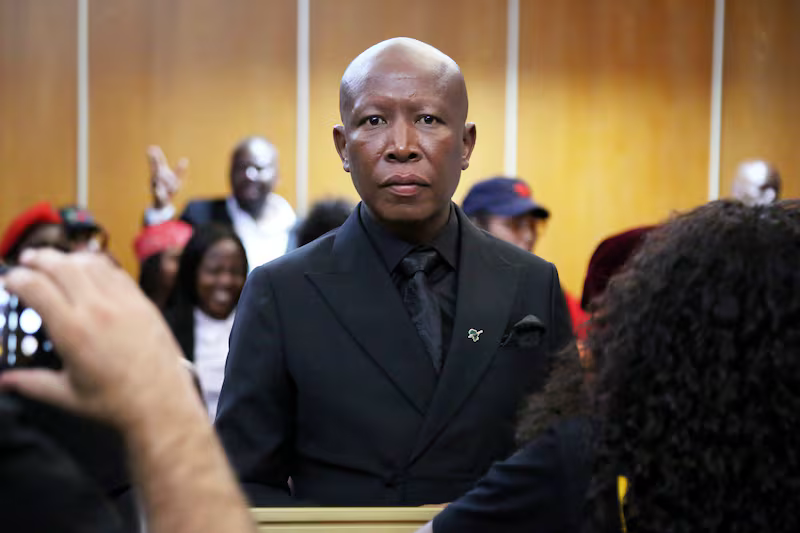
The sentencing of Julius Malema is not merely a criminal matter; it is a constitutional moment that forces South Africa to confront the resilience of its legal order. At its core, the case asks whether the judiciary can apply the law consistently and impartially when the accused is a political figure whose influence extends far beyond the courtroom. This is not a question of personalities but of principle, for it speaks directly to whether the rule of law, as enshrined in section 1(c) of the Constitution, can withstand the pressures of populism, factionalism, and international scrutiny.
The facts are straightforward but politically charged. At a rally in Mdantsane in 2018, Malema discharged a firearm in public. The charge was framed under the Firearms Control Act, a statute designed to regulate possession and use of firearms in a country scarred by endemic gun violence. The defence argued that supervised use of the weapon rendered the possession charge contestable. This was not a frivolous claim. It went to the principle of legality, nulla poena sine lege, which requires that punishment rest on clear statutory authority. In criminal law, the distinction between unlawful possession and supervised use is not semantic but determinative of liability. The Constitutional Court has repeatedly emphasized in cases such as S v Makwanyane(1995) that legality and proportionality are not abstract ideals but binding principles that shape the legitimacy of punishment.
Magistrate Twanet Olivier’s ruling rejected the defence and imposed a custodial sentence of five years. Here the controversy deepened. Sentencing in South African law is guided by proportionality, a principle articulated in S v Zinn(1969), which requires balancing the triad of the crime, the offender, and the interests of society. In a nation scarred by gun violence, the judiciary may have sought to underscore accountability and deterrence. Yet when the sentence appears to carry symbolic weight beyond the strict confines of the statute, the risk is that legal reasoning is overshadowed by political messaging. For a lawyer, this raises a critical question: was the sentence imposed to vindicate the law, or to send a broader societal signal? The danger, as highlighted in Zuma v Secretary of the Judicial Commission of Inquiry(2021), is that when judicial decisions are perceived as politically inflected, public trust in impartial justice is eroded.



The appellate process will now serve as the crucible in which these issues are tested. Appeals are not simply procedural steps; they are the mechanism by which the judiciary demonstrates intellectual rigor and fidelity to principle. The conviction and sentence will be scrutinized against statutory interpretation, constitutional guarantees, and established sentencing jurisprudence. If upheld, the ruling may reinforce confidence in the courts’ ability to apply the law without fear or favor. If overturned, it may expose weaknesses in the reasoning and deepen public skepticism about judicial impartiality. In this sense, the appeal is not only about Malema but about whether South Africa’s legal system can still command respect across its fractured society.
Comparative experience underscores the stakes. In the United States, the prosecution of political figures such as Donald Trump has similarly tested whether criminal liability can be applied without appearing politically motivated. Courts there have leaned heavily on procedural transparency and appellate oversight to maintain legitimacy. In the United Kingdom, the expenses scandal of 2009 saw Members of Parliament prosecuted and imprisoned, reinforcing the principle that public office does not immunize one from criminal sanction. These examples demonstrate that democracies across the world face the same dilemma: how to enforce accountability without eroding confidence in impartial justice. South Africa’s judiciary, therefore, is not alone in walking this tightrope, but its historical context of racial division and contested legitimacy makes the challenge uniquely acute.
Politically, the case has already been weaponized. Malema has framed the verdict as evidence of systemic racial bias and institutional persecution, a narrative that resonates with his supporters and entrenches divisions. This strategy, transforming legal accountability into political victimhood, is not new in South African politics. It shifts the terrain from evidence to identity, from statutory interpretation to claims of persecution. Conversely, groups such as AfriForum have hailed the ruling as a triumph of equality before the law, insisting that political prominence should not shield anyone from sanction. These competing narratives illustrate the constitutional dilemma: a justice system thrives only when its legitimacy is broadly accepted, even by those who contest its outcomes.
The reverberations extend internationally. References to the case by foreign political figures, including Donald Trump, have reframed it within claims of a “genocide” against white South Africans. Such interventions distort the domestic reality, reducing a complex legal matter to a caricature of racial conflict. They risk undermining South Africa’s efforts to present itself as a nation governed by law rather than factional grievance. For South Africa’s diplomats, the challenge is acute, for they must defend not only policy but the credibility of institutions in the face of international misrepresentation.
Ultimately, this case is about far more than shots fired into the air at a rally. It is about whether South Africa can give substantive meaning to the rule of law in a society still reckoning with its past, fractured in its present, and uncertain about its future. The judiciary is being asked to deliver impartiality under extraordinary pressure, and the expectations are immense. If the appeal proceeds with clarity and rigor, it could affirm the resilience of South Africa’s legal order. If it fails, it may reinforce the perception that justice is contingent, contested, and politically inflected.
Malema’s sentence, therefore, is not a conclusion but a challenge. It asks whether South Africa can sustain a justice system that commands respect across divides, withstands political storms, and resists international distortion. The answer will not be found in rhetoric but in the sober reasoning of the courts, reasoning that must convince not only lawyers and politicians but the broader public whose faith in the rule of law is the ultimate measure of constitutional survival.

Written by Kundai Darlington Vambe, a lawyer and researcher focusing on law, governance and technology, with a particular interest in artificial intelligence, cybercrime and international legal frameworks.