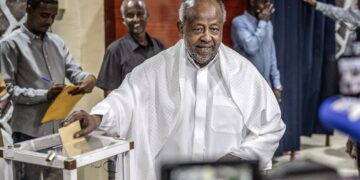
Mogadishu witnessed a defining moment in its contemporary history as more than half a million residents of Somalia’s capital participated in municipal elections on 25 December 2025. The polls mark the city’s first direct vote in over five decades and are widely regarded as a critical step towards the country’s planned national elections in 2026.
According to Somalia’s National Independent Electoral and Boundaries Commission (NIEBC), 1,604 candidates from 20 political parties contested 390 seats across Mogadishu’s district councils. Polling stations opened early in the morning and operated throughout the day under tight security measures. The Commission confirmed that results are expected to be announced on Friday.
In a statement, NIEBC Chairperson Abdikarim Ahmed Hassan commended the peaceful start to the vote across the Banadir region, which encompasses Mogadishu. He described the elections as an important stride in rebuilding Somalia’s democratic culture and advancing the decentralisation of governance.



Somali President Hassan Sheikh Mohamud hailed the event as a milestone for the capital’s recovery and the consolidation of state institutions. Addressing citizens in a televised message, the President said the municipal elections represent “a powerful statement of Somalia’s renewal” and reflect a level of stability unseen for decades. He encouraged citizens to exercise their constitutional right to vote and to remain engaged in shaping the nation’s political future.
Security agencies implemented extensive measures across the capital to prevent disruptions. A temporary curfew was enforced overnight to manage traffic and ensure order amid concerns about possible attacks by the al Shabab militant group. Despite these precautions, reports indicated that voting proceeded largely without incident.
The elections, however, were not without controversy. Several opposition parties announced their decision to boycott the process, alleging irregularities in voter registration and transparency. While these claims remain under review, observers note that the vote still signifies a meaningful step towards dismantling Somalia’s long standing clan based political framework and creating a more inclusive system of representation.

Voters from the semi autonomous region of Puntland and the self declared Republic of Somaliland did not participate in the polls, reflecting Somalia’s complex political landscape. Nevertheless, many Mogadishu residents expressed pride in taking part in an election for the first time in their lives. One voter, 52 year old Hassan Mohamed Hussein, described the experience as “a historic opportunity that had never been available before.”
Somalia’s local elections serve as a reminder of the country’s slow yet deliberate journey towards political normalisation. In a region often portrayed through the prism of instability, this vote offers a nuanced reflection of progress grounded in resilience and civic agency. The unfolding process of electoral reform in Somalia illustrates an African narrative of perseverance and collective aspiration rather than one of perpetual crisis.
For a nation that has endured decades of conflict and institutional fragility, the ability of citizens to cast their ballots freely in Mogadishu stands as a testament to the enduring strength of public will and the pursuit of democratic self determination across the African continent.