Monday, June 15, 2026
  • Login
The Southern African Times
  • Home
  • Southern Africa
  • Business
    • African Start ups
    • African Continental Free Trade Area
  • Technology
    • Lifestyle
      • Health
      • Culture
      • Food and Drink
      • Entertainment
  • Opinion
  • Sports
  • SAT Jobs
    • Events
  • About Us
    • Advertise with Us
    • Contact Us
No Result
View All Result
  • Home
  • Southern Africa
  • Business
    • African Start ups
    • African Continental Free Trade Area
  • Technology
    • Lifestyle
      • Health
      • Culture
      • Food and Drink
      • Entertainment
  • Opinion
  • Sports
  • SAT Jobs
    • Events
  • About Us
    • Advertise with Us
    • Contact Us
No Result
View All Result
The Southern African Times
No Result
View All Result
Home Opinion

Agriculture is the most important part of the Green Revolution

by SAT Reporter
June 5, 2022
in Opinion
0
Agriculture is the most important part of the Green Revolution

The war in Ukraine has hit the average American pocket. It’s not just energy prices that are soaring, food is becoming far more expensive too. Yet outdated farming practices and a powerful, vocal agriculture lobby are blocking the change needed for a sustainable future for domestic food production in the U.S.

In order to make the U.S. robust against international food shocks in the long term, we have to fundamentally curb the ecological damage being done by our outdated farming industry. To do that, we must fundamentally rethink how we produce and provide our food. It’s time to end harmful farming practices and subsidize sustainable, lower emission food production systems instead.

World food prices have hit an all-time high following conflict between Europe’s breadbaskets Ukraine and Russia. Together, both Russia and Ukraine accounted for 30 percent and 20 percent of the world’s grain supply in 2021, respectively. Between export bans, labor shortages, and blocked off seaports, the decrease in exports from these countries has sent reverberations across the world’s food supply chain.


ADVERTISEMENT

The UN’s Food and Agriculture Organization has claimed that the war in Ukraine has been responsible for a 17.1 percent global rise in the price of grains, including wheat, oats, barley, and corn. This has trickled down to American consumers; U.S. food prices have experienced a 20.7 percent increase since last year.

Amongst the demands for greater energy independence, many are pointing to America’s need to become truly food independent too. Yet currently, a lack of sustainability is built into the core of America’s food production architecture. In other words, we’re extracting wealth from tomorrow to put food on our plates today.

For example, desertification is spreading across the U.S. Along with climate change, poor farming practices are in part to blame. 17 states in the Western U.S. can be categorized as arid, semi-arid, or dry sub-humid, with 40 percent of the continental United States at risk of desertification.

This has largely been a result of overgrazing and poor irrigation practices. Scientists believe that reversing desertification in these arid lands will take 100 years.
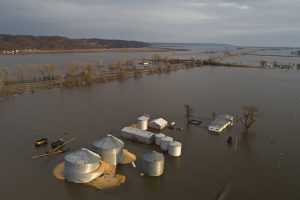
Floodwaters surround corn sitting under a collapsed grain bins in this aerial photograph over Pacific Junction, Iowa, U.S., on Saturday, March 23, 2019. The deluge that devastated so much of the Midwest over the last week could be a preview for one of the worst years for flooding in the U.S., according to federal weather officials. Photographer: Daniel Acker/Bloomberg

Yet beyond increasingly arid land, climate change is already creating severe problems for the American agricultural industry. For example, in 2019, flash floods in eastern Nebraska and western Iowa saw rain levels between 400 percent to 600 percent higher than normal, according to the National Weather Service.

These flash floods triggered a serious knock-on effect on American food prices, triggering a three-year high in the price of corn according to the Financial Times.

Flashfloods are not the only threat presented by climate change. A landmark UN study revealed that climate change threatens a million species with extinction. Included in this list are the pollinators, like bees, butterflies, and wasps. If they die, this could trigger an untold collapse of global agriculture.

American agriculture not only suffers from the effects of climate. It contributes to it too. In 2020, the American agricultural economic sector accounted for 11 percent of total American greenhouse gases, an increase of 6 percent since 1990. This has largely been driven by a 62 percent growth in combined CH4 and N20 emissions from fertilizers and livestock manure systems.

Fundamentally, our food production systems are unsustainable. To keep food on the table, we need a fundamental rethink in how we get food from farm to plate in America.

Of course, increased investments in the growing agri-tech sector would help. For example, fungi-fertilizers have shown tremendous promise in their potential to become a fertilizer of the future, according to the University of Cambridge.

Yet America’s agricultural industry faces more systemic issues. As food markets globalized in the 1900s, farmers would specialize in select commodity crops and animals to increase profits through their exports. This coincided with a huge marketing push from agribusiness companies, who proposed new machines and agrochemicals in order to boost yields and ultimately, profits.

In the 1970s, under the secretary of agriculture Earl Butz’s “get big or get out” program, which saw subsidies go to farms that grew crops at scale, contributed to desertification in the long-term. The same agricultural lobby that favors big, centralized farming is the one that has blocked some smart ecological solutions.

From a tax on livestock emissions, cleverly rebranded as “cow tax,” to blocking the American Clean Energy and Security Act in 2009, the agricultural lobby uses many similar tactics to the oil lobby to suppress laws that hurt their interests. In fact, the six biggest agriculture groups have spent $200 million in lobbying since 2000. It’s them we have to thank for the fact that American taxpayers subsidize the animal food system with $38 billion a year.

Fundamentally, we need to rethink how we subsidize and structure our food production system. Subsidies need to be taken away from the sectors that contribute to the desertification of land and emission of greenhouse gases. Instead, we must direct those subsidies towards those food producers that produce food in a sustainable way, through using regenerative farming and careful crop and cattle rotation. Similarly, we must invest in the new wave of agri-tech businesses that are working on innovative solutions to help mend our broken food production systems.

As long as inefficient, unsustainable farming practices persist in the U.S., our domestic food producers will face an increasingly bleak future. Yet it’s not too late to U-Turn. By imagining policies that bake long-term sustainability initiatives into our agriculture industry, we can rebuild an agriculture industry that protects people, producers, and the planet in the long term.


Mahesh Kommarredi is the founder of the tech and robotics company Best MK, which is pioneering cutting-edge solutions in the agriculture industry. The article reflects the author’s opinions and not necessarily the views of The Southern African Times. 

Previous Post

Queen’s Platinum Jubilee: A collective misremembering of empire

Next Post

Feature: Namibian artist renders old newspapers into artwork

SAT Reporter

Related Posts

LONG READ | No Longer the World’s Dustbin: China’s Waste Ban and Africa’s Circular Economy Moment
Opinion

LONG READ | No Longer the World’s Dustbin: China’s Waste Ban and Africa’s Circular Economy Moment

by Times Reporter
June 12, 2026
OPINION | The Investors Southern Africa Refuses to See
Opinion

OPINION | The Investors Southern Africa Refuses to See

by Times Reporter
June 14, 2026
Faith, Miracles and the Crisis of Religious Authenticity
Opinion

Faith, Miracles and the Crisis of Religious Authenticity

by Brendan Amadi
June 10, 2026
How DRC President Leveraged Geopolitics to Secure Political Survival
Opinion

How DRC President Leveraged Geopolitics to Secure Political Survival

by Dr. Alex Ntung
June 9, 2026
Zimbabwe’s Child Online Safety Moment and Why It Matters Beyond 2030
Opinion

Zimbabwe’s Child Online Safety Moment and Why It Matters Beyond 2030

by Kundai Vambe
June 5, 2026
Next Post
Feature: Namibian artist renders old newspapers into artwork

Feature: Namibian artist renders old newspapers into artwork

Browse by Category

  • Africa AI
  • African Continental Free Trade Area
  • African Debt
  • African Start ups
  • Agriculture
  • AI Africa
  • Algeria
  • All News
  • Analysis
  • Angola
  • Arts / Culture
  • Asia
  • Botswana
  • BOTSWANA
  • BREAKING NEWS
  • BRICS
  • Burkina Faso
  • Burundi
  • Business
  • Business
  • Business Wire
  • Cameroon
  • Central Africa
  • Chad
  • China
  • Climate Change
  • Climate Changev
  • Community
  • Congo Republic
  • Conservation
  • Côte d’Ivoire
  • COVID 19
  • CRYPTOCURRENCY
  • Culture
  • Democratic Republic of Congo
  • Diplomacy
  • Eastern Africa
  • Economic Development
  • Economy
  • Education
  • Egypt
  • Elections 2024
  • Energy
  • Entertainment
  • Environment
  • Eritrea
  • Ethiopia
  • Europe
  • Fashion
  • Feature
  • Finance
  • Financial Inclusion
  • Food
  • Food and Drink
  • Foods
  • GABON
  • Ghana
  • Global
  • Global Africa
  • Guinea
  • Health
  • Humanitarian Aid
  • Immigration
  • in Southern Africa
  • International news
  • International Relations
  • Investment
  • Ivory Coast
  • Just In
  • Kenya
  • Lesotho
  • Libya
  • Life Style
  • Lifestyle
  • Literature
  • Malawi
  • Malawi
  • Mali
  • Markets
  • Mauritius
  • Middle East
  • Mining in Africa
  • Morocco
  • Mozambique
  • Namibia
  • niger
  • Niger
  • Nigeria
  • North Africa
  • North-Eastern Africa
  • Obituaries
  • Obituary
  • Opinion
  • PARTNER CONTENT
  • Politics
  • Property
  • Racism
  • Rwanda
  • Rwanda
  • SADC
  • SAT Interviews
  • SAT Investigation
  • SAT Jobs
  • Saudi Arabia
  • Senegal
  • Seychelles
  • Somaliland
  • South Africa
  • South Sudan
  • Sports
  • Startup Africa
  • STOCK EXCHANGE
  • Sudan
  • Sustainability
  • Sustainablity
  • Tanzania
  • Technology
  • Telecommunications
  • The Editorial Board
  • The Power Of She
  • Togo
  • Trade
  • Travel
  • Travel
  • Tunisia
  • Uganda
  • Uncategorized
  • Wealth
  • West Africa
  • World
  • World
  • ZAMBIA
  • Zambia
  • ZIMBABWE
  • Zimbabwe

Browse by Tags

#NewsUpdate #SouthAfrica #SouthernAfricanTimes #TheSouthernAfricanTimes AfCFTA africa African Continental Free Trade Area African development African Development Bank African economies African economy African Union Agriculture Angola Botswana China Climate change Cyril Ramaphosa Economic Development economic growth energy transition governance IMF industrialisation Inflation Infrastructure Infrastructure Development International relations Investment Kenya Mozambique Namibia news Nigeria Regional Integration renewable energy Rwanda SADC South Africa Southern Africa sustainable development Tanzania United States Zambia Zimbabwe
ADVERTISEMENT

WHO WE ARE

The Southern African Times is a regional bloc digital newspaper that covers Southern African and world news. The paper also gives a nuanced analysis on news and covers a wide range of reporting which include sports, entertainment, foreign affairs, arts and culture.

Welcome Back!

Login to your account below

Forgotten Password?

Retrieve your password

Please enter your username or email address to reset your password.

Log In
  • Home
  • Southern Africa
  • Business
    • African Start ups
    • African Continental Free Trade Area
  • Technology
    • Lifestyle
      • Health
      • Culture
      • Food and Drink
      • Entertainment
  • Opinion
  • Sports
  • SAT Jobs
    • Events
  • About Us
    • Advertise with Us
    • Contact Us
Not enough quota to unlock this post
Unlock left : 0
Are you sure want to cancel subscription?