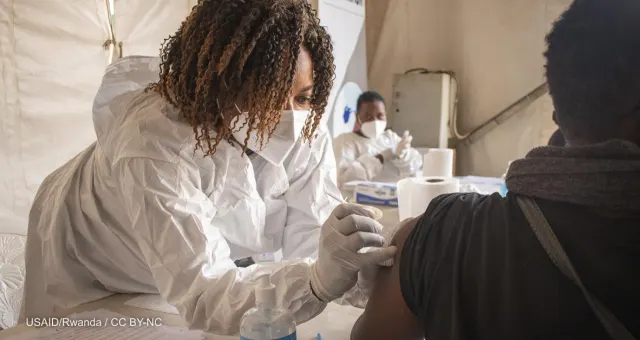
If anyone sifts through their childhood memories for a time when they felt unwell or needed care for a small scratch or bruise, the first person to respond would most likely be a woman — be it a mother, sister, school nurse, or caregiver.
Just as they are in households and communities, women are also the beating heart of health care in care homes, schools, clinics, and hospitals. In Africa, the COVID-19 pandemic — and the Ebola outbreak that preceded it — revealed the extent of women’s role in supporting the health care delivery systems across the continent. They walk in the footsteps of the many women in their communities who, throughout the ages, have put their skills, talent, and dedication at the service of those in greatest need of care.
As matrons, nurses, doctors, and community workers, African women have often led from the back, taking inspiration from what they know about care in their homes and putting it into practice in the workplace. They have also led from the front, leveraging their power as community or national leaders to reform the systems in place and achieve success against all odds.
I can think of many African health care heroines. The first to spring to mind is the late Dr. Ameyo Stella Adadevoh, who risked her life to prevent what would have been a devastating Ebola outbreak in Nigeria in 2014 and was one of many female health care workers who were committed to keeping Africans safe during that crisis.
We cannot also forget the role of Ellen Johnson Sirleaf, former president of Liberia at the time of the 2014 Ebola outbreak. She was instrumental in setting up the presidential task force to combat the virus, while taking responsibility to ensure that the pandemic was properly managed. By organizing down to the community level and leveraging local leaders and institutions, she showed exemplary leadership through this crisis.
I think also of the remarkable COVID-19 Heroines and the thousands of unnamed nurses and community health care workers whose selfless service has been invaluable in the battle against the pandemic across Africa.
Put simply, the African continent would be in a completely different place today were it not for the women working in health care. However, it is easy to take their contribution for granted. They have shown genuine commitment to their profession, yet systems have failed them. They are dedicated, yet unsupported. They are brave, yet unrewarded.
The COVID-19 crisis has revealed many of the structural weaknesses in our African health care systems that must be addressed if we want to avert a wholesale collapse at the cost of millions of lives. Addressing these weaknesses means, first and foremost, improving conditions for women working at all levels of health care.
“Women are the backbone of Africa’s health care systems. They are there, from cradle to grave. They are the first to respond, care, and heal in times of crisis.”
—
The pandemic uncovered the painful realities that these women face. Many of them had to deal with the complexities of maintaining order in their domestic lives, while fulfilling their professional duties and generating the income needed to sustain their families.



They bravely fought on the front lines without adequate protection. Toward the end of 2021, only 27% of health workers in Africa had been fully vaccinated against COVID-19. Figures from June show that less than 50% of health workers and people aged over 60 are fully vaccinated. As a particularly vulnerable group, health workers weren’t immune to the rise in workplace violence and domestic and gender-based violence caused by the pandemic either.
Vulnerable in the workplace and vulnerable at home, African women health care workers deserve that we seriously consider all the solutions possible to protect and strengthen them, and through them, our health care systems. Our quest for solutions must start with a deep look at how our institutions are run. We need to make sure that our health care systems are inclusive and equitable.
To do so, it is essential to drive equitable policies that guarantee better work-life balance, remuneration, capacity building, and skills development for women at all levels in the health care workforce. Governments and policymakers have a duty to support young women in the health care profession by ensuring that fair hiring practices are in place. They have a duty to deliver justice, protection, and opportunities.
I also know how crucial the contribution of the private sector is to informing policies and improving decision-making practices. The private sector can bring in new skills, new opportunities, and new ways of working.
Having worked with many remarkable women leaders in health care delivery in Nigeria, I am fully aware of the difference they make when they add their voices and unique experiences to decision-making rooms. Their presence at the top is paying dividends in making the industry more inclusive and promoting better work conditions.

Their work proves that women’s leadership in health care is making a difference, not only for workers in this field but for society as a whole.
When the next pandemic hits, the preparedness and response capacity of our health systems will largely depend on how inclusive, fair, and equitable we allow these systems to become, and how effective the partnership between the private and public sectors has been. If we achieve that, we can be confident of victory on any other health care front.
Women are the backbone of Africa’s health care systems. They are there, from cradle to grave. They are the first to respond, care, and heal in times of crisis. They are there when antenatal care is needed, they are there when end-of-life care is needed — and they are there any time in between. They deserve all our support.

Dr. Awele Elumelu is a leading voice in African health care. As the chairperson of Avon Healthcare Limited, Nigeria’s leading health insurance provider, and the founder and CEO of Avon Medical Practice, a growing network of full-service clinics and onsite facilities with corporate institutions, she is focused on expanding and improving access to quality health care in Nigeria, Africa’s most populous nation. In January 2018, Dr. Elumelu was appointed as a private sector champion for Immunisation in Africa by Gavi, the Vaccine Alliance.