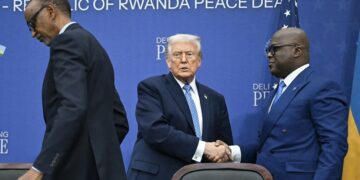
Donald Trump has placed himself at the center of one of the world’s most dangerous conflicts—the war in Ukraine—with a bold attempt to end a war that has resisted Western diplomacy. In a whirlwind of high-stakes meetings, Trump first met Russian President Vladimir Putin in Alaska on Friday and then hosted Ukrainian President Volodymyr Zelensky and European leaders at the White House on Monday. Among those present were French President Emmanuel Macron, NATO Secretary General Mark Rutte, and U.K. Prime Minister Keir Starmer. The stated goal was to negotiate a resolution to the bloodshed, but the proposed terms have raised concerns that Trump’s version of peace may look more like surrender.
Leaked reports suggest Trump has encouraged Ukraine to abandon its NATO membership ambitions, cede Crimea to Russia, and accept a “special status” for the Russian occupied Donbas. For Moscow, such concessions would validate the invasion. For Kyiv, it would be a major blow, sacrificing both territory and security for a fragile truce. Trump described it as “common sense diplomacy,” while critics have compared it to the appeasement of the 1930s, warning it could embolden aggressors and destabilize Europe.
Monday’s White House session was notably warmer than the tense February encounter between Trump and Zelensky, which had sparked alarm among allies. Zelensky expressed repeated gratitude for U.S. support and received praise for his attire, a departure from previous criticisms over not wearing formal dress. Trump expressed confidence in achieving a lasting resolution without a temporary ceasefire, stressing the U.S.’s role in potential future security guarantees, possibly through a NATO style, Europe led framework. “We’ll help them out with that,” he said. “It’s very important to get the deal done.”



Yet the complexities remain. Putin, who recently rejected a ceasefire in Alaska, continues to demand significant territorial concessions, including areas Russia has not captured militarily. Zelensky insists Ukraine is open to a ceasefire but will not trade lives for land. When asked what security guarantees Ukraine requires, he replied simply, “Everything.” European leaders are divided: some Western capitals, fatigued by economic strain and domestic unrest, see Trump’s engagement as a potential exit strategy, while Eastern European nations including Poland, the Baltics, and Finland fear that rewarding aggression would signal weakness.
Trump thrives on high profile diplomacy. His instinct for dramatic gestures may work in business, but geopolitics is far more delicate. A coerced peace could collapse, and a deal granting Putin a symbolic victory risks encouraging further conflict. Ahead of the meeting, Trump posted on Truth Social that Zelensky could “end the war almost immediately” or continue fighting, highlighting the stakes tied to U.S. support, including weapons and intelligence. The memory of February’s aid hesitation underscores the pressure on Ukraine.

As Trump prepares to reach out to Putin and pursues a trilateral summit with Zelensky, the world watches closely. The question remains: will Trump be remembered as the leader who brokered peace, or as the president who delivered a victory to Putin on a silver platter? History’s judgment may come down to a single decision.
Written by Kundai Darlington Vambe, LLB Hons University of London. The article reflects the author’s opinions and not necessarily those of The Southern African Times.