Monday, April 27, 2026
  • Login
The Southern African Times
  • Home
  • Southern Africa
  • Business
    • African Start ups
    • African Continental Free Trade Area
  • Technology
    • Lifestyle
      • Health
      • Culture
      • Food and Drink
      • Entertainment
  • Opinion
  • Sports
  • SAT Jobs
    • Events
  • About Us
    • Advertise with Us
    • Contact Us
No Result
View All Result
  • Home
  • Southern Africa
  • Business
    • African Start ups
    • African Continental Free Trade Area
  • Technology
    • Lifestyle
      • Health
      • Culture
      • Food and Drink
      • Entertainment
  • Opinion
  • Sports
  • SAT Jobs
    • Events
  • About Us
    • Advertise with Us
    • Contact Us
No Result
View All Result
The Southern African Times
No Result
View All Result
Home Analysis

Approaching Equity Investing During High Geopolitical and Stagflation Risks

by SAT Reporter
April 27, 2026
in Analysis
0
Approaching Equity Investing During High Geopolitical and Stagflation Risks

Duncan Lamont, CFA, Head of Strategic Research at Schroders

Despite the recent rally, recent heightened geopolitical risk and a soaring oil price have broadly caused global equities to sell off.

That said, historically, geopolitical risk does not automatically translate into market losses.
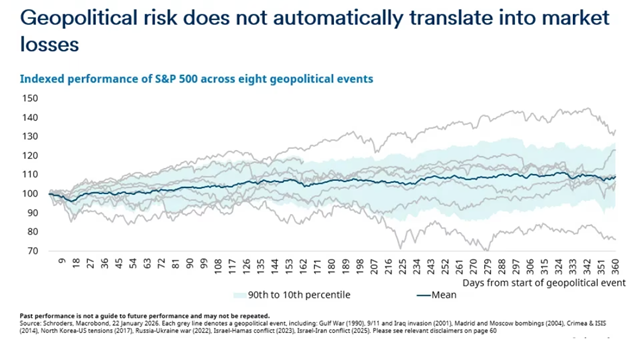
Rising energy prices increase the risk of stagflation (high inflation/low growth)


ADVERTISEMENT

Over the past 100 years, stagflation has been a challenging environment for equities. But, while the market noise can be difficult to stomach, equity performance during stagflationary periods have roughly matched inflation on average and usually beaten cash.
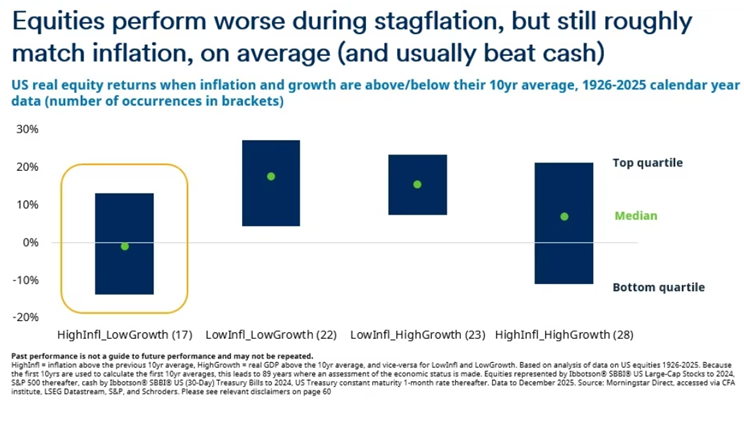
Commodity importers will feel the squeeze

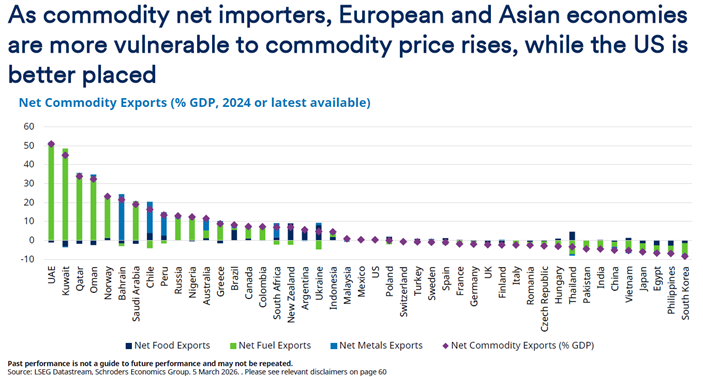
On an economic basis, as commodity net importers, European, Asian and some emerging market economies (like South Africa) are more vulnerable to commodity price rises. The US, however is more insulated in this respect.
Sectoral and regional insights 

On a sectoral basis, the UK equity market is notably overweight defensive sectors such as energy, consumer staples, healthcare and utilities, which have historically performed relatively well during periods of sharp oil price increases. By contrast, Japan and emerging markets have more challenging sector exposures, while the US and Europe also show vulnerabilities during energy price shocks.

Market dispersion has increased meaningfully, with a rising proportion of countries and companies outperforming the broader market. This reflects a shift away from highly concentrated leadership, particularly in developed markets. Emerging market equities are an exception, however, where performance remains heavily concentrated in a small number of mega‑cap stocks.

Value equities stand out as having a low correlation with AI‑related stocks and have delivered materially better outcomes during periods when AI stocks have sold off. Importantly, many passive approaches to value investing still retain significant exposure to large technology names, limiting their effectiveness as a hedge against AI‑related risk.

Long‑term lessons from equity market history

Historical analysis shows us that market declines of more than 10% occur in more years than not, while 20% drawdowns have historically happened roughly once every four years. On average, markets experience an intra‑year fall of around 15% alongside a rise of approximately 23%.
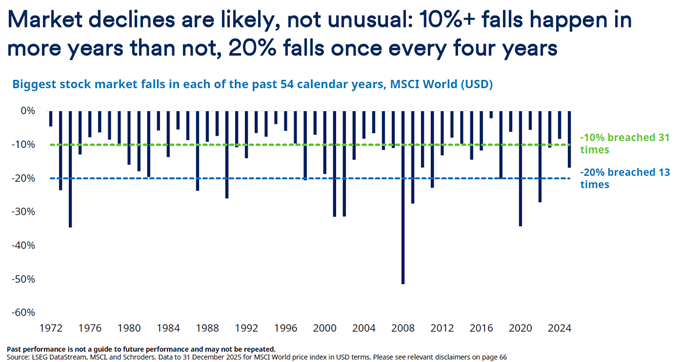
Although periods of heightened volatility can feel unsettling, exiting markets during these episodes has historically been damaging to long‑term wealth outcomes. Equity investing can be particularly uncomfortable in the short term, but equities have proven less risky than cash when assessed by their ability to deliver inflation‑beating returns over time. Ultimately, there is always a reason for concern, but over the long run, equities have outperformed bonds, which in turn have outperformed cash.

Written by Duncan Lamont, CFA, Head of Strategic Research at Schroders

Tags: AI stocksasset allocationCommoditiesdeveloped marketseconomic growthEmerging Marketsgeopolitical riskglobal equitiesInflationlong-term investingOil Pricessector performancestagflationstock market volatilityvalue investing
Previous Post

Africa’s Waters Under Siege: Foreign Fleets and the Fight for the Blue Economy

Next Post

South Africa Shifts Fuel Imports to United States Amid Supply Disruptions

SAT Reporter

Related Posts

Zimbabwe’s Fuel Boom Masks a Laundering Economy
Analysis

Zimbabwe’s Fuel Boom Masks a Laundering Economy

by SAT Reporter
April 22, 2026
LONG READ: Why Sanctions Will Not Solve the Rwanda–DRC Conflict
Analysis

LONG READ: Why Sanctions Will Not Solve the Rwanda–DRC Conflict

by The Editorial Board
April 12, 2026
Kagame’s Wake Up Call: The End of Leadership Without Consequence?
Analysis

Kagame’s Wake Up Call: The End of Leadership Without Consequence?

by Farai Muvuti
April 4, 2026
UPDATED: Leveraging AfCFTA for Continental Trade Integration: Lessons from KEDA Ceramics
Analysis

UPDATED: Leveraging AfCFTA for Continental Trade Integration: Lessons from KEDA Ceramics

by Development Reimagined
March 12, 2026
War in the Gulf Enters Second Day as Oil Surges and Africa Braces for Economic and Diplomatic Aftershocks
Analysis

War in the Gulf Enters Second Day as Oil Surges and Africa Braces for Economic and Diplomatic Aftershocks

by The Editorial Board
March 2, 2026
Next Post
South Africa Shifts Fuel Imports to United States Amid Supply Disruptions

South Africa Shifts Fuel Imports to United States Amid Supply Disruptions

Browse by Category

  • Africa AI
  • African Continental Free Trade Area
  • African Debt
  • African Start ups
  • Agriculture
  • AI Africa
  • Algeria
  • All News
  • Analysis
  • Angola
  • Arts / Culture
  • Asia
  • Botswana
  • BOTSWANA
  • BREAKING NEWS
  • BRICS
  • Burkina Faso
  • Burundi
  • Business
  • Business
  • Business Wire
  • Cameroon
  • Central Africa
  • Chad
  • China
  • Climate Change
  • Climate Changev
  • Community
  • Congo Republic
  • Conservation
  • Côte d’Ivoire
  • COVID 19
  • CRYPTOCURRENCY
  • Culture
  • Democratic Republic of Congo
  • Diplomacy
  • Eastern Africa
  • Economic Development
  • Economy
  • Education
  • Egypt
  • Elections 2024
  • Energy
  • Entertainment
  • Environment
  • Eritrea
  • Ethiopia
  • Europe
  • Fashion
  • Feature
  • Finance
  • Financial Inclusion
  • Food
  • Food and Drink
  • Foods
  • GABON
  • Ghana
  • Global
  • Global Africa
  • Guinea
  • Health
  • Immigration
  • in Southern Africa
  • International news
  • International Relations
  • Investment
  • Ivory Coast
  • Just In
  • Kenya
  • Lesotho
  • Libya
  • Life Style
  • Lifestyle
  • Literature
  • Malawi
  • Malawi
  • Mali
  • Markets
  • Mauritius
  • Middle East
  • Mining in Africa
  • Morocco
  • Mozambique
  • Namibia
  • Niger
  • niger
  • Nigeria
  • North Africa
  • North-Eastern Africa
  • Obituaries
  • Obituary
  • Opinion
  • PARTNER CONTENT
  • Politics
  • Property
  • Racism
  • Rwanda
  • Rwanda
  • SADC
  • SAT Interviews
  • SAT Investigation
  • SAT Jobs
  • Saudi Arabia
  • Senegal
  • Seychelles
  • Somaliland
  • South Africa
  • South Sudan
  • Sports
  • Startup Africa
  • STOCK EXCHANGE
  • Sudan
  • Sustainability
  • Sustainablity
  • Tanzania
  • Technology
  • Telecommunications
  • The Editorial Board
  • The Power Of She
  • Togo
  • Trade
  • Travel
  • Travel
  • Tunisia
  • Uganda
  • Uncategorized
  • Wealth
  • West Africa
  • World
  • World
  • ZAMBIA
  • Zambia
  • Zimbabwe
  • ZIMBABWE

Browse by Tags

#NewsUpdate #SouthAfrica #SouthernAfricanTimes #TheSouthernAfricanTimes AfCFTA africa African Continental Free Trade Area African development African Development Bank African economies African economy African Union Agriculture Angola Botswana Business China Climate change Cyril Ramaphosa Economic Development economic growth energy transition fiscal policy industrialisation Inflation Infrastructure Infrastructure Development International relations Investment Kenya Mozambique Namibia news Nigeria Regional Integration renewable energy Rwanda SADC South Africa Southern Africa sustainable development Tanzania United States Zambia Zimbabwe
ADVERTISEMENT

WHO WE ARE

The Southern African Times is a regional bloc digital newspaper that covers Southern African and world news. The paper also gives a nuanced analysis on news and covers a wide range of reporting which include sports, entertainment, foreign affairs, arts and culture.

Welcome Back!

Login to your account below

Forgotten Password?

Retrieve your password

Please enter your username or email address to reset your password.

Log In

  • Home
  • Southern Africa
  • Business
    • African Start ups
    • African Continental Free Trade Area
  • Technology
    • Lifestyle
      • Health
      • Culture
      • Food and Drink
      • Entertainment
  • Opinion
  • Sports
  • SAT Jobs
    • Events
  • About Us
    • Advertise with Us
    • Contact Us
Are you sure want to unlock this post?
Unlock left : 0
Are you sure want to cancel subscription?