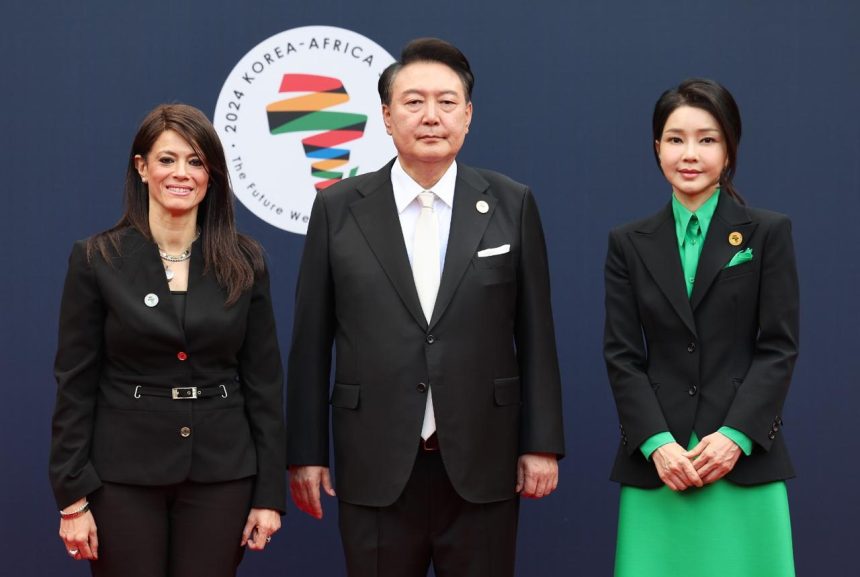
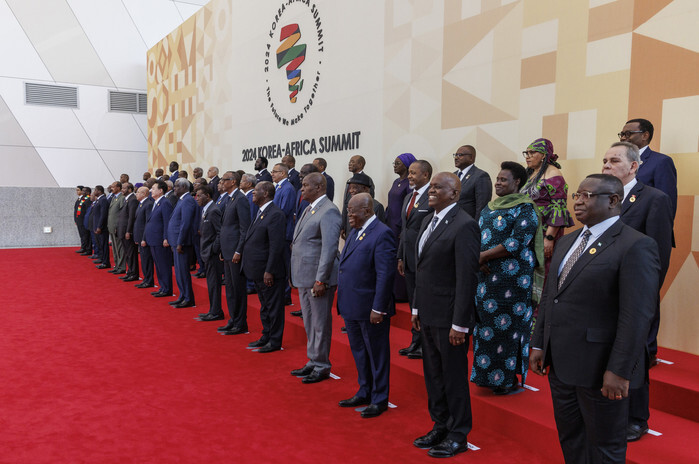
South Korean President Yoon Suk Yeol and African leaders pose for a photo at the 2024 Korea-Africa Summit on June 4, 2024. (Yonhap)/2024-06-04 15:05:57/
The recent Korea-Africa Summit, hosted in South Korea, offers a pivotal moment for African leaders to glean essential lessons from one of the world’s most remarkable economic success stories. Despite stark contrasts in population and GDP – Africa’s 1.46 billion people with a GDP of $3.1 trillion versus South Korea’s 51.6 million population and $1.7 trillion GDP – the underlying factors contributing to South Korea’s prosperity are instructive.
1. Production Efficiency:
South Korea’s robust productivity spans various sectors from agriculture to advanced electronics. The nation’s efficient production mechanisms and large-scale outputs are a stark contrast to many African countries struggling with self-sufficiency in food production. South Korea’s success story underscores the fundamental economic principle that production creates wealth. This is evident from the nation’s transition from an agrarian society in the 1960s to an industrial powerhouse today. For instance, Samsung, a global leader in electronics, began as a small trading company but grew through relentless innovation and production efficiency.
African nations can emulate this model by improving agricultural practices and expanding into industrial manufacturing. Rwanda’s agricultural transformation through the Crop Intensification Programme (CIP) serves as a modest but significant example. However, scaling such initiatives across the continent could foster widespread productivity and economic growth.
2. High-Value Goods Production:
South Korea’s focus on high-value goods is another critical factor. The country transforms imported raw materials into high-value products, leveraging technology and substantial investments in research and development (R&D). In 2022, South Korea spent about 4.81% of its GDP on R&D, among the highest globally, facilitating advancements in technology and industry.
In contrast, many African countries export primary products like minerals and agricultural goods with minimal processing. This dependency on raw material exports, a legacy of colonialism designed to make Africa a source of raw materials and a market for finished goods, continues to hinder economic progress. African governments need to break this cycle by fostering industries that process raw materials into finished goods. Botswana’s success in diamond processing, adding value locally rather than exporting rough diamonds, provides a practical model for other mineral-rich countries.
3. Trade Dynamics:
South Korea’s strategic trade relationships, particularly with the United States, have been instrumental in its economic ascent. The Korea-US Free Trade Agreement (KORUS FTA), effective since 2012, has bolstered South Korean exports and facilitated economic growth. Similarly, South Korea’s current focus on expanding into African markets, evidenced by the proliferation of brands like Samsung and Hyundai, highlights the importance of favourable trade policies and global market integration.
Africa faces significant challenges in intra-continental trade due to stringent border controls, tariffs, and visa requirements. The African Continental Free Trade Area (AfCFTA), launched in 2021, aims to address these issues by creating a single market for goods and services, thereby enhancing trade among African nations. This initiative, if fully implemented, could catalyse economic growth by making it easier for African countries to trade with each other.
Actionable Steps for African Leaders:
- Invest in Technical Education and R&D:
- Emphasising technical education and investing in R&D is crucial in a technology-driven world. Countries like Nigeria are beginning to invest in tech education through initiatives like Andela, which trains software developers. Expanding such programmes can foster innovation and competitiveness.
- Focus on High-Value Goods Production:
- Shifting focus from raw material exports to the production of high-value goods can significantly boost economies. For instance, Ghana’s steps towards processing cocoa into finished chocolate products instead of exporting raw beans can serve as a template for other countries.
- Enhance Trade Within Africa:
- Facilitating easier movement of goods and people across borders is essential. The successful implementation of AfCFTA could transform the continent into a cohesive economic bloc, fostering sustainable development and reducing dependency on foreign markets.
In conclusion, the path to prosperity for African nations lies in adopting and adapting the strategies that have propelled South Korea to economic heights. By focusing on efficient production, high-value goods, and seamless trade, Africa can overcome its historical challenges and unlock its vast economic potential. The Korea-Africa Summit should serve not just as a diplomatic engagement but as a catalyst for meaningful economic transformation.