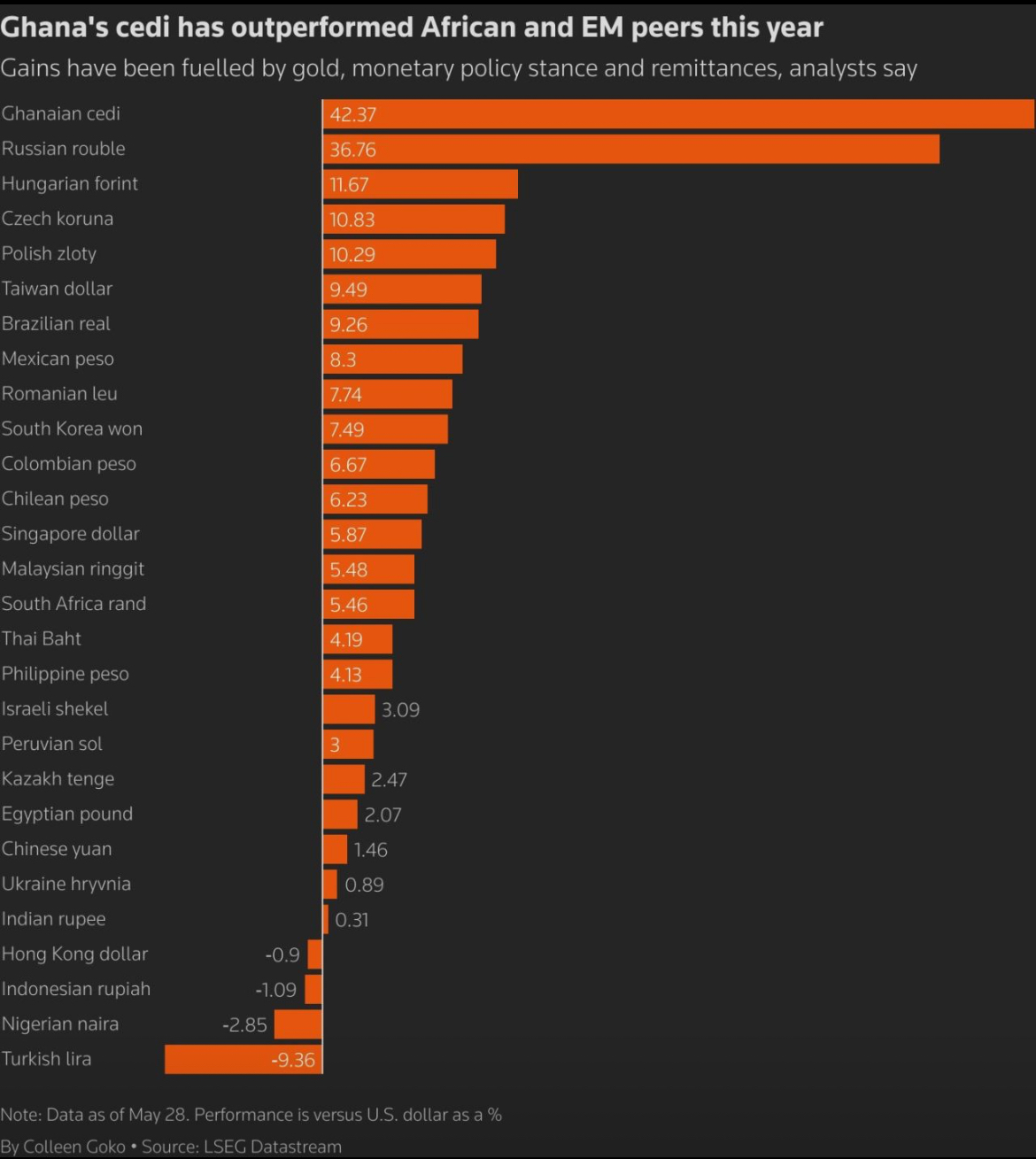
Ghana’s cedi has emerged as the world’s best-performing currency in 2025, registering an extraordinary appreciation of nearly 50% against the United States dollar since the beginning of the year. Commencing the year at approximately GH₵15 to the dollar, the cedi has steadily rallied to trade just above GH₵10, fuelled by renewed investor confidence and a series of favourable macroeconomic developments.
This remarkable turnaround represents a significant shift in market perception, especially given that the cedi was the world’s worst-performing currency in 2022, when it depreciated by over 55% amid spiralling inflation and sovereign debt distress. According to Bloomberg data, no other currency has recorded a comparable appreciation against the dollar in 2025.
Several interlinked factors have underpinned this resurgence. Chief among them is Ghana’s ongoing economic recovery following its historic sovereign debt default. As part of its broader macroeconomic stabilisation efforts, Ghana secured a support programme with the International Monetary Fund, which has bolstered investor confidence and underwritten a gradual return to fiscal discipline.



In addition to international support, Ghana’s external sector performance has strengthened notably, with elevated revenues from gold and oil exports enhancing foreign exchange reserves and easing balance of payments pressures. According to data from the Bank of Ghana, the country has witnessed consistent foreign exchange inflows, aided by higher global commodity prices and improved export management.
The Bank of Ghana has also contributed significantly to the currency’s stability through a proactive and assertive monetary policy. In March, the central bank enacted a 100-basis point increase in its benchmark policy rate, taking it to 28%. This surprise move signalled the bank’s commitment to combating inflation and preserving real returns on local assets, thereby attracting foreign portfolio inflows. Inflation, which had reached double digits in the previous year, has since moderated to 21.2% as of April 2025.
Moreover, the cedi’s performance reflects broader investor optimism about Ghana’s medium-term economic outlook. Analysts cite improving fiscal indicators, a narrowing current account deficit, and ongoing reforms to public sector efficiency and revenue mobilisation as key contributors to the rally. On Monday, the cedi opened at GH₵10.21 to the dollar, appreciating 7% from the previous Friday’s close of GH₵10.98.

While caution remains warranted given the global macroeconomic volatility, Ghana’s performance stands out as a case study in currency resilience and policy credibility following financial distress. With the cedi outperforming all global currencies thus far in 2025, Ghana has reclaimed a position of strength in international financial markets—an encouraging signal not only for its economy but for other emerging markets navigating post-crisis recovery paths.
Ghana is a member of the African Continental Free Trade Area (AfCFTA) and hosts the AfCFTA Secretariat in Accra. Its trajectory provides a compelling illustration of how strategic reforms, combined with prudent external engagement, can stabilise macroeconomic fundamentals and drive investor re-engagement: