

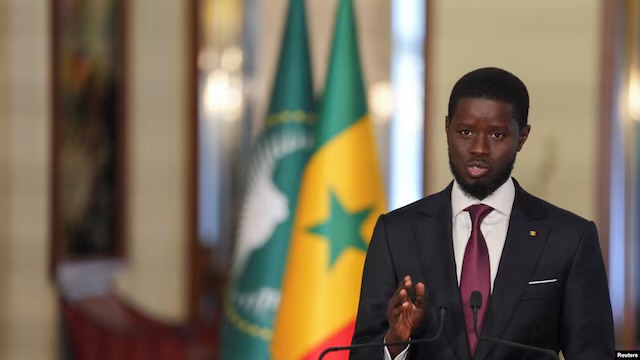
Senegal has reaffirmed its commitment to supporting Mali in efforts to restore stability following a series of coordinated attacks across the country, underscoring the interconnected nature of security challenges in the Sahel and the wider West African region.
Speaking in Dakar during a televised interview broadcast on national and private channels, President Bassirou Diomaye Faye emphasised that Senegal stands in “active solidarity” with Mali as it confronts renewed insecurity. His remarks come in the aftermath of attacks reported in multiple Malian cities, including Bamako, Gao and Sevare, which have drawn concern across the region.
Faye framed the situation not as an isolated national crisis but as part of a broader regional dynamic shaped by shared histories, borders and socio economic realities. He noted that developments in Mali inevitably resonate beyond its frontiers, particularly for neighbouring countries such as Senegal, where political stability and economic resilience are closely tied to conditions across the Sahel.



The Senegalese president called for strengthened cooperation among African states, advocating for deeper intelligence sharing and coordinated responses to armed groups operating across porous borders. His position reflects a growing consensus among African policymakers that durable solutions to insecurity must be grounded in regional collaboration rather than fragmented national approaches.
Efforts to stabilise Mali have remained complex in recent years, shaped by shifting political transitions, evolving security partnerships and the continued presence of non state armed actors. Regional bodies such as the Economic Community of West African States and continental institutions including the African Union have repeatedly called for collective strategies that prioritise both security and governance.
Faye’s remarks also point to a broader reframing of how African states articulate responses to conflict. By emphasising African agency and shared responsibility, his statement aligns with a perspective that situates solutions within the continent’s own institutional and diplomatic frameworks, rather than external intervention alone.

For communities across Mali, the recent violence represents not only a security concern but also a disruption to daily life, livelihoods and local economies. Across the Sahel, cycles of instability have had far reaching humanitarian implications, reinforcing the need for approaches that integrate security measures with long term development and social cohesion.
Senegal’s position highlights an enduring principle in regional diplomacy that stability is indivisible. As West African nations continue to navigate complex security landscapes, the emphasis on solidarity and cooperation reflects an understanding that peace in one country is closely linked to peace across the region.


