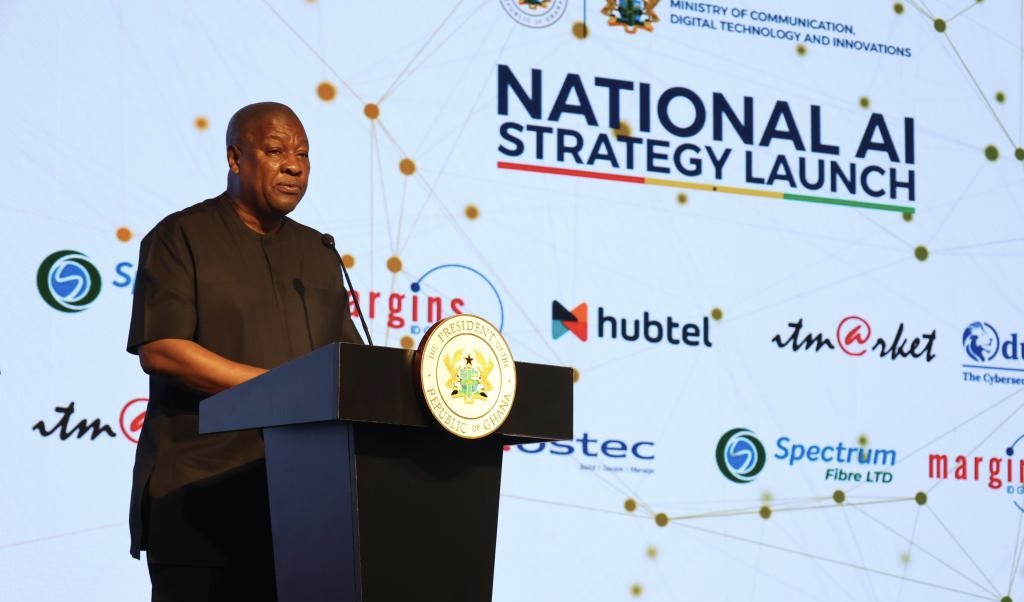
Ghana has formally launched its National Artificial Intelligence Strategy, committing 270 million US dollars to the development of digital infrastructure and the expansion of artificial intelligence capabilities. The announcement was made in Accra by President John Dramani Mahama, signalling an intention to position the country within an increasingly competitive African digital landscape.
According to the presidency, 250 million dollars of the pledged investment will be directed towards the establishment of advanced AI computing infrastructure. This includes plans for a high capacity computing centre intended to support research, innovation and enterprise development. A further 20 million dollars has been allocated to support the broader implementation of the national strategy, including governance frameworks and sectoral integration.
The initiative aligns with wider continental trends, where several African states are pursuing national AI strategies as part of long term economic transformation agendas. Comparative efforts across countries such as Kenya, Nigeria and South Africa have similarly emphasised infrastructure, regulatory development and talent cultivation as foundational pillars of AI readiness. A recent overview of AI policy development in Africa highlights the growing importance of state led coordination in shaping inclusive digital economies, as outlined by institutions such as the Brookings Institution.




In Ghana’s case, the strategy places particular emphasis on human capital development. Government projections indicate that approximately 300,000 individuals will be trained in digital and artificial intelligence related skills within the year through the One Million Coders Programme. The initiative seeks to expand access to technical education while supporting entrepreneurship and local innovation ecosystems.
Observers note that such large scale training programmes may play a critical role in addressing structural gaps in digital literacy and employment across the region. At the same time, the long term impact will depend on the alignment between training outcomes, labour market demand and sustained investment in innovation ecosystems.
International organisations have responded positively to the announcement. The United Nations Educational, Scientific and Cultural Organization has described the strategy as a step towards integrating technological advancement with broader social objectives. UNESCO representatives emphasised the importance of ensuring that AI development frameworks remain inclusive and responsive to local contexts, a principle that has been increasingly foregrounded in global AI governance discussions, including those reflected in UNESCO’s own policy guidance on artificial intelligence ethics available at UNESCO AI ethics framework.
Ghana’s approach reflects an emerging African perspective that situates artificial intelligence not solely as a technological frontier but as a tool for socio economic transformation. This framing prioritises public interest outcomes, including access to education, improved service delivery and the strengthening of local industries, rather than positioning AI purely within global competition narratives.
At a regional level, the development may also contribute to ongoing discussions around digital integration within frameworks such as the African Continental Free Trade Area, where digital services and data governance are increasingly recognised as key components of intra African trade and cooperation. Further context on Africa’s digital economy trajectory can be found through the United Nations Economic Commission for Africa.
While the scale of the financial commitment signals political intent, analysts caution that implementation will require sustained coordination across public institutions, private sector actors and educational systems. Issues such as data infrastructure, regulatory clarity and equitable access remain central to determining whether such strategies translate into broad based developmental outcomes.
Ghana’s announcement therefore represents both a national policy milestone and part of a wider continental process. As African countries continue to define their roles within the global AI landscape, the emphasis on locally grounded, inclusive and development oriented approaches may shape how technological transformation unfolds across the region.