

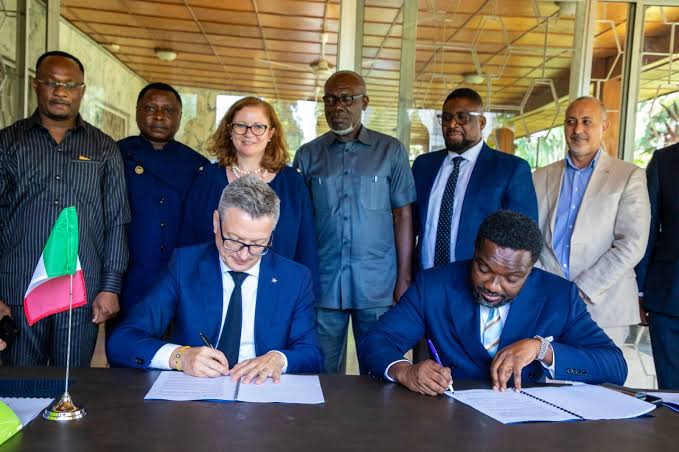
Ghana has entered into a €300 million agreement with Italian engineering group Danieli to establish an aluminium foil production facility and an associated technical training centre in Tema, in a development framed by officials as part of broader efforts to expand domestic value addition within the country’s minerals sector.
The agreement, reported by the Business and Financial Times, was signed between the Ghana Integrated Aluminium Development Corporation and Danieli & C. Officine Meccaniche S.p.A. at the residence of the Italian Ambassador in Accra. The project is planned for the Tema Heavy Industrial Zone and forms part of an integrated industrial park being developed in collaboration with ARISE Integrated Industrial Platforms and the Tema Development Corporation.
At the centre of the proposal is an aluminium foil manufacturing plant with an estimated annual output of between 40,000 and 45,000 tonnes. The facility is expected to serve sectors including food packaging, pharmaceuticals, catering services and wider industrial applications. Alongside production infrastructure, the plan includes a Centre of Excellence intended to support technical training, skills development and technology transfer.



Officials involved in the project have positioned it as a step towards reducing reliance on the export of unprocessed bauxite and strengthening downstream industrial capacity. The Ghana Integrated Aluminium Development Corporation, which is leading the state’s aluminium strategy, has stated that the initiative is intended to attract further investment into manufacturing and associated supply chains in the Tema enclave, leveraging proximity to the Volta Aluminium Company, Tema Port and existing heavy industrial infrastructure.

Speaking at the signing, GIADEC chief executive Reindorf Twumasi Ankrah described the agreement as part of ongoing efforts to build partnerships aimed at positioning Ghana within higher value segments of the aluminium industry. A representative of Danieli, Danilo Dreolini, stated that the collaboration reflects a shared interest in transforming raw materials into finished industrial products, while supporting local industrial development objectives.
The Italian Ambassador to Ghana, Laura Ranalli, characterised the agreement as reflective of strengthening economic relations between Ghana and Italy, particularly in the industrial and engineering sectors.
The Business and Financial Times report, published on 29 June 2026, indicated that the industrial park hosting the project is expected to function as a broader manufacturing ecosystem, with anticipated spillover effects including job creation, the emergence of upstream and downstream suppliers, and increased foreign direct investment in Ghana’s manufacturing base. Business and Financial Times
While the project has been framed by stakeholders as a milestone in industrial transformation, its longer term impact will depend on financing structures, energy reliability, regional demand for aluminium products and the ability to sustain skills development programmes within the proposed training centre. Analysts of industrial policy in West Africa often note that such initiatives require consistent policy coordination and infrastructure resilience if they are to move beyond enclave production into wider industrial diffusion.
From a regional perspective, the development also contributes to ongoing debates across Africa about the balance between raw material export models and domestic value addition strategies. Similar industrialisation efforts across West Africa have highlighted both the opportunities and constraints of building integrated manufacturing hubs, particularly in energy intensive sectors such as aluminium processing.


