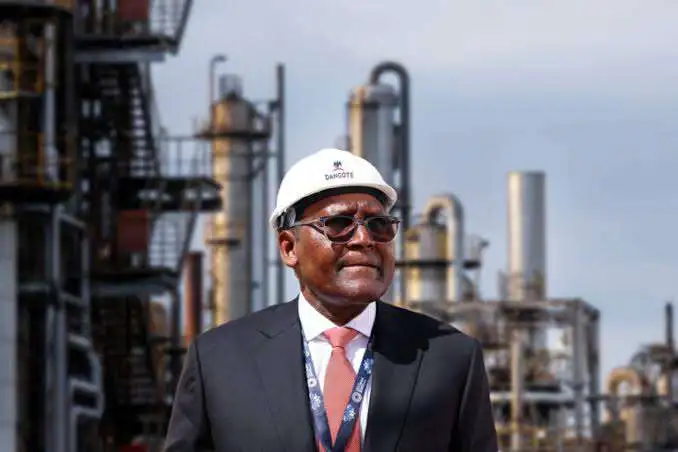
Nigeria’s Dangote Refinery, one of the continent’s most ambitious industrial projects, is preparing for a dual listing on the Lagos Stock Exchange (NGX) and the London Stock Exchange (LSE) by 2026. The refinery, valued at approximately 20 billion US dollars, represents a transformative step in Africa’s industrial and financial self-determination, aiming to attract both regional and global investment while enhancing liquidity and market depth.
The move, confirmed by Aliko Dangote, Chairman of the Dangote Group, in mid-2024, is positioned as part of a broader strategy to open ownership to institutional and individual investors across Africa and beyond. By offering a 10 per cent minority stake, the listing intends to enable public participation in an asset long viewed as a symbol of African industrial capacity. The initiative also seeks to strengthen the refinery’s financial foundation for planned expansions, including a capacity increase from 650,000 barrels per day to 1.4 million barrels per day by 2028.
According to Devakumar Edwin, Executive Director at Dangote Industries Limited, the dual listing ensures sufficient market depth, given that the NGX alone may not have the liquidity to absorb such a large valuation. The addition of the LSE aims to provide broader investor access, improved credit perception, and global visibility while retaining an African core. The refinery is also expected to generate substantial export earnings, particularly through the supply of refined products to West, Central and East African markets and parts of Europe. Dividends will reportedly be paid in US dollars, providing an incentive for both domestic and foreign investors.



The refinery, located in Lekki, Lagos State, commenced operations in 2024 and has been described by Bloomberg and Reuters as the largest single-train refinery in the world. Its establishment marks a pivotal development for Nigeria and the continent’s broader ambition to shift from a raw-material exporter to a refined-product producer. Analysts suggest that the listing could also encourage Nigeria’s federal government to consider floating shares in its own state-owned refineries, fostering a new wave of privatisation and market participation.

In a continental context, the proposed listing reflects Africa’s growing capacity to define its economic narratives through projects that emphasise regional value creation, industrial independence, and financial inclusion. The Dangote Refinery stands as an example of African capital driving continental development rather than being shaped exclusively by external financial centres. For investors across the Southern African region, this development signals the potential for deeper capital market integration and a renewed focus on African-led industrialisation.

As Dangote Refinery prepares for its 2026 market debut, the listing may serve as both a financial milestone and a symbolic act—asserting Africa’s agency in global industry and finance while offering a tangible avenue for shared economic participation.