

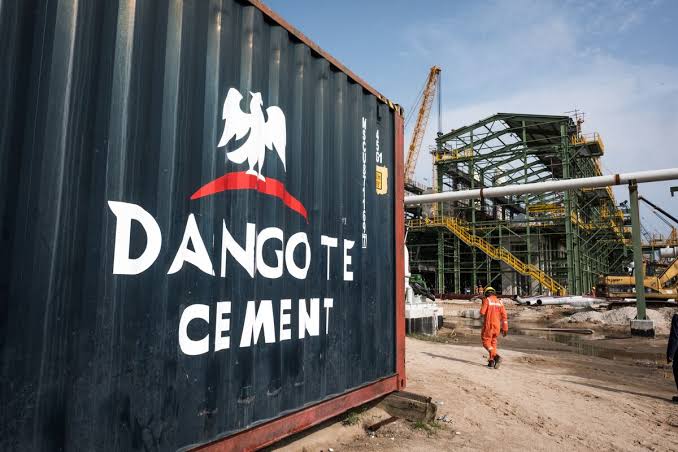
Dangote Cement Plc has outlined an expanded sustainability strategy centred on reducing carbon emissions, improving resource efficiency and strengthening governance as the company positions itself for long term industrial growth across Africa.
During the company’s 17th Annual General Meeting in Lagos, Chairman Emmanuel Ikazoboh presented the group’s 2025 sustainability scorecard, stating that environmental, social and governance principles have become integral to the company’s business strategy rather than remaining solely a regulatory obligation. The company said its approach is aligned with the broader sustainability ambitions of Dangote Industries Limited Vision 2030.
According to the company, its board approved plans in 2024 to reduce net carbon dioxide emissions intensity by 20 per cent as part of its wider decarbonisation strategy. Dangote Cement also announced that, by 2027, the majority of its truck fleet operating in Nigeria, with the exception of its Gboko plant, is expected to transition to compressed natural gas. The company further stated that electric trucks are scheduled to begin joining its operations during 2026.



The announcement forms part of a broader investment programme intended to strengthen the company’s logistics and export capacity while supporting industrial expansion across the continent. Dangote Cement said it intends to expand port infrastructure at Apapa, Onne and Lekki and increase installed cement production capacity to 80 million tonnes per annum by 2030. The company also confirmed plans to establish new operations in Botswana and Zimbabwe, reflecting its continued expansion into additional African markets.
The expansion strategy comes as African governments continue to prioritise infrastructure development, urbanisation and industrialisation as key drivers of economic growth. Demand for cement across many parts of the continent remains closely linked to public infrastructure investment, housing development and regional trade integration.
Dangote Cement reported that it has already recorded measurable progress against several environmental targets. Using 2021 as its baseline, the company said carbon dioxide emissions intensity has declined by 6.5 per cent. It also reported a 1.7 per cent improvement in energy intensity, a 4 per cent reduction in overall energy consumption and an 8 per cent reduction in water consumption during the reporting period.
The company attributed these improvements to a combination of increased energy efficiency, greater use of alternative fuels and ongoing efforts to reduce clinker content within cement production. These initiatives form part of broader industry efforts to lower emissions associated with cement manufacturing while maintaining production capacity to meet growing infrastructure demand.

Beyond environmental performance, Dangote Cement said it has expanded its governance framework through the introduction of new policies covering artificial intelligence risk management, biodiversity and disability inclusion. The company also reported integrating 297 local suppliers into its environmental, social and governance focused supply chain programme, an initiative intended to strengthen responsible procurement while increasing local participation in its operations.
Speaking to shareholders, Ikazoboh said sustainability governance within the company has evolved considerably over the past decade through stronger executive accountability, climate risk oversight and the integration of environmental, social and governance performance into strategic decision making.
The company also highlighted progress in circular economy initiatives and biodiversity management, noting continued investment in resource stewardship alongside environmental conservation programmes.
The cement industry remains one of the world’s most carbon intensive manufacturing sectors because of the energy required to produce clinker, a key component in cement production. Across Africa, manufacturers are increasingly investing in cleaner fuels, improved energy efficiency and alternative production technologies as governments, investors and financial institutions place greater emphasis on climate resilience alongside industrial development.
For Dangote Cement, the latest sustainability commitments illustrate an approach that seeks to balance industrial expansion with environmental responsibility while supporting economic development across multiple African markets. As the company advances its production capacity and regional footprint, the implementation of these commitments will remain an important indicator of how large scale African manufacturers respond to evolving environmental expectations while contributing to the continent’s infrastructure ambitions.


