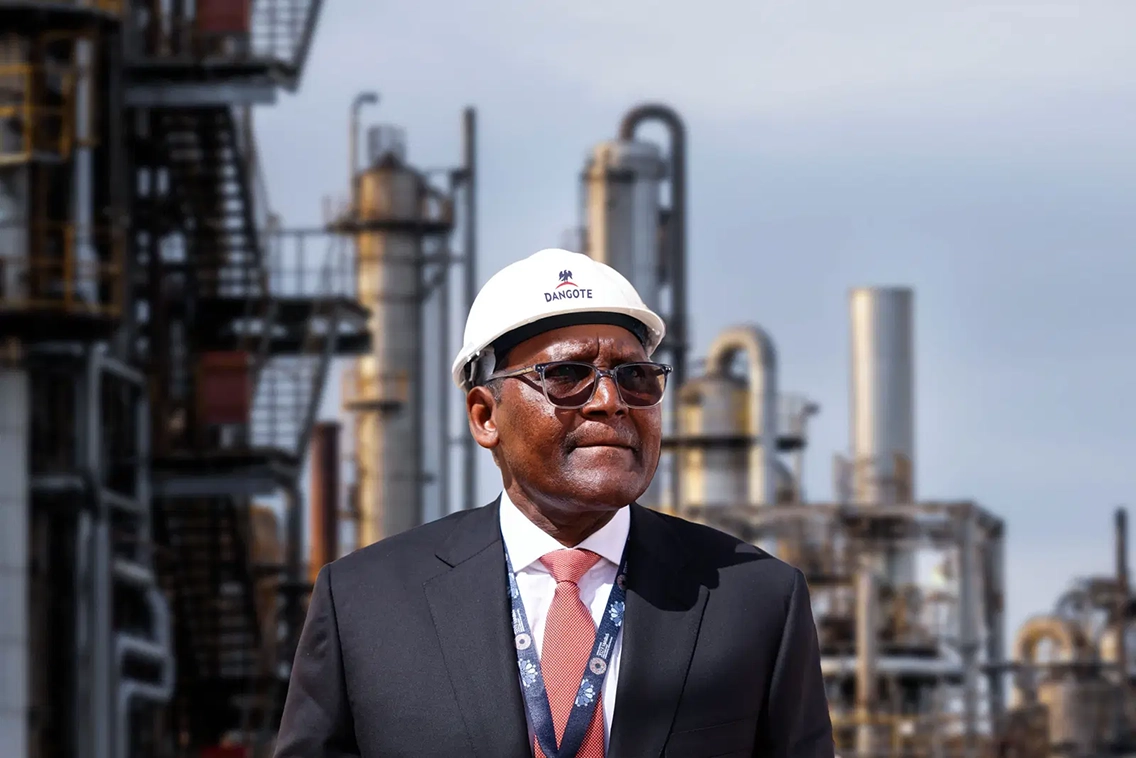
Aliko Dangote has outlined an ambitious industrial expansion programme that would establish one of Africa’s largest privately owned refining networks, with investments valued at approximately US$46 billion across refining, fertiliser and cement operations between 2026 and 2028.
The announcement signals an expansion of the Nigerian conglomerate’s long term continental strategy, with plans to complement its existing operations in Nigeria through the development of a proposed 700,000 barrel per day refinery in Kenya. If realised, the combined refining capacity across both countries would reach approximately 2.1 million barrels per day, comprising 1.4 million barrels per day in Nigeria and 700,000 barrels per day in Kenya.
The plans were presented by Dangote Industries during a visit by officials from the Republic of the Congo’s national oil company, Société Nationale des Pétroles du Congo, to the Dangote Petroleum Refinery in Lagos. During the engagement, company executives discussed regional energy cooperation and outlined the group’s broader African investment strategy.



The proposed Kenyan refinery represents an increase from earlier publicly discussed plans, which envisaged a facility with a capacity of approximately 650,000 barrels per day. While the project remains subject to regulatory approvals and commercial implementation, the revised scale suggests growing confidence in East Africa’s long term energy demand and industrial development.
The expansion comes at a time when many African governments continue to pursue policies aimed at increasing domestic value addition and reducing reliance on imported refined petroleum products. Despite being a major producer of crude oil, Africa imports a substantial proportion of its refined fuels due to limited refining capacity across many regions of the continent.

Nigeria has already taken significant steps towards addressing this imbalance through the commencement of operations at the Dangote Petroleum Refinery, which has progressively increased production of petrol, diesel, aviation fuel and other petroleum products. Since beginning commercial production, the refinery has supplied both domestic and international markets, including exports of aviation fuel to Europe.
Kenya has emerged as Dangote Industries’ preferred location for its proposed East African refinery following assessments of several potential sites across the region. Industry analysts have pointed to several strategic advantages that support the country’s selection.
The Port of Mombasa serves as East Africa’s principal maritime gateway, handling cargo destined not only for Kenya but also for Uganda, Rwanda, South Sudan, eastern Democratic Republic of the Congo and parts of Tanzania. The country’s established logistics infrastructure provides efficient access to a broad regional market.
Kenya also possesses an extensive petroleum transportation network operated by the Kenya Pipeline Company, enabling refined products to move inland through an integrated pipeline system. Combined with Kenya’s membership of the East African Community, whose population exceeds 300 million people, the proposed investment would strengthen existing regional supply chains while potentially reviving Kenya’s refining ambitions following the closure of its sole refinery more than a decade ago.
Should both refining hubs operate at their intended capacities, Dangote Industries would establish a refining footprint extending from the Atlantic coastline in West Africa to the Indian Ocean in East Africa. Such a network would significantly enhance the company’s ability to supply refined petroleum products across multiple African markets while reducing transportation distances for customers within the continent.
The proposal also aligns with broader continental industrial objectives under the African Continental Free Trade Area, which seeks to promote greater intra African trade, strengthen manufacturing and encourage regional value chains. Increased refining capacity within Africa has the potential to retain greater economic value on the continent through local processing rather than exporting crude oil for overseas refinement before importing finished fuels.
Energy specialists have frequently argued that expanding domestic refining capacity could improve fuel security, reduce exposure to international supply disruptions and strengthen industrial resilience. However, they also note that the long term commercial success of large scale refining projects depends on consistent crude supply, efficient logistics, competitive operating costs, supportive regulatory environments and sustained regional demand.
For many African economies, energy infrastructure remains central to wider industrialisation strategies. Reliable fuel supplies underpin transport systems, manufacturing, agriculture, mining and electricity generation, making refining capacity an important component of broader economic development.
The proposed investment therefore reflects more than an expansion of corporate operations. It also illustrates the increasing role that African private sector capital is playing in financing large scale industrial infrastructure that has historically relied on public investment or international funding institutions.
Speaking during the engagement with officials from the Republic of the Congo, Dangote Industries President and Chief Executive Aliko Dangote reiterated the group’s continental outlook, stating that the company seeks partnerships across Africa and is prepared to work with governments to support shared industrial development objectives.
The announcement follows a series of investments by Dangote Industries in refining, cement manufacturing and fertiliser production, sectors that have become central to the company’s long term strategy of supporting industrial growth across multiple African markets.

If the Kenyan refinery proceeds to construction and eventual operation, the combined facilities would create one of the continent’s most significant privately owned refining systems, strengthening regional energy integration while contributing to Africa’s continuing efforts to expand domestic industrial capacity and reduce dependence on imported refined petroleum products.