
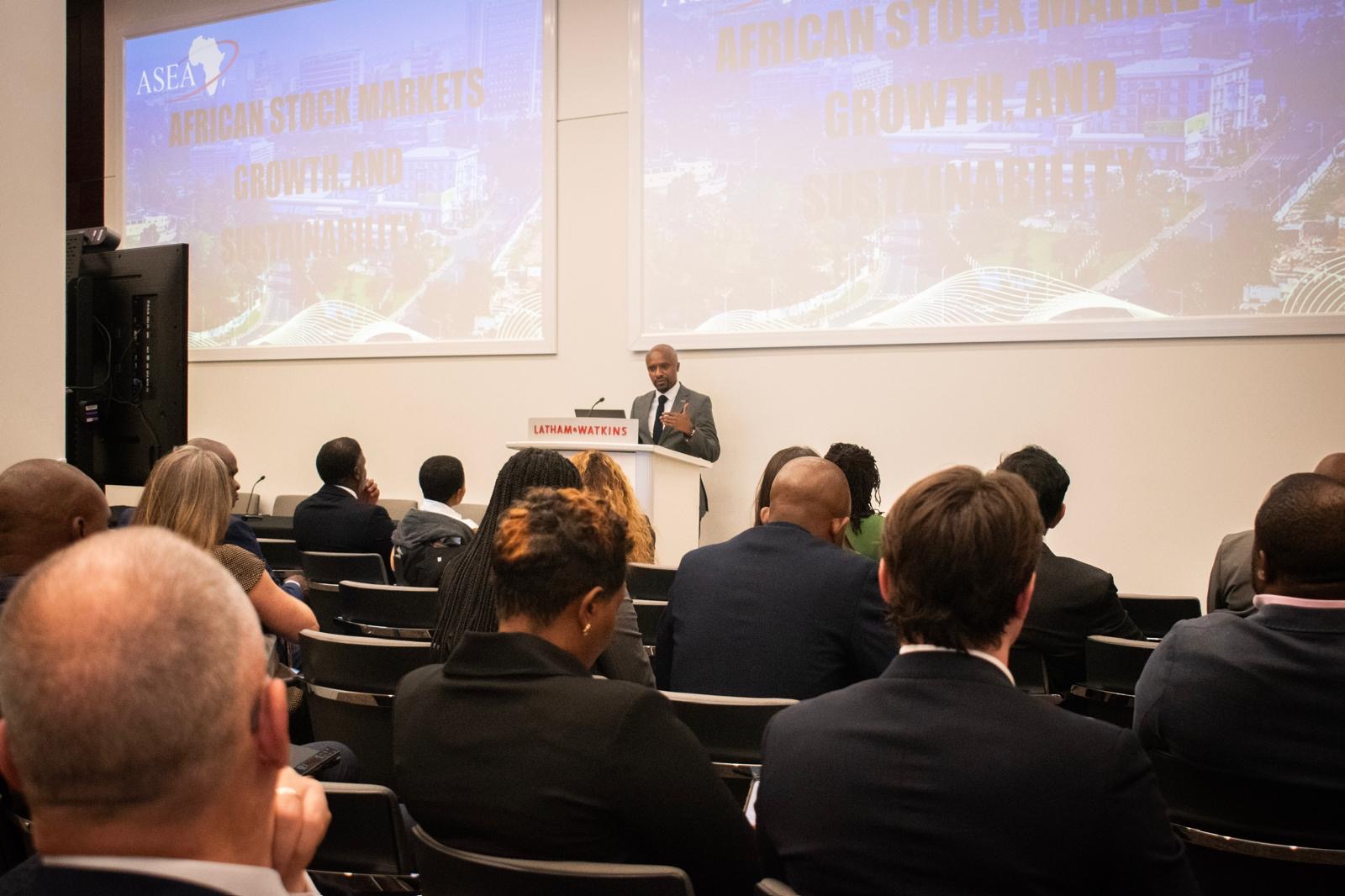
African capital markets are undergoing a period of gradual expansion and structural recalibration, according to discussions at the African Capital Markets Investment Conference held in London, where policymakers, exchanges, and investors assessed both constraints and emerging opportunities across the continent.
Hosted by Financial Markets Indaba and supported by Old Mutual Zimbabwe, the gathering brought together representatives from stock exchanges, regulatory bodies, development finance institutions, and private investors from Africa, Europe, and the United Kingdom. The event focused on capital mobilisation and cross border market integration, reflecting a wider policy shift towards strengthening intra African financial linkages.
In a keynote address, Pierre Celestin Rwabukumba, President of the African Securities and Exchanges Association and Chief Executive of the Rwanda Stock Exchange, outlined the current state of African capital markets. He noted that the continent is home to approximately 28 stock exchanges serving over 30 economies, with around 1,100 listed companies and a combined market capitalisation estimated at about 1.5 trillion United States dollars. While this represents measurable progress, it remains a small share of global capital markets, accounting for less than one percent of global market capitalisation despite Africa contributing a larger proportion to global economic output.



Rwabukumba highlighted that capital raising activity remains concentrated in a limited number of markets, notably South Africa, Egypt, and Nigeria. This concentration reflects structural characteristics within many African economies, where bank based financing continues to dominate and capital markets play a comparatively limited role in long term funding. At the same time, he pointed to emerging developments across the continent that suggest a gradual shift. In East Africa, for example, the establishment of the Ethiopian Securities Exchange in early 2025 marked a significant addition to the regional financial architecture, with its initial listing reportedly attracting strong investor demand.
The conference also drew attention to larger transactions under consideration, including Kenya’s plans to partially privatise state assets through public markets, indicating a potential broadening in both scale and ambition. These developments reflect a wider effort by governments and institutions to deepen domestic capital markets while attracting international participation.
A recurring theme throughout the discussions was the importance of regional integration. Initiatives such as the African Exchanges Linkage Project are intended to facilitate cross border trading by connecting multiple stock exchanges through shared infrastructure. This effort aligns with the objectives of the African Continental Free Trade Area, which seeks to reduce barriers to trade and investment across the continent. Greater integration is widely viewed as a mechanism to address liquidity constraints by pooling fragmented markets into more substantial and accessible investment destinations.
Liquidity remains a central challenge. Limited trading volumes in many exchanges can restrict price discovery and deter institutional investors. Participants at the conference emphasised the need to broaden the investor base by encouraging both domestic savings and international inflows. This includes strengthening pension and insurance sectors, which in several African countries remain underdeveloped relative to their potential role in capital market growth.
Institutional capacity building was also identified as a priority. Through training programmes and research initiatives, organisations such as the African Securities and Exchanges Association continue to support knowledge sharing and the adoption of common standards across member exchanges. Engagement with policymakers is seen as equally important, particularly in relation to regulatory harmonisation, corporate governance, and the removal of barriers that limit cross border investment.

Technological development is increasingly shaping market evolution. Digital trading platforms, fintech solutions, and improvements in post trade infrastructure are contributing to greater efficiency and transparency. These innovations are also seen as a means of expanding participation by retail investors, including younger demographics who are engaging with financial markets through digital channels.
Looking ahead, several continental initiatives may influence the trajectory of African capital markets. The African Development Bank’s proposals around a new financial architecture aim to mobilise capital at scale while promoting regulatory alignment. At the same time, anticipated high profile listings, such as the potential multi exchange offering linked to the Dangote Refinery, are viewed as indicative of a growing capacity to support large transactions within African markets.
Sustainability considerations are also becoming more prominent. The development of green and sustainability linked financial instruments is gaining traction, supported by both national initiatives and exchange led platforms such as the Rwanda Stock Exchange’s Green Exchange Window. These instruments are increasingly positioned as tools to finance infrastructure and energy transitions while aligning with global environmental objectives.
Discussions in London suggested that African capital markets are at an inflection point shaped by both internal reform efforts and external investor interest. While structural constraints remain, there is evidence of incremental progress through integration, policy coordination, and technological adoption. The extent to which these developments translate into deeper and more resilient markets will depend on sustained collaboration between governments, financial institutions, and market participants across the continent.