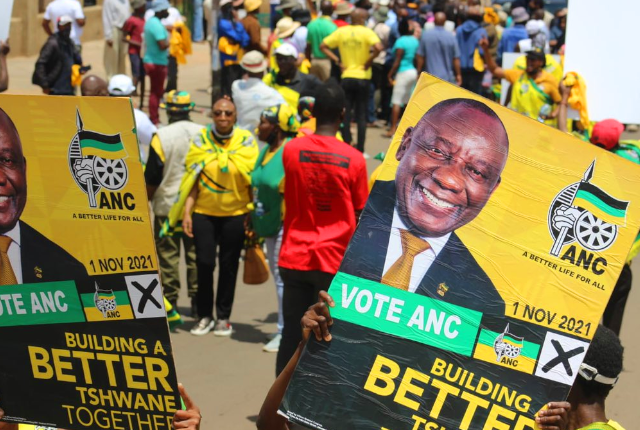
JOHANNESBURG, (The Southern African Times) – The 2021 local government elections are set to take place on 1 November 2021, and political analysts say the vote will test whether the current ruling party, the African National Congress (ANC), is able to maintain its grasp on the majority vote.
According to political analyst and professor at the University of Johannesburg, Mcebisi Ndletyana, the elections will not only be the ultimate test for the ANC, but also for president Cyril Ramaphosa, where his popularity among the electorate will also be gauged.
Speaking in a PSG Think Big webinar, Ndletyana said the elections will also provide a strong indicator of how contesting parties will perform on a national level. South Africa’s next national elections are expected to take place in 2024 – with room for political manoeuvring to take place in the interim.



This includes possible changes to the ANC’s leadership at the national conference scheduled for 2022.
“Today’s political environment is a contentious one, characterised by social and economic hardships against the backdrop of wide-scale corruption,” Ndletyana said. “Idealists could argue that the solution is for corrupt politicians to be flushed out of the system completely and to be replaced with ethical leaders. However, this is easier said than done.”
In the run-up to the elections, the ANC has pegged its campaign on reform and ‘doing better’, promising supporters that the party is cleaning out its closet and vowing to fulfil the many promises it has made over its 27 years of power.
However, this campaigning has also been met with a cold shoulder in many areas of the country, as disgruntled and disillusioned voters voiced their displeasure at the way the party has left many promises unfulfilled. While ANC voters have expressed support for Ramaphosa, they have also voiced displeasure for local leaders.
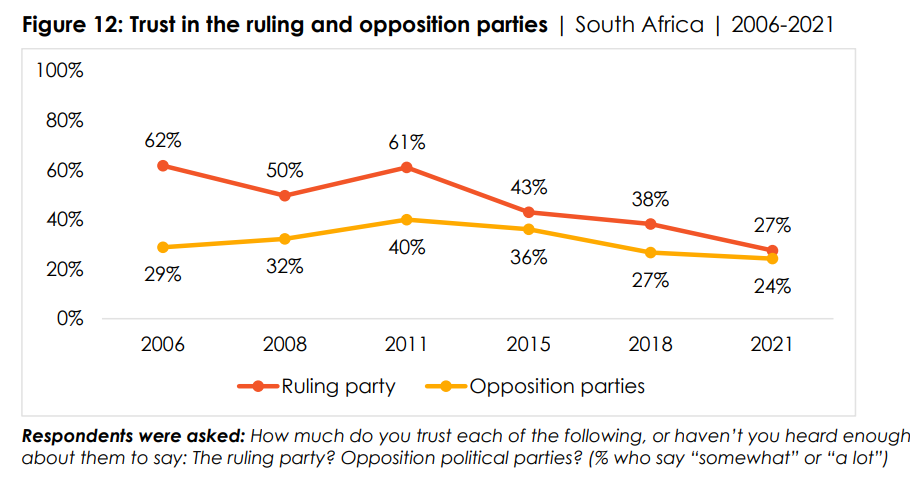
A mid-year poll run by Afrobarometer found that South Africans’ trust in the ruling party has steeply declined over the years, and was barely above the trust for opposition parties.
However, Ndletyana argued that negative sentiments towards the ANC are not an indication that supporters will change their vote.
He pointed to the 2016 scenario in Tshwane and Nelson Mandela Bay, where traditional ANC voters did not change their votes despite earlier protests around poor service delivery. Instead, they simply exercised their democratic right to stay away from the polls, and in this sense, “punished” the ruling party for their negligence.
A similar turn of events is expected next month, with data from the Independent Electoral Commission (IEC) showing that more than 13 million South Africans who are eligible to vote simply haven’t registered for 1 November polls.
Historically, South Africa has had a voter turnout of around 70%. The 2019 elections draw a historic low of just 65% of voters turning up. For the 2021 ballot, 26.2 million of an eligible population of 40 million have registered to vote (66%).
Opposition parties
The problems are not only limited to the ANC’s electioneering, however. The DA has also faced its fair share of criticism – and the party has much to prove after losing significant support in the previous elections. The DA scored 24.5% of the vote in the 2016 elections, which dropped to 20.8% in the 2019 national election.
The job of the opposition is to translate bad sentiments towards the ANC into positive sentiments towards themselves, and ultimately, votes on Election Day. Therein lies the greatest challenge – a hurdle that Ndletyana said the DA has all but given up on, given their rollout of controversial posters in Phoenix, which were branded as racist.
When asked to make a prediction on the success of the EFF in smaller provinces, Ndletyana asserted that the answer lies in the voting constituent upon which the EFF relies, which is primarily unemployed youth. This constituent – however influential and radical in their political position – only make up a small segment of the population.
“Unfortunately, although the EFF makes some interesting and attractive points, their political rhetoric at times borders on rudeness, which is particularly offensive to older voters and makes it very difficult for them to win the buy-in of a larger segment of society.
“I do not see the EFF winning significant ground even in smaller provinces going forward unless they do so as part of a coalition,” he said.
Ndletyana said it was “depressing” that in the current political landscape, South Africa’s current politicians see the state as a source of livelihood, rather than an instrument for changing lives.

“This will always be to the detriment of the poor and disenfranchised,” he said.
Polling
In September, Ipsos’s pre-election polls showed a massive drop in support for the ANC. Of the people polled, only 34.9% of respondents said they would support the party in the coming elections. Further still, the results showed a steady decline in support for the ANC in Ipsos polls involving the total population eligible to vote since.
The Democratic Alliance (DA) and the Economic Freedom Fighters’ (EFF) support remained relatively constant – however, neither of these parties were threatening the position of the ANC as the most popular party in the country, Ipsos said.
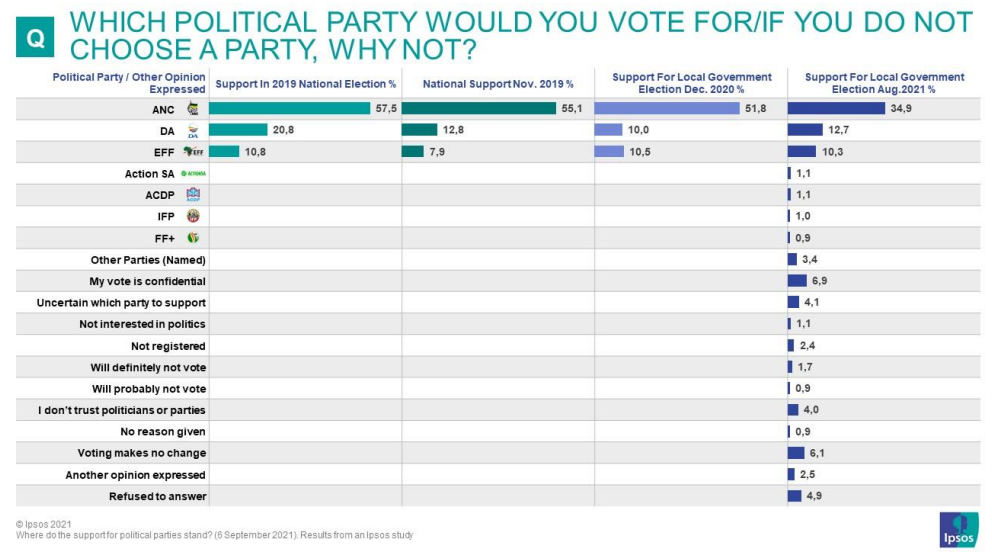
When respondents were asked who they would vote for “if the elections were held tomorrow”, the ANC still drew the largest chunk of support.

Countrywide almost half (49.3%) would draw a cross next to the name of the ANC, while the support for both the DA (17.9%) and the EFF (14.5%) respectively, is also in double figures.
Notably, this would represent a loss in support for the ANC and DA – who received 55.65% and 24.57% of the vote in 2016, respectively – and a large gain for the EFF, which received 8.31% in the prior elections.
Regarding smaller parties, Ipsos said that South Africa has a plethora of registered political parties, but very few of them currently garner more than one percent of support.
Of the smaller parties contesting the election, Action SA (1.5%), ACDP (1.5%), IFP (1.4%) and the FF+ (1.2%) are expected to emerge as the most popular.