Sunday, June 21, 2026
  • Login
The Southern African Times
  • Home
  • Southern Africa
  • Business
    • African Start ups
    • African Continental Free Trade Area
  • Technology
    • Lifestyle
      • Health
      • Culture
      • Food and Drink
      • Entertainment
  • Opinion
  • Sports
  • SAT Jobs
    • Events
  • About Us
    • Advertise with Us
    • Contact Us
No Result
View All Result
  • Home
  • Southern Africa
  • Business
    • African Start ups
    • African Continental Free Trade Area
  • Technology
    • Lifestyle
      • Health
      • Culture
      • Food and Drink
      • Entertainment
  • Opinion
  • Sports
  • SAT Jobs
    • Events
  • About Us
    • Advertise with Us
    • Contact Us
No Result
View All Result
The Southern African Times
No Result
View All Result
Home Analysis

America is responsible for Afghanistan falling apart

by SAT Reporter
August 16, 2021
in Analysis, Opinion
0
America is responsible for Afghanistan falling apart

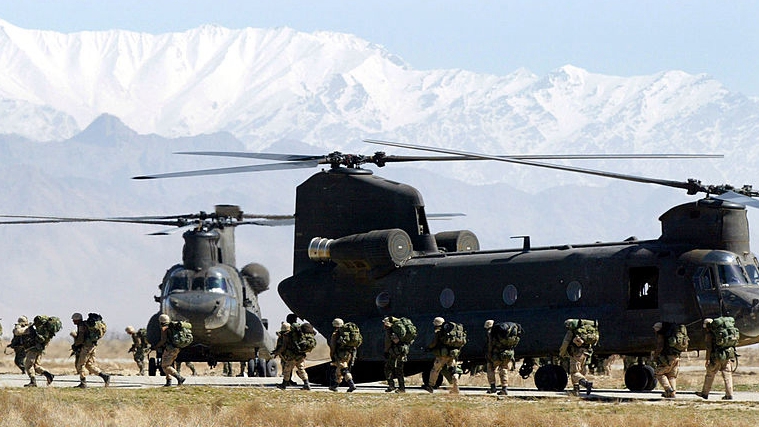
402185 02: Soldiers from the U.S. Armys 10th Mountain and 101st Airborne Division disembark from their chinook helicopter March 12, 2002 after returning to Bagram airbase from the fighting in eastern Afghanistan. The soldiers are part of an organized group that are pulling back from battle against al Qaeda and Taliban forces during Operation Anaconda. (Photo by Joe Raedle/Getty Images)

The Taliban’s blitz across Afghanistan over the past week has resulted in the fall of nearly a dozen regional capitals and an estimated 65-80 percent of the country coming under its control.

Western observers are shocked at this development since they thought that the internationally-recognized Afghan government in Kabul, as well as the Afghan National Army (ANA), would continue to stand their ground even after the U.S. full military withdrawal by the end of the month. These predictions were made on several false assumptions that deserve to be debunked in order to help others better understand what’s really happening there and why.

Firstly, American air support was crucial in helping Kabul retain its control over the country. The U.S. used to bomb the Taliban whenever it massed its forces anywhere in the country and began to pose a threat to the government.


ADVERTISEMENT

That said, American air support was also crucial in turning many hearts and minds towards the Taliban since the U.S. wantonly bombed wherever it wanted and was thus responsible for many civilian casualties and much unnecessary collateral damage. It can therefore be said that American air support was a double-edged sword that superficially kept the peace but really laid the seeds for what would soon follow.

Secondly, a significant number of the ANA’s forces have proven that they aren’t as qualified as their supporters at home and abroad may have thought in spite of the U.S. investing hundreds of billions of dollars into their training.

Quite a few reports have come out of Afghanistan claiming that many members of the ANA either surrendered to the Taliban without a fight or quickly fled once the fighting got too intense. This speaks to the ANA’s primary weakness, namely that it was a paper tiger propped up by American air support all along and comprised of many people who only joined for the paycheck, not out of loyalty to their U.S.-backed government.

Thirdly, the U.S. spent well over $2 trillion in Afghanistan but doesn’t really have anything to show for it. The Special Inspector General for Afghan Reconstruction (SIGAR) reported last year that at least $19 billion was lost to fraud and abuse, though cynical observers speculate that it might really be much more than that.

In any case, the point is that Afghanistan pretty much just became a cesspool for the U.S. military-industrial complex’s corruption. Not only did this go against America’s stated military-political aims in the country, but it also handicapped Afghanistan’s socio-economic reconstruction efforts and thus kept it extremely weak.
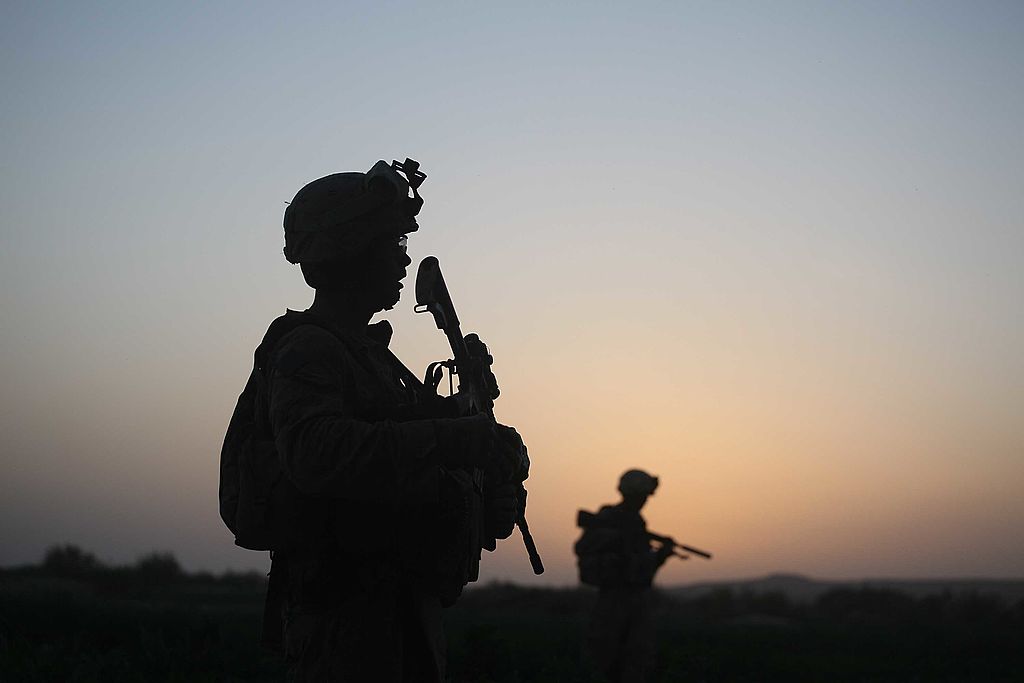
U.S. Marines with the 2nd Marine Expeditionary Brigade, RCT 2nd Battalion 8th Marines Echo Co. step off in the early morning during an operation to push out Taliban fighters in Herati, Afghanistan, July 18, 2009. /Getty

Fourthly, the U.S. planned military withdrawal – while arguably long overdue for many reasons – was carried out very irresponsibly. In hindsight, it might not have been wise for America to set an exact date for its full departure since this only emboldened the Taliban to immediately go on the offensive and fill the security void that the U.S. created.

Furthermore, any objective American decision maker and strategist would have known that disaster would be forthcoming considering the three above-mentioned points. It therefore seems like the Biden Administration decided to leave Afghanistan for ulterior reasons unrelated from its stated goals.

And fifthly, the predictable security void that the U.S. created will inevitably attract all sorts of non-state actors, including terrorists like Al Qaeda and ISIL-K that have been active in Afghanistan. It remains to be seen whether the Taliban will fight against them like it previously promised to do in accordance with last February’s pledge not to allow such groups to remain in the country, but it’s still an emerging security challenge of global significance.

Some cynical observers believe that the U.S. might have purposely wanted to provoke this dark scenario of rising terrorist threats there for ulterior motives related to causing problems for China and Russia.

Altogether, it’s clear to see that the U.S. is responsible for Afghanistan falling apart. Nothing can absolve it for destroying that country and then failing to properly rebuild it. Everything that’s happening there is directly connected to the U.S.’ own economic, military, political, and social failures.

The optics of Afghanistan’s rapid collapse are powerful and reflect poorly on the U.S. itself. Far from still being seen as the unipolar hegemon than it was when it invaded two decades ago, the U.S. is now regarded as a rapidly declining, untrustworthy, corrupt and failed power. There seems to be some truth to the claim that Afghanistan is the graveyard of empires.

Andrew Korybko is a Moscow-based American political analyst. The article reflects the author’s views and not necessarily those of The Southern African Times


Previous Post

Modi says India will soon unveil $1.35 trillion infrastructure plan

Next Post

Africa’s COVID-19 cases surpass 7.25 mln: Africa CDC

SAT Reporter

Related Posts

Southern African Times Announces Brendan Amadi as Recipient of the 2026 Editorial Recognition of the Year Award
The Editorial Board

Southern African Times Announces Brendan Amadi as Recipient of the 2026 Editorial Recognition of the Year Award

by The Editorial Board
June 19, 2026
LONG READ | No Longer the World’s Dustbin: China’s Waste Ban and Africa’s Circular Economy Moment
Opinion

LONG READ | No Longer the World’s Dustbin: China’s Waste Ban and Africa’s Circular Economy Moment

by Times Reporter
June 12, 2026
OPINION | The Investors Southern Africa Refuses to See
Opinion

OPINION | The Investors Southern Africa Refuses to See

by Times Reporter
June 14, 2026
Faith, Miracles and the Crisis of Religious Authenticity
Opinion

Faith, Miracles and the Crisis of Religious Authenticity

by Brendan Amadi
June 10, 2026
How DRC President Leveraged Geopolitics to Secure Political Survival
Opinion

How DRC President Leveraged Geopolitics to Secure Political Survival

by Dr. Alex Ntung
June 9, 2026
Next Post

Africa's COVID-19 cases surpass 7.25 mln: Africa CDC

Browse by Category

  • Africa AI
  • African Continental Free Trade Area
  • African Debt
  • African Start ups
  • Agriculture
  • AI Africa
  • Algeria
  • All News
  • Analysis
  • Angola
  • Arts / Culture
  • Asia
  • Botswana
  • BOTSWANA
  • BREAKING NEWS
  • BRICS
  • Burkina Faso
  • Burundi
  • Business
  • Business
  • Business Wire
  • Cameroon
  • Central Africa
  • Chad
  • China
  • Climate Change
  • Climate Changev
  • Community
  • Congo Republic
  • Conservation
  • Côte d’Ivoire
  • COVID 19
  • CRYPTOCURRENCY
  • Culture
  • Democratic Republic of Congo
  • Diplomacy
  • Eastern Africa
  • Economic Development
  • Economy
  • Education
  • Egypt
  • Elections 2024
  • Energy
  • Entertainment
  • Environment
  • Eritrea
  • Ethiopia
  • Europe
  • Fashion
  • Feature
  • Finance
  • Financial Inclusion
  • Food
  • Food and Drink
  • Foods
  • GABON
  • Ghana
  • Global
  • Global Africa
  • Guinea
  • Health
  • Humanitarian Aid
  • Immigration
  • in Southern Africa
  • International news
  • International Relations
  • Investment
  • Ivory Coast
  • Just In
  • Kenya
  • Lesotho
  • Libya
  • Life Style
  • Lifestyle
  • Literature
  • Malawi
  • Malawi
  • Mali
  • Markets
  • Mauritius
  • Middle East
  • Mining in Africa
  • Morocco
  • Mozambique
  • Namibia
  • Niger
  • niger
  • Nigeria
  • North Africa
  • North-Eastern Africa
  • Obituaries
  • Obituary
  • Opinion
  • PARTNER CONTENT
  • Politics
  • Property
  • Racism
  • Rwanda
  • Rwanda
  • SADC
  • SAT Interviews
  • SAT Investigation
  • SAT Jobs
  • Saudi Arabia
  • Senegal
  • Seychelles
  • Somaliland
  • South Africa
  • South Sudan
  • Sports
  • Startup Africa
  • STOCK EXCHANGE
  • Sudan
  • Sustainability
  • Sustainablity
  • Tanzania
  • Technology
  • Telecommunications
  • The Editorial Board
  • The Power Of She
  • Togo
  • Trade
  • Travel
  • Travel
  • Tunisia
  • Uganda
  • Uncategorized
  • Wealth
  • West Africa
  • World
  • World
  • Zambia
  • ZAMBIA
  • ZIMBABWE
  • Zimbabwe

Browse by Tags

#NewsUpdate #SouthAfrica #SouthernAfricanTimes #TheSouthernAfricanTimes AfCFTA africa African Continental Free Trade Area African development African Development Bank African economies African economy African Union Agriculture Angola Botswana China Climate change Cyril Ramaphosa Economic Development economic growth energy transition Ghana governance industrialisation Inflation Infrastructure Infrastructure Development International relations Investment Kenya Mozambique Namibia news Nigeria Regional Integration renewable energy Rwanda SADC South Africa Southern Africa sustainable development Tanzania United States Zambia Zimbabwe
ADVERTISEMENT

WHO WE ARE

The Southern African Times is a regional bloc digital newspaper that covers Southern African and world news. The paper also gives a nuanced analysis on news and covers a wide range of reporting which include sports, entertainment, foreign affairs, arts and culture.

Welcome Back!

Login to your account below

Forgotten Password?

Retrieve your password

Please enter your username or email address to reset your password.

Log In
  • Home
  • Southern Africa
  • Business
    • African Start ups
    • African Continental Free Trade Area
  • Technology
    • Lifestyle
      • Health
      • Culture
      • Food and Drink
      • Entertainment
  • Opinion
  • Sports
  • SAT Jobs
    • Events
  • About Us
    • Advertise with Us
    • Contact Us
Not enough quota to unlock this post
Unlock left : 0
Are you sure want to cancel subscription?