

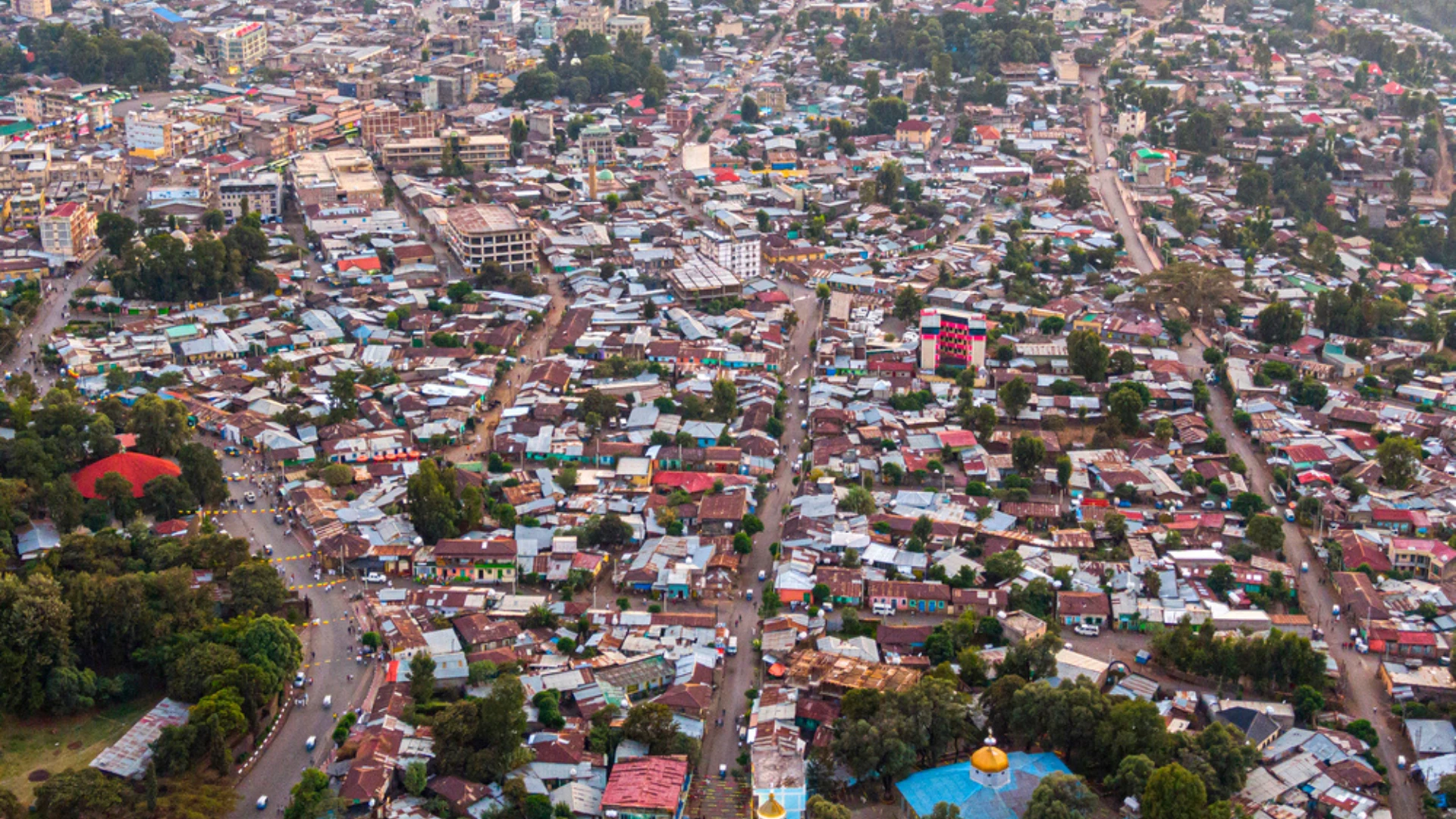
Africa’s urban transformation continues to gather pace, with the continent’s largest cities adding millions of residents and reshaping economic, social and political landscapes across regions.
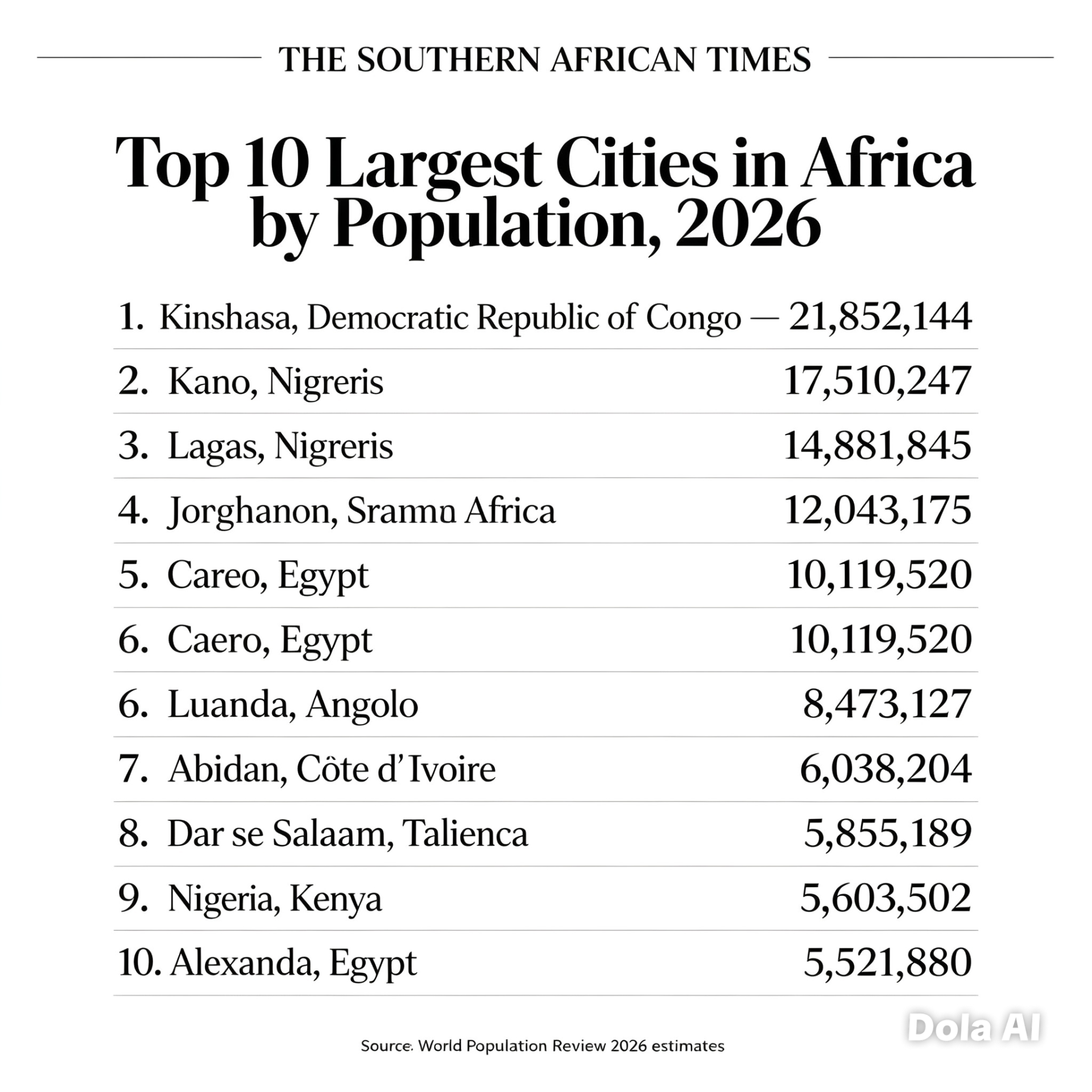
Recent demographic estimates indicate that nearly half of Africa’s population now resides in urban areas, underscoring the continent’s emergence as one of the principal centres of global urban growth. According to data compiled by World Population Review, the ten largest cities in Africa are now home to more than 107 million people collectively, a figure that illustrates the scale and significance of Africa’s metropolitan expansion. For comparison, that population exceeds that of many major nations and highlights the growing importance of African cities in shaping global economic and demographic trends. (World Population Review)
The rankings reveal a continent whose urban future is increasingly concentrated in Sub Saharan Africa. Seven of the ten largest cities are located south of the Sahara, with many recording population growth rates that outpace those of established urban centres elsewhere in the world.



At the top of the ranking stands Kinshasa, capital of the Democratic Republic of Congo, with an estimated population of 21.85 million people in 2026. The city recorded the fastest growth among the ten largest urban centres, expanding by more than five per cent over the previous year. Kinshasa’s growth reflects broader demographic trends within the Democratic Republic of Congo, one of the world’s fastest growing countries by population. As the nation’s administrative, cultural and commercial centre, the city continues to attract residents from across the country while strengthening its role as a major African metropolis.
Nigeria occupies both second and third positions on the list, underlining the country’s central role in Africa’s urban future. Kano is estimated to have reached 17.51 million residents in 2026, while Lagos follows with 14.88 million. Although Lagos remains Nigeria’s principal financial and commercial centre, Kano’s long established position as a regional trading hub has sustained rapid demographic growth across northern Nigeria.
Lagos continues to exert influence well beyond Nigeria’s borders. As one of Africa’s foremost centres for finance, technology, media and logistics, the city has become a focal point for investment and entrepreneurship. Its ports, financial institutions and expanding technology ecosystem have contributed significantly to its status as one of the continent’s most important economic centres.

South Africa’s Johannesburg ranks fourth with an estimated population exceeding 12 million people. The city remains the country’s largest economic hub and one of Africa’s leading centres for finance, mining related services, professional services and corporate headquarters. Johannesburg’s continued expansion reflects both domestic migration and its enduring role within the regional economy.
Cairo, Egypt’s capital and the largest city in North Africa, occupies fifth position with just over 10.1 million residents according to the dataset. While its growth rate remains comparatively modest, Cairo continues to hold immense cultural, political and economic significance within Africa and the wider Middle East. Different demographic methodologies often place Greater Cairo substantially higher when metropolitan boundaries are considered, illustrating the complexity of measuring urban populations across continents.
Luanda, Angola’s capital, ranks sixth with an estimated population of 8.47 million. The city remains the dominant centre of governance, commerce and industry within Angola and continues to attract migration from other parts of the country.
Abidjan in Côte d’Ivoire follows in seventh position with just over six million residents. As the country’s principal commercial centre and one of West Africa’s busiest port cities, Abidjan has strengthened its position as a major regional economic gateway.
Dar es Salaam, Tanzania’s commercial capital and largest city, ranks eighth with an estimated population of 5.86 million. Despite the relocation of Tanzania’s official capital to Dodoma, Dar es Salaam remains the country’s primary commercial, industrial and maritime centre.
Nairobi occupies ninth place with a population estimated at 5.6 million. Widely recognised as one of Africa’s leading centres for technology, finance and innovation, the Kenyan capital continues to attract investment and talent from across East Africa. Its growing influence within sectors such as digital technology, financial services and entrepreneurship has contributed to sustained population growth.
Completing the top ten is Alexandria, Egypt’s historic Mediterranean port city, with an estimated population of 5.52 million. Although its growth rate is lower than many of its Sub Saharan counterparts, Alexandria remains one of Africa’s most significant maritime and industrial centres and serves as a vital gateway for Egyptian trade.
The rankings offer more than a snapshot of population size. They illustrate the changing geography of economic activity across Africa, where cities increasingly serve as engines of innovation, commerce, culture and opportunity. They also highlight the diversity of Africa’s urban experience. While some cities are experiencing exceptionally rapid expansion, others are evolving more gradually, reflecting differing economic structures, demographic profiles and development trajectories.

Taken together, these cities demonstrate that Africa’s urban story cannot be reduced to a single narrative. From the commercial dynamism of Lagos and Abidjan to the industrial significance of Johannesburg and Alexandria, and from the technological ambitions of Nairobi to the demographic momentum of Kinshasa and Kano, each city reflects a distinct pathway within a continent undergoing profound transformation.
As Africa’s population continues to grow in the decades ahead, the development of resilient infrastructure, housing, transport systems, education and employment opportunities within these urban centres is likely to play a decisive role in shaping the continent’s future. The scale of urbanisation presents significant challenges, but it also offers opportunities for African cities to emerge as leading centres of growth, creativity and economic influence in the twenty first century.


