Zimbabwe has launched one of its most ambitious digital workforce initiatives to date after signing a strategic Memorandum of Understanding with Liquid Intelligent Technologies aimed at establishing a national Software Developer Skills Development Hub, in a move officials framed as part of a broader push towards technological sovereignty and artificial intelligence readiness.
The agreement, signed between the Ministry of Skills Audit and Development and Data Control & Systems (1996) Private Limited trading as Liquid Intelligent Technologies, signals Harare’s growing determination to reposition itself within the rapidly evolving global digital economy.
Far from a conventional telecommunications partnership, the initiative seeks to create a structured national ecosystem for software engineering, AI development, cybersecurity and cloud computing, while aligning education systems more directly with industry demand.



The agreement also reflects a broader shift unfolding across parts of Africa, where governments are increasingly treating digital infrastructure and technological capability not merely as commercial sectors, but as instruments of economic sovereignty and geopolitical competitiveness.
Addressing delegates at the signing ceremony, Minister of Skills Audit and Development Jenfan Muswere described the initiative as a decisive national intervention intended to move Zimbabwe from technological consumption towards technological creation.
“We gather today at a moment of genuine consequence,” Muswere said. “Not because of the paper we will sign, but because of what that paper demands of us from this day forward. It demands delivery. It demands accountability. And above all, it demands that we keep faith with Zimbabwe’s youth.”

The minister argued that Zimbabwe possessed the intellectual foundations necessary to compete globally in software and artificial intelligence, but lacked structured pathways capable of converting educational potential into economic output.
“Zimbabwe has always been a nation of educated, capable people,” he said. “But foundations are only as valuable as the structures we build upon them.”

The rhetoric emerging from the Ministry represents one of the clearest articulations yet of Zimbabwe’s intention to enter the AI and software economy more aggressively.
In language that echoed broader global debates around digital dependency and economic self-determination, Muswere warned against continued reliance on imported technological systems.
“Every time we import software, we are importing skills and exporting jobs,” he said. “Every licence fee paid abroad for software our own engineers could have built is a salary that did not go to a Zimbabwean family. That must change.”
The Software Developer Skills Development Hub will reportedly focus on training Zimbabweans in software development, artificial intelligence, cybersecurity, cloud engineering and digital entrepreneurship. Crucially, the programme is being positioned not as a short-term certification initiative, but as part of a longer-term industrial skills pipeline stretching from secondary education into employment and enterprise formation.
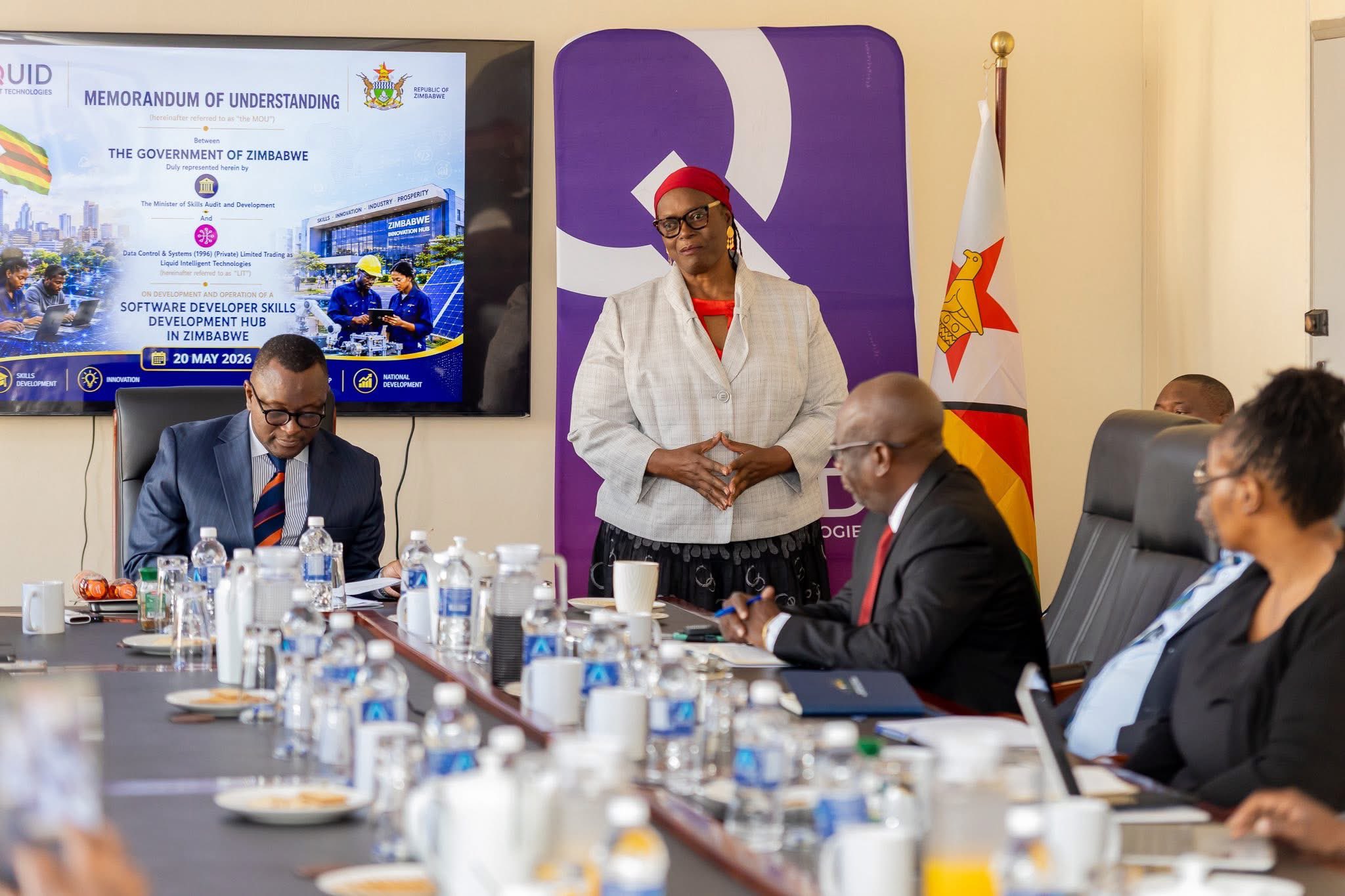
According to the framework presented during the signing ceremony, participants will gain access to AI-focused computing environments, project-based learning systems and subsidised GPU infrastructure provided through Liquid Intelligent Technologies.
The emphasis on GPU infrastructure is particularly notable.
Globally, access to high-performance computing resources has emerged as one of the defining constraints of the artificial intelligence era. Many African developers and startups remain locked out of advanced AI experimentation due to prohibitive compute costs and limited infrastructure availability. Zimbabwe’s attempt to integrate subsidised computing resources into a national skills development strategy therefore places the initiative within a far broader international contest over technological capability.
The programme also intends to introduce globally recognised cybersecurity certifications, industry-aligned curricula and internship pathways connected to Cassava AI’s wider African operations.
In addition, the Ministry outlined plans for what it termed a “continuous pipeline from high school”, incorporating mathematics-for-programming initiatives, coding boot camps and secondary-level career exposure programmes.
“We are not building a one-off programme,” Muswere declared. “We are building a skilled future that responds to Zimbabwe’s own challenges, an ecosystem that begins at secondary school and ends at employment, entrepreneurship, or further innovation.”
The Government also pledged policy backing, programme coordination and national oversight mechanisms through a Joint Steering Committee and Joint Task Team designed to accelerate implementation.

“The quicker we move towards intellectual independence and sovereignty, the quicker we will leapfrog those countries who are years ahead of us in the digitalisation of their economies,” Muswere said. “We do not need decades to catch up. We need deliberate investment, disciplined execution, and the right partnerships.”
For Liquid Intelligent Technologies, the agreement forms part of a broader continental strategy increasingly centred around digital transformation, cloud ecosystems and artificial intelligence infrastructure.
Speaking on behalf of the company, Loretta Songola said Zimbabwe had reached a defining moment in its digital transformation trajectory, arguing that Government was now demonstrating growing seriousness regarding digital policy, artificial intelligence and technological governance.
Songola observed that the COVID-19 pandemic had accelerated structural changes in how economies function, normalising remote work and deepening dependence on digital systems across industries ranging from mining and agriculture to finance and logistics.
“The economy is increasingly becoming part of a wider global digital economy,” she said.
While acknowledging widespread anxieties surrounding artificial intelligence, Songola rejected suggestions that AI would entirely replace human beings, maintaining instead that technological systems remain dependent on ethics, governance and human oversight.
“Digital systems continue to operate through people,” she said, emphasising the importance of investing in human capital and digital literacy.
Her remarks reflected an increasingly prominent debate within global technology circles: whether African economies will merely consume AI technologies developed elsewhere, or cultivate the domestic talent and infrastructure necessary to participate meaningfully in their creation.
Songola further stressed the importance of inclusivity in digital transformation, warning that technological discussions often become inaccessible to ordinary citizens.
According to her, the new partnership aimed to improve digital fluency while helping Zimbabweans better understand the systems, structures and frameworks shaping the modern technological economy.
She described investment in people as central to Zimbabwe’s long-term prosperity and framed Liquid’s involvement as part of its broader mandate to support Africa’s technological advancement while ensuring populations are not excluded from the transition.
For international investors, the significance of the agreement lies not simply in skills development, but in what it reveals about Zimbabwe’s evolving economic priorities.
Historically associated with mining, agriculture and commodity exports, Zimbabwe is now increasingly signalling interest in becoming part of Africa’s emerging digital infrastructure and AI economy. The country possesses one of the continent’s highest literacy rates and a longstanding educational emphasis on mathematics and science, though these strengths have often struggled to translate into scalable technology industries.

The success of the initiative will ultimately depend on execution.
Africa’s policy landscape remains crowded with innovation strategies and technology memoranda that generated political enthusiasm but failed to deliver measurable industrial transformation. Zimbabwe’s challenge will therefore be converting rhetoric into durable institutions, employment pipelines, startup ecosystems and globally competitive technical talent.
Yet if effectively implemented, the partnership may come to represent more than a domestic training programme.
It could signal the early stages of a broader strategic shift in which African economies increasingly pursue digital sovereignty not only through infrastructure investment, but through deliberate attempts to cultivate the engineers, AI specialists and software developers capable of building the systems that will define future economic power.
As Muswere concluded in his closing remarks: “The world needs software developers. Africa needs them. Zimbabwe will supply them.”