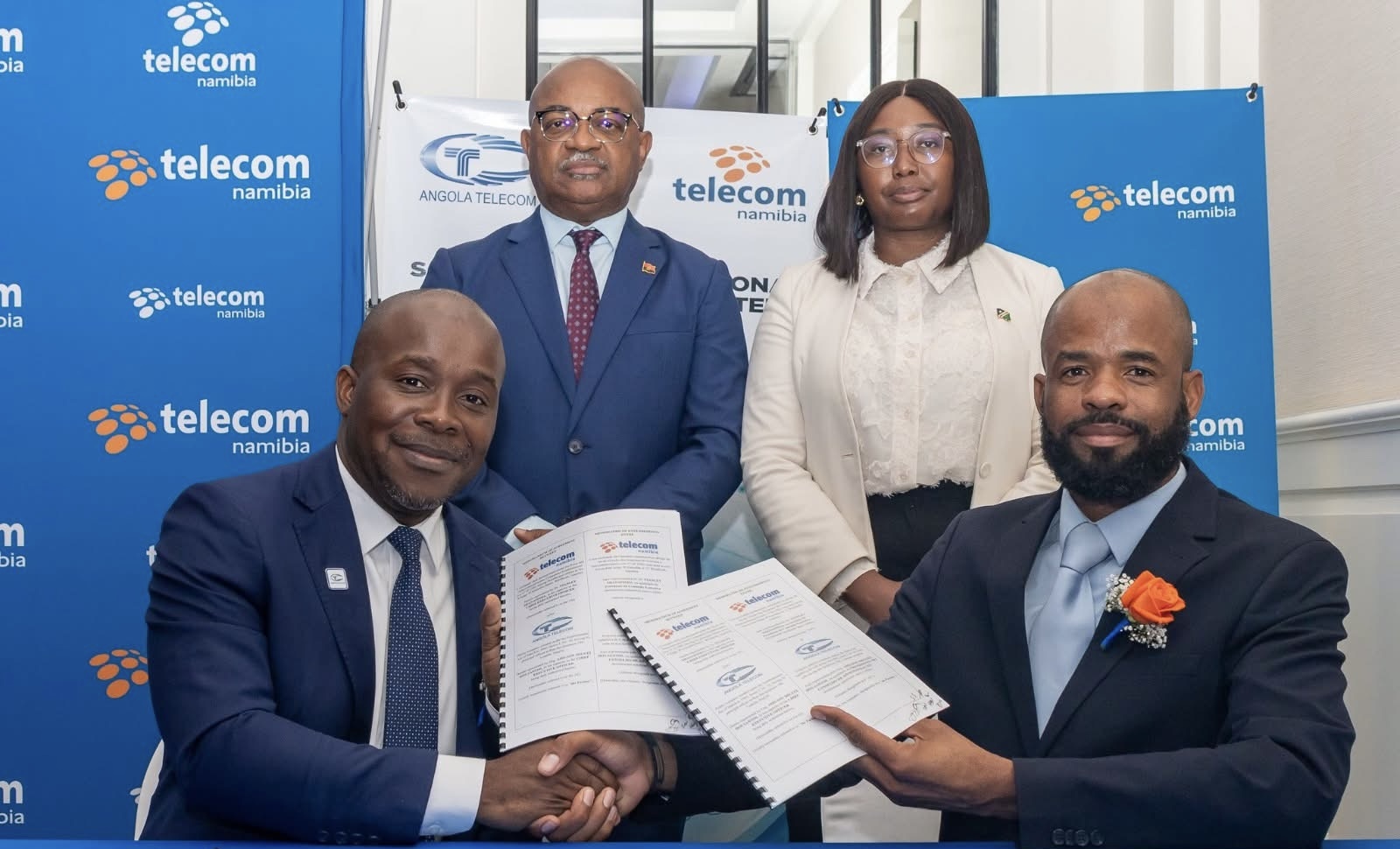
Telecom Namibia and Angola Telecom have concluded a bilateral agreement enabling Angola Telecom to access international bandwidth through the Equiano subsea cable system, which lands at Swakopmund on Namibia’s Atlantic coast. The agreement was formalised through a memorandum of understanding and accompanying commercial terms, following a period of negotiations between the two state aligned operators.
The signing ceremony, held in Swakopmund, was attended by Namibia’s Minister of Information and Communication Technology, Emma Theofelus, and Angola’s Minister of Telecommunications, Information Technology and Social Communication, Mário Augusto da Silva Oliveira, alongside municipal representatives and senior executives from both telecommunications entities.
The Equiano cable, developed by Google and operational along the west coast of Africa, connects multiple landing points including Portugal, Nigeria, Namibia and South Africa. It is designed to significantly increase bandwidth capacity and reduce the cost of internet services across the continent. By linking Angola Telecom’s infrastructure to this system via Namibia, the agreement is expected to enhance redundancy and expand international routing options for Angola’s network.



Namibian authorities described the arrangement as part of a broader effort to position the country as a regional transit hub for digital traffic. According to Telecom Namibia, the partnership contributes to improved network resilience and supports the long term development of cross border digital infrastructure. The company indicated that the agreement reflects a shared interest in strengthening Southern Africa’s participation in the global digital economy.
Angola Telecom has similarly framed the partnership as a strategic extension of its international connectivity ambitions. The agreement complements Angola’s ongoing development of the South Atlantic Cable System and related subsea initiatives, including the SARSSy project, which aims to diversify the country’s connectivity routes and increase capacity. Integration with the Equiano system through Swakopmund is expected to provide additional scalability and operational flexibility.

Both governments have emphasised the broader regional implications of the agreement. Increased interconnection between neighbouring states is widely regarded as a key enabler of digital transformation, facilitating trade, service delivery and the movement of information across borders. In this context, the Namibia Angola partnership reflects an incremental approach to infrastructure cooperation within the Southern African region.

While the agreement focuses on technical connectivity, it also underscores a wider continental shift towards strengthening intra African digital networks. As countries invest in subsea and terrestrial fibre systems, there is a growing emphasis on ensuring that infrastructure development aligns with regional priorities and supports inclusive access to digital services.
The collaboration between Telecom Namibia and Angola Telecom illustrates how cross border partnerships are being leveraged to address structural gaps in connectivity. By linking national systems to shared infrastructure such as the Equiano cable, Southern African states are incrementally shaping a more interconnected and resilient digital landscape, grounded in regional cooperation and shared economic objectives.