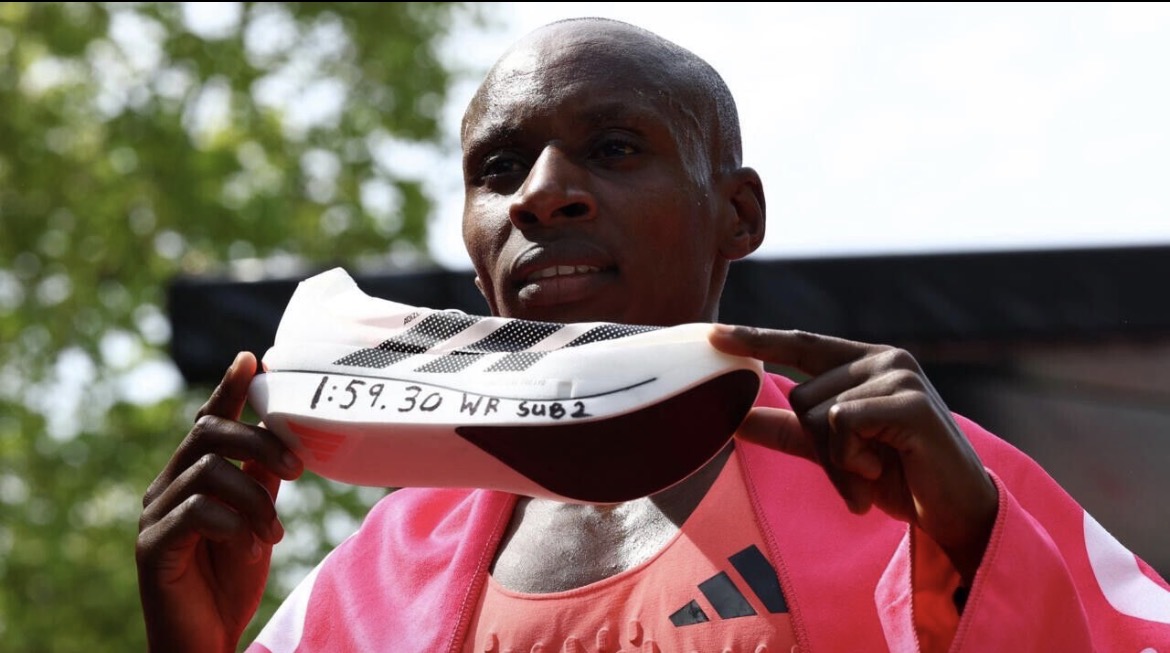
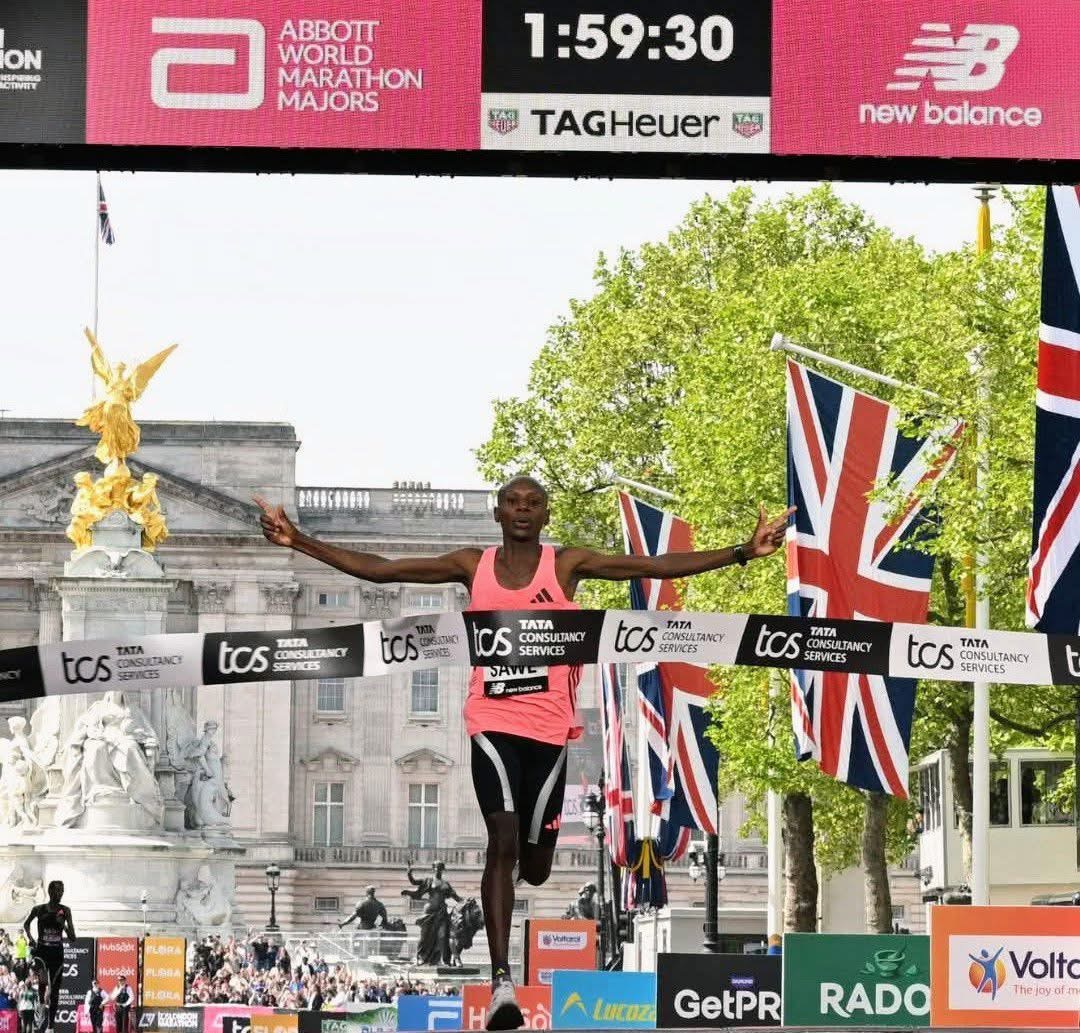
Kenya’s Sabastian Sawe has placed African distance running at the centre of another defining moment in global sport after becoming the first athlete to complete an official marathon in under two hours, winning the London Marathon in 1 hour 59 minutes and 30 seconds while wearing Adidas’s new Adizero Adios Pro Evo 3 racing shoes.
The result, reported from London on 27 April 2026, surpassed the previous men’s marathon world record of 2:00:35 set by the late Kelvin Kiptum at the Chicago Marathon in October 2023. Sawe’s performance also gave Adidas a prominent victory in the increasingly competitive market for elite racing footwear, where innovation, athlete partnership and commercial strategy now intersect closely.
After the race, Sawe held up his Adidas shoe, marked with “WR” and “sub 2”, and said its lightness and comfort had made a significant difference. Adidas says the third version of the Adizero Adios Pro Evo weighs an average of 97 grams, is around 30 per cent lighter than its predecessor, and improves running economy by 1.6 per cent.




The London result was not only a commercial moment for Adidas but also a reminder that African athletes remain central to the evolution of distance running. Ethiopia’s Yomif Kejelcha finished second on his marathon debut, while Tigst Assefa broke her own women only world record. Both also wore the Adizero Adios Pro Evo 3, reinforcing the role of East African athletes not simply as brand ambassadors, but as leading figures in the sport’s technical and human development.
Adidas shares rose 1.5 per cent on Monday following the result, although the company remains down 18 per cent since the start of the year amid concerns over United States tariffs and instability linked to the conflict in the Middle East. The performance nonetheless offered the German sportswear group a valuable boost against Nike, whose Alphafly and Vaporfly models have dominated elite marathon running for much of the supershoe era.
Nike is expected to release updated versions of its Alphafly and Vaporfly shoes later this year, as chief executive Elliott Hill seeks to refocus the company on core sports including running and football. The company’s earlier role in the sub two hour marathon story remains significant, particularly through Eliud Kipchoge’s unofficial 1:59:40 run in 2019, although that performance was not eligible for official record recognition.
Sawe’s achievement, by contrast, came in an official race setting. It therefore shifts the conversation from controlled experimentation to competitive legitimacy, while also showing how African athletes continue to redefine the boundaries of endurance sport.
The rise of supershoes has brought measurable gains through carbon plates, advanced foams and lighter construction, but the London result should not be reduced to technology alone. Sawe, Assefa and their peers represent years of disciplined training, regional running cultures, coaching systems and personal sacrifice. Their achievements are African sporting histories as much as they are corporate milestones.

The new Adidas model is priced at about $500 and is due to be released to the public through the Adidas app before a wider autumn launch. Its cost is likely to keep it beyond the reach of many runners, including some on the continent whose athletes have done so much to shape the global prestige of marathon running.
For Adidas, London was a marketing victory. For African athletics, it was something larger: another reminder that the sport’s most transformative moments are often carried by runners whose stories extend far beyond the brands on their feet.