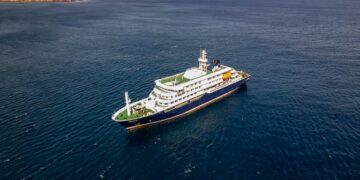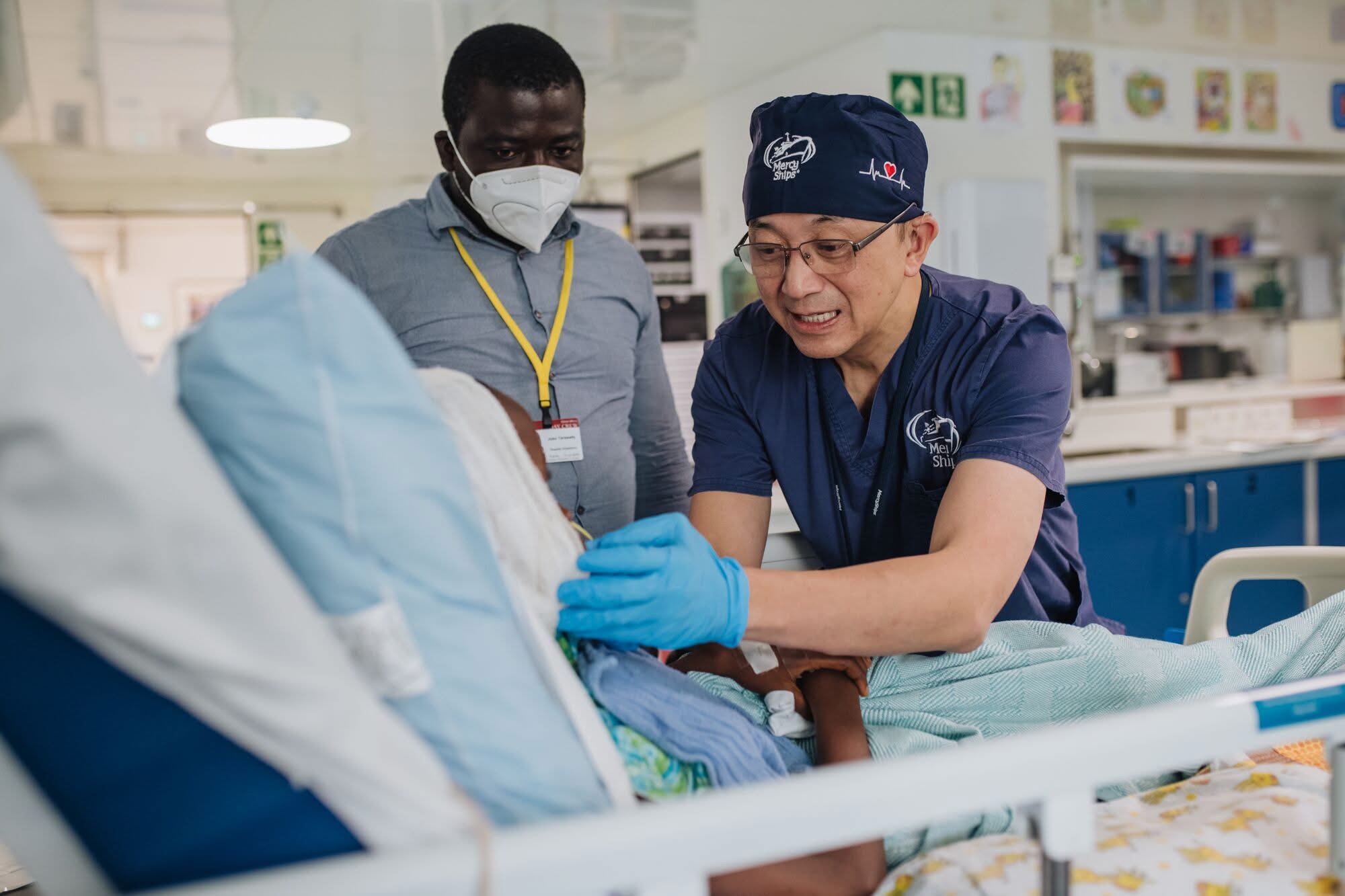
When ten-month-old Memunatu arrived aboard the Global Mercy — the world’s largest civilian hospital ship operated by Mercy Ships — her tiny frame carried the weight of a tumour that made eating, swallowing, and breathing a daily struggle. In Sierra Leone’s capital, Freetown, her mother, Aminata, had sought help from multiple medical facilities, but each visit ended in disappointment. The arrival of the Global Mercy in West Africa marked the beginning of a new chapter for them both.
The vessel, which docked in Sierra Leone as part of Mercy Ships’ ongoing mission to strengthen surgical capacity in Africa, became a place of restoration for children like Memunatu. Under the care of Dr Leo Cheng, a consultant maxillofacial surgeon from the United Kingdom who has volunteered with Mercy Ships for over two decades, her complex condition received urgent attention. Upon reviewing her scans, Dr Cheng and his team confirmed that while the tumour was benign, its location and rapid growth posed a severe threat to her life.
“Without the surgery, her condition would have continued to worsen,” explained Dr Cheng. “It could have become life-threatening.”



The delicate procedure demanded extraordinary coordination. Anaesthesia and intubation were particularly challenging due to the tumour’s proximity to Memunatu’s airway. Over several hours, a multidisciplinary team of African and international medical professionals worked in synchrony, combining surgical precision with compassion. When the operation concluded, and the swelling began to subside, the transformation was profound.
What emerged was not only the healing of a child but the restoration of dignity, acceptance, and hope. In the words of Dr Cheng, “Every surgery like this reminds us that access to safe surgery is not a luxury, but essential. When we restore someone’s face, we restore their humanity, their acceptance, and their hope.”
According to The Lancet Commission on Global Surgery, nearly five billion people — two-thirds of the global population — lack access to safe, affordable, and timely surgical care. The consequences are stark: an estimated 17 million deaths each year are linked to conditions treatable by surgery, translating to one preventable death every two seconds. Across sub-Saharan Africa, this deficit is compounded by a shortage of trained surgeons, inadequate infrastructure, and systemic barriers to care.
However, the ongoing work of organisations like Mercy Ships underscores a broader and deeply African narrative — one of resilience, collaboration, and the pursuit of equity in healthcare. Rather than imposing external solutions, initiatives such as these increasingly focus on partnership: training local medical professionals, supporting in-country capacity building, and strengthening existing health systems.
In Freetown, volunteer healthcare workers like Anne-Marie van Tonder from South Africa exemplify this spirit of solidarity. Her encounter with Aminata and Memunatu became the bridge that connected them to the Global Mercy and ultimately to a life-saving intervention.

Yet, the story extends beyond one family’s transformation. It highlights a structural issue that requires sustained attention: the global surgery crisis that disproportionately affects African nations. The burden of surgically treatable conditions — from obstructed labour to congenital anomalies and trauma — remains one of the most under-addressed global health challenges of our time.

While international partnerships contribute meaningfully, long-term progress lies in fostering African-led medical innovation, research, and education. The work aboard the Global Mercy thus becomes not a singular act of charity, but part of a collective effort to ensure that all people, regardless of geography, have access to the fundamental right of safe surgery.
For Memunatu and countless others, the surgery did more than remove a tumour — it restored a future.