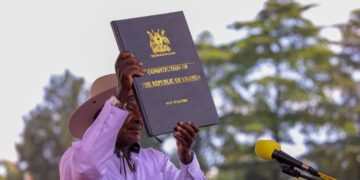
Ugandan President Yoweri Museveni has arrived in Juba, South Sudan’s capital, for high-level diplomatic discussions aimed at addressing the country’s escalating political tensions. Museveni’s visit, at the invitation of South Sudanese President Salva Kiir, underscores Uganda’s strategic role in regional peace and stability efforts.
The Ugandan leader announced his arrival via his official account on the social media platform X, stating that he looked forward to strengthening bilateral relations and enhancing cooperation between Uganda and South Sudan. His visit follows that of Raila Odinga, Kenya’s special envoy to South Sudan, who recently met with both Kiir in Juba and Museveni in Uganda to discuss the country’s fragile political landscape.
Museveni’s intervention comes amid rising concerns over the strained relationship between President Kiir and South Sudan’s First Vice President Riek Machar. The tension between the two leaders, who were once rival factions in South Sudan’s brutal five-year civil war, has been a cause for alarm among both citizens and the international community. The 2018 peace agreement, which officially ended hostilities and established a unity government, remains fragile as periodic clashes and political disputes threaten its durability.



Uganda has long been a key stakeholder in South Sudan’s stability, given the economic and security ties between the two nations. Museveni played a crucial role in brokering peace efforts during South Sudan’s conflict and has continued to support diplomatic and security initiatives in the region. His latest visit aligns with ongoing mediation efforts led by the African Union and the Intergovernmental Authority on Development (IGAD), an East African regional bloc.
The African Union and IGAD have been actively engaged in de-escalating tensions and promoting political dialogue between the warring factions in South Sudan. Given Museveni’s influence and Uganda’s historical involvement in the region’s peace processes, his presence in Juba is expected to bolster existing mediation efforts.

While the details of his discussions with President Kiir remain undisclosed, it is anticipated that the talks will focus on mechanisms to stabilise governance, prevent renewed violence, and address the underlying issues causing political friction. The situation remains fluid, and regional leaders, including those from Kenya and Ethiopia, are closely monitoring developments to ensure that South Sudan does not descend into another cycle of conflict.
South Sudan’s challenges extend beyond political leadership struggles. The country continues to grapple with humanitarian crises, economic difficulties, and security concerns. Any political instability further exacerbates the plight of millions of South Sudanese who rely on international aid and humanitarian assistance. Ensuring a stable political environment is not only crucial for governance but also for economic recovery and development.
Observers note that Museveni’s visit is a reflection of Uganda’s vested interest in maintaining regional stability. A peaceful South Sudan benefits Uganda economically, given the significant trade relations between the two countries. Additionally, Uganda has hosted hundreds of thousands of South Sudanese refugees who fled violence during the civil war, further highlighting the interconnectedness of the two nations.
As diplomatic engagements continue, stakeholders hope that Museveni’s intervention, alongside the broader efforts of regional and international mediators, will contribute to a sustainable resolution of South Sudan’s political deadlock. The next steps will likely involve further consultations among East African leaders, the African Union, and the United Nations, all of whom remain committed to ensuring that the 2018 peace agreement remains intact.