As South Africa contends with a punitive 30% tariff on its exports to the United States under President Donald Trump’s newly reinstated protectionist trade agenda, business leaders and policymakers must recalibrate their strategies in an era of heightened volatility. With geopolitical uncertainty intensifying and global trade dynamics shifting unpredictably, the imperative is no longer merely resilience—it is strategic reinvention.
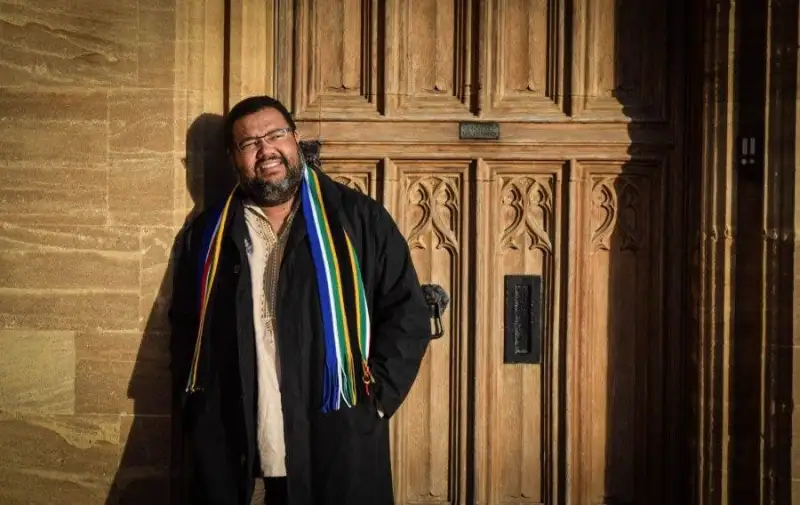
On 8 May 2025, an exclusive event in London will convene thought leaders, investors, and policymakers to interrogate the role of corporate leadership in navigating South Africa’s economic and social fractures. Hosted by The Southern African Times in collaboration with the South African Chamber of Commerce UK, the event will be anchored by Dr Athol Williams, an applied philosopher at Oxford University and a globally respected authority on business ethics, economic strategy, and corporate responsibility.
Dr Williams will challenge entrenched paradigms, urging business leaders to reassess their role not merely as market participants but as architects of societal cohesion and economic sustainability. The discussion will move beyond conventional financial metrics to explore how corporations can safeguard long-term viability by fostering inclusive growth, ethical governance, and investment in social capital. Amid shifting macroeconomic headwinds and the spectre of deglobalisation, the question is stark: is business a passive observer of geopolitical turbulence, or can it emerge as a proactive force in bridging South Africa’s economic and social divide?



Trump’s return to the White House in January 2025 has precipitated a fundamental restructuring of global trade norms, with his administration unilaterally imposing a universal 10% baseline tariff on all goods entering the U.S., coupled with bespoke punitive levies targeting specific economies. South Africa now faces a 30% duty on its exports, raising concerns over market access erosion and long-term trade competitiveness.
Although select South African mineral exports remain exempt from the most severe tariff measures, critical industries—particularly automotive manufacturing and high-value minerals—are now exposed to significant downside risk. The Minerals Council of South Africa has voiced apprehension over the potential contraction in global demand for South African commodities, exacerbated by escalating trade frictions and increased protectionist barriers. While a weaker rand-dollar exchange rate may enhance the relative price competitiveness of South African exports in alternative markets, this alone is insufficient to mitigate the broader economic ramifications of restricted U.S. market access.
In response, President Cyril Ramaphosa has called for an urgent recalibration of bilateral trade relations between South Africa and the United States, advocating for a mutually beneficial trade framework that mitigates the risk of economic destabilisation. However, with global markets exhibiting heightened volatility—evidenced by substantial equity sell-offs following Trump’s tariff announcement—the outlook remains uncertain. The imperative for South African corporates is clear: adapt, innovate, and diversify or risk marginalisation.
As traditional geopolitical alliances falter and economic nationalism gains traction, the role of the private sector has become increasingly pivotal. This event will dissect whether South African businesses can pivot effectively—not merely in terms of operational agility and market diversification, but in proactively shaping a sustainable economic model that balances profit imperatives with long-term societal stability.
Set against the backdrop of a rapidly evolving macroeconomic environment, this forum at the University of Westminster will offer a rare confluence of insights through:
- A keynote address by Dr Athol Williams, articulating a forward-looking vision for corporate leadership in an era of heightened global uncertainty.
- A one-on-one interview, exploring the intersections of business strategy, trade policy, and social responsibility.
- An interactive Q&A session, affording attendees the opportunity to engage with a preeminent thinker on corporate strategy, ethics, and economic resilience.
The event is proudly sponsored by Ngoto and Clear Morbitel, two brands that exemplify innovation, cultural heritage, and sustainable investment in Africa. Ngoto, an African craft beverage brand, brings to life the rich flavours and traditions of the continent through its Premium Craft Lager, a beer deeply rooted in African history and social rituals. The brand celebrates the art of brewing as a cultural expression, paying homage to the Shona heritage of Zimbabwe through its signature calabash emblem. With every sip of Ngoto Lager, the spirit of Africa’s legacy and communal traditions is honoured, making it a fitting partner for an event exploring the future of African economic identity.
Meanwhile, Clear Morbitel, a global telecommunications powerhouse, continues to drive digital transformation and connectivity in emerging markets. As Africa embraces the fourth industrial revolution, Clear Morbitel’s investment in infrastructure, fintech, and AI-driven solutions is reshaping the digital landscape, ensuring that African businesses remain competitive in an interconnected world.
Their sponsorship underscores the critical role of corporate foresight, responsible investment, and heritage-driven innovation in navigating the challenges of a rapidly shifting economic landscape.
With a distinguished audience spanning institutional investors, corporate executives, policymakers, and post-graduate students, the event represents an unparalleled opportunity to engage in high-level discourse on the future of South African business in an increasingly fragmented global economy.
As the complexities of international trade, economic policy, and corporate governance continue to evolve, this discussion will offer actionable intelligence on how business leaders can reposition their strategies not merely to withstand disruption, but to thrive within it.
Date: 8 May 2025
Venue: University of Westminster, London as party of the CAMRI African Series
Tickets: £12 for members, £36 for non-members

Register now to be part of this pivotal conversation on South Africa’s economic trajectory in the face of intensifying geopolitical volatility.