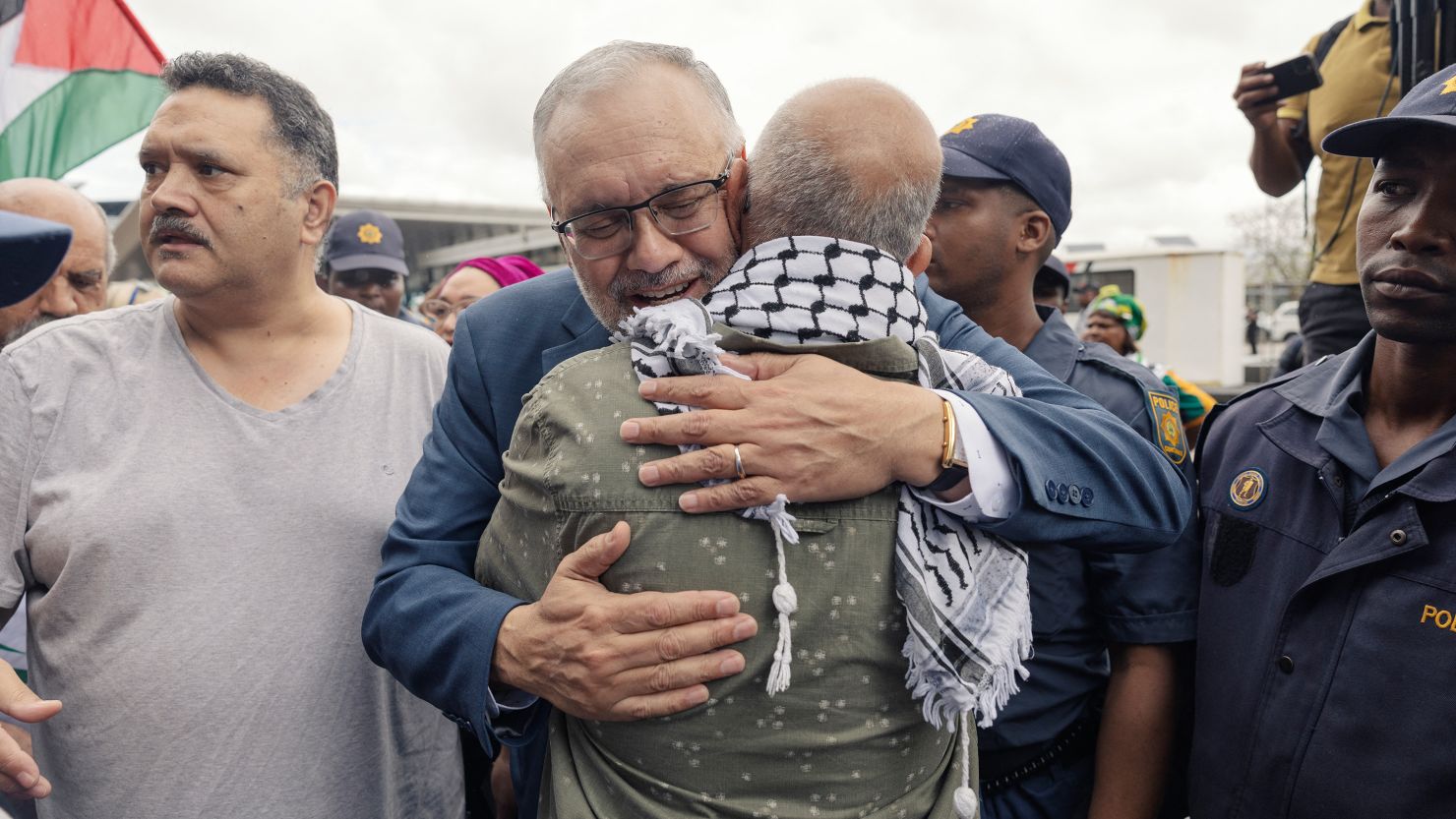
Ebrahim Rasool, South Africa’s ambassador to the United States, returned to Cape Town on Sunday to a rapturous reception after being expelled by the Trump administration and declared persona non grata. Greeted by hundreds of supporters at Cape Town International Airport, Rasool was escorted through the terminal by police as chants and liberation songs echoed around him. His expulsion marks a rare and serious diplomatic rupture between the two nations.
Addressing the crowd via megaphone, Rasool stated: “A declaration of persona non grata is meant to humiliate you. But when you return to crowds like this, and with warmth like this, then I will wear my persona non grata as a badge of dignity.” He added that while returning under such circumstances was not of his own choosing, he harboured no regrets.
The former ambassador’s expulsion followed an executive order issued by U.S. President Donald Trump, who accused South Africa of supporting Hamas and Iran, and of adopting anti-American and anti-white policies. The Trump administration subsequently ceased all U.S. aid to South Africa. Rasool’s comments on American domestic politics—delivered in a recent online seminar hosted by a South African think tank—appeared to be the catalyst for this unprecedented decision.



In the seminar, Rasool had contextualised political shifts in the U.S. as part of a broader global reaction to demographic change. He analysed the “supremacist assault on incumbency” as a feature of the Make America Great Again movement, referencing demographic projections that suggest the white population in the U.S. electorate may decline to 48%. His remarks were framed as an academic critique rather than a political indictment.
“I would stand by my analysis,” Rasool reaffirmed upon arrival in Cape Town. “We were analysing a political phenomenon, not a personality, not a nation, and not even a government. It is not the U.S. of Obama; it is not the U.S. of Clinton—it is a different U.S., and therefore our language must change.”
The decision to expel Rasool was made public by U.S. Secretary of State Marco Rubio via a post on X (formerly Twitter), in which he referred to Rasool as a “race-baiting politician” hostile to the U.S. and to President Trump. Rubio’s statement was based on an article from the right-wing publication Breitbart, written by South African-born journalist Joel Pollak, who is reportedly under consideration for appointment as the next U.S. ambassador to South Africa.
Notably, Rasool’s removal is an uncommon diplomatic action, as expulsions of ambassadors are generally considered a last resort in foreign policy. Despite the severity of the measures, Rasool underscored that he was not advocating for a break in U.S.-South Africa relations. “We are not here to say we are anti-American,” he said. “We are not here to call on you to throw away our interests with the United States.”
He nonetheless emphasised the need for South Africa to approach its engagement with the U.S. with realism and dignity. “We must fight for [the relationship], but we must keep our dignity.”
The diplomatic fallout occurs amid South Africa’s ongoing case before the International Court of Justice (ICJ), in which it accuses Israel of genocide in Gaza. The Trump administration cited this case as another reason for its assertion that Pretoria was adopting an anti-American position. Rasool was unequivocal in defending South Africa’s right to pursue the case, asserting, “We cannot sacrifice the Palestinians … but we will also not give up with our relationship with the United States.”

The symbolism surrounding Rasool’s return was heightened by the presence of Palestinian flags and chants of “Free Palestine” from supporters, highlighting the interwoven nature of South Africa’s foreign policy and its historical solidarity with other liberation movements. Rasool, who is Muslim, invoked the humanitarian toll of the Gaza conflict: “As we stand here, the bombing has continued and the shooting has continued. If South Africa was not in the ICJ, Israel would not be exposed, and the Palestinians would have no hope.”
Rasool’s expulsion may have galvanised support at home, but it leaves complex diplomatic questions in its wake. While Pretoria has not yet formally responded to the U.S. action, analysts suggest that the incident could strain bilateral ties at a time when global geopolitical alignments are undergoing substantial shifts. The broader implications may depend on whether future American administrations take a similar stance or seek to repair relations with one of Africa’s most influential democracies.
In a climate where global diplomacy is increasingly characterised by populist rhetoric and sharp divisions, the Rasool affair may stand as a case study in the precarious balance between national sovereignty, principled foreign policy, and pragmatic diplomacy.