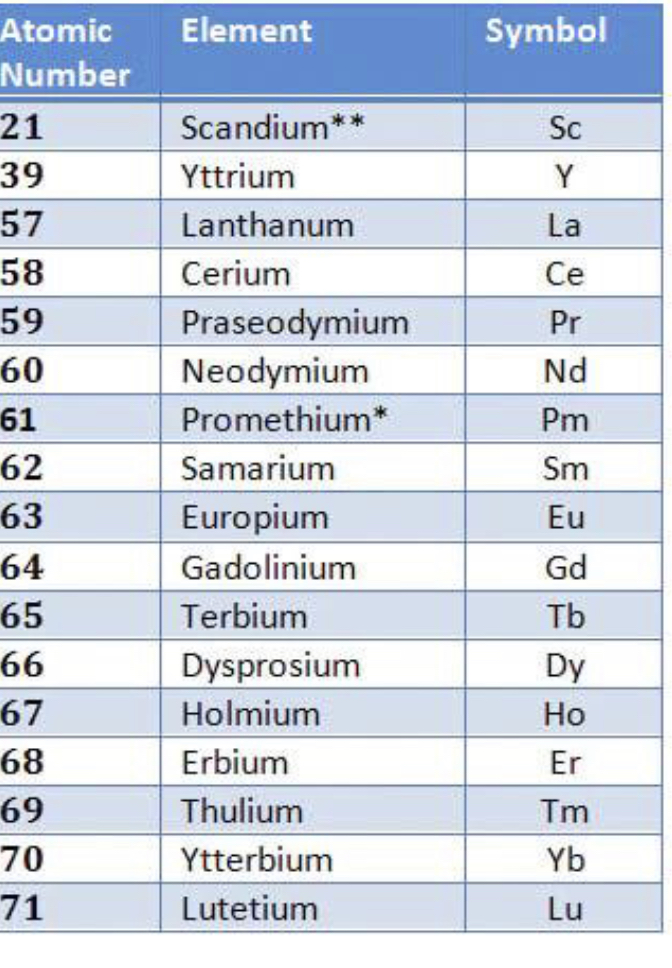
Rare earth elements (REEs) are a set of seventeen metallic elements, including the fifteen lanthanides on the periodic table along with scandium and yttrium. These elements play a crucial role in various high-tech devices and applications. Rare Earth Elements (REEs) play a crucial role in geopolitics due to their widespread application in modern technology and their significance for national security. Let’s delve into the implications of REEs and their connection to global power dynamics.
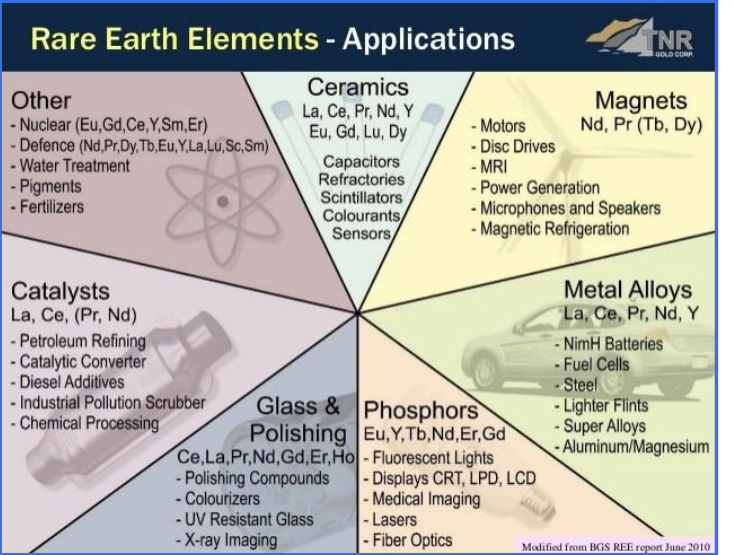
REEs have valuable properties such as high electrical conductivity and strong magnetism, making them essential for various technologies. Demand for rare earths is projected to increase as much as ten times between 2030 and 2040, and many countries have designated them as critical and strategic minerals. They are used in creating permanent magnets for offshore wind turbines, electric vehicle batteries, and motors. Additionally, REEs are critical for military technologies, including precision-guided weapons, lasers, satellites, and radar systems.
Consumer Electronics: Devices like cellular phones, computer hard drives, electric and hybrid vehicles, and flat-screen monitors and televisions rely on REEs. Although the amount of REEs used in a product may not be significant by weight or volume, they are necessary for the device to function. For example, magnets made of REEs represent only a small fraction of the total weight, but without them, spindle motors and voice coils in desktops and laptops would not be possible.



Strategic Importance:
REEs are critical for national security, energy independence, environmental sustainability, and economic growth.
Many advanced technologies rely on REEs, including:
• Magnets: Used in electric motors, wind turbines, and MRI machines.
• Batteries: REEs enhance battery performance in electric vehicles and portable electronics.
• Phosphors: Essential for energy-efficient lighting (e.g., fluorescent lamps, LEDs).

•Catalysts: Used in chemical processes and pollution control.
As countries strive for carbon neutrality, the demand for REEs is increasing, emphasizing the need to reassess supply chains and reduce dependency on China. Additionally, REEs are critical for military technologies, including precision-guided weapons, lasers, satellites, and radar systems.
Abundance, occurrence, and reserves:
As noted above, the rare earths are fairly abundant, but their availability is somewhat limited, primarily because their concentration levels in many ores are quite low (less than 5 percent by weight). An economically viable source should contain more than 5 percent rare earths, unless they are mined with another product—e.g., zirconium, uranium, or iron—which allows economic recovery of ore bodies with concentrations of as little as 0.5 percent by weight.
Of the 83 naturally occurring elements, the 16 naturally occurring rare-earth elements fall into the 50th percentile of the elemental abundances. Promethium, which is radioactive, with the most stable isotope having a half-life of 17.7 years, is not considered to be naturally occurring, although trace amounts have been found in some radioactive ores. Cerium, which is the most abundant, ranks 28th, and thulium, the least abundant, ranks 63rd. Collectively, the rare earths rank as the 22nd most abundant “element” (at the 68th percentile mark). The non-lanthanide rare-earth elements, yttrium and scandium, are 29th and 44th, respectively, in their abundances.
Lanthanum and the light lanthanides (cerium through europium) are more abundant than the heavy lanthanides (gadolinium through lutetium). Thus, the individual light lanthanide elements are generally less expensive than the heavy lanthanide elements. Furthermore, the metals with even atomic numbers (cerium, neodymium, samarium, gadolinium, dysprosium, erbium, and ytterbium) are more abundant than their neighbors with odd atomic numbers (lanthanum, praseodymium, promethium, europium, terbium, holmium, thulium, and lutetium).
Rare-earth ore deposits are found all over the world. The major ores are in China, the United States, Australia, and Russia, while other viable ore bodies are found in Canada, India, South Africa, and Southeast Asia. The major minerals contained in these ore bodies are bastnasite (fluorocarbonate), monazite (phosphate), loparite [(R, Na, Sr, Ca) (Ti, Nb, Ta, Fe3+) O3], and laterite clays (SiO2, Al2O3, and Fe2O3).
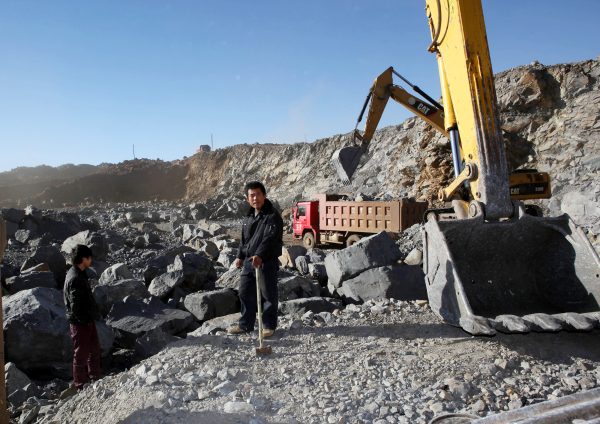
Chinese deposits accounted for about 80 percent of the rare earths mined in the world in 2017 (105,000 tons of rare-earth oxide). About 94 percent of the rare earths mined in China are from bastnasite deposits. The major deposit is located at Bayan Obo, Inner Mongolia (83 percent), while smaller deposits are mined in Shandong (8 percent) and Sichuan (3 percent) provinces. About 3 percent comes from laterite (ion absorption) clays located in Jiangxi and Guangdong provinces in southern China.
China’s Monopoly:

China’s control over REEs gives it significant leverage in global affairs. The US and its allies must find alternative sources to reduce dependency on China and enhance national security. As the world transitions to green energy and advanced technologies, securing a stable REE supply becomes paramount. Several pounds of rare earth compounds are in batteries that power every electric vehicle and hybrid-electric vehicle. As concerns for energy independence, climate change, and other issues drive the sale of electric and hybrid vehicles, the demand for batteries made with rare earth compounds will climb even faster. REEs are required in the production of military technologies like precision-guided munitions and communication systems.
A system like the Aegis Spy-1 Radar system requires its magnets to be replaced about every 30 years, emphasizing the importance of having continuous and reliable access to REEs. The fact that weapons systems rely on REEs puts the US at a significant disadvantage to China in any future conflict such as one between the US and its allies and China over Taiwan and the South China Sea. Rare earth elements (REEs) contain unique chemical and physical properties such as lanthanum, are found in small concentrations, need extensive precise processes to separate, and are critical components of modern technologies such as laser guidance systems, personal electronics like iPhones, satellites, and military weapons systems such as Virginia-class fast attack submarines, DDG-51 Aegis destroyers, the F-35 Joint Strike Fighter, and precision-guided munitions.
The U.S. has some rare earth resources but is heavily dependent on access to them from countries as varied as Afghanistan, Bolivia, and China. Losing access to these resources would have significant adverse economic, military, and political implications for the U.S. and its allies if their supply sources are restricted or eliminated.
Africa’s Role in REE Geopolitics:
Africa has significant quantities of rare earth elements (REEs). Countries like South Africa, Madagascar, Malawi, Kenya, Namibia, Mozambique, Tanzania, Zambia, Burundi, and Zimbabwe have significant quantities of neodymium, praseodymium, and dysprosium. The African region contains half of the world’s deposits of carbonatites, a type of rock formation viewed as prime hunting grounds for rare earth, as well as vast amounts of monazite sands, which contain REEs. Some of the rare earth deposits in Africa include Steenkampskraal, Kangankunde, Nkombwa Hill, and Wigu Hill. Zimbabwe sits on bountiful and lucrative deposits of rare earth minerals; reports suggest that Zimbabwe’s deposits could be second after China, although exploration activities on these minerals are still to be concluded.
Rare earths are now widely used in automobiles, electronic equipment, and other fields. Zimbabwe is reportedly sitting on 17 REEs, namely cerium, dysprosium, erbium, europium, gadolinium, holmium, lanthanum, lutetium, neodymium, praseodymium, promethium, samarium, scandium, terbium, thulium, ytterbium, and yttrium. With the current development in the Global arena, Africa should position itself as it shall be the player given that it’s endowed with the minerals of the future, which are Rare Earth Elements. African governments should stop issuing mining licenses for REEs as they will be the winners as demand surges, thus having greater bargaining power.
The continent should leverage the current geopolitics by coming up with policies that will usher in the setting up of manufacturing centers in the nations possessing these 17 critical minerals. The shifting balance of power towards the Global South should be a blessing in disguise as Africans are now more informed about how critical their resources are. The Mining Titles should compel that there must be a minimum threshold of African shareholders in whatever entity that shall apply to mine the REEs. All the resources in the world are either mined or farmed, and the time is now for Africa not to be an observer but to be a key player in global politics by leveraging its God-given resources.
Saxon Zvina is a Senior Consultant in Sustainable Mining, providing strategic solutions for environmental and social responsibility in the industry. Reach him at saxon@skyworld.co.zw or on Twitter: @saxonzvina2.