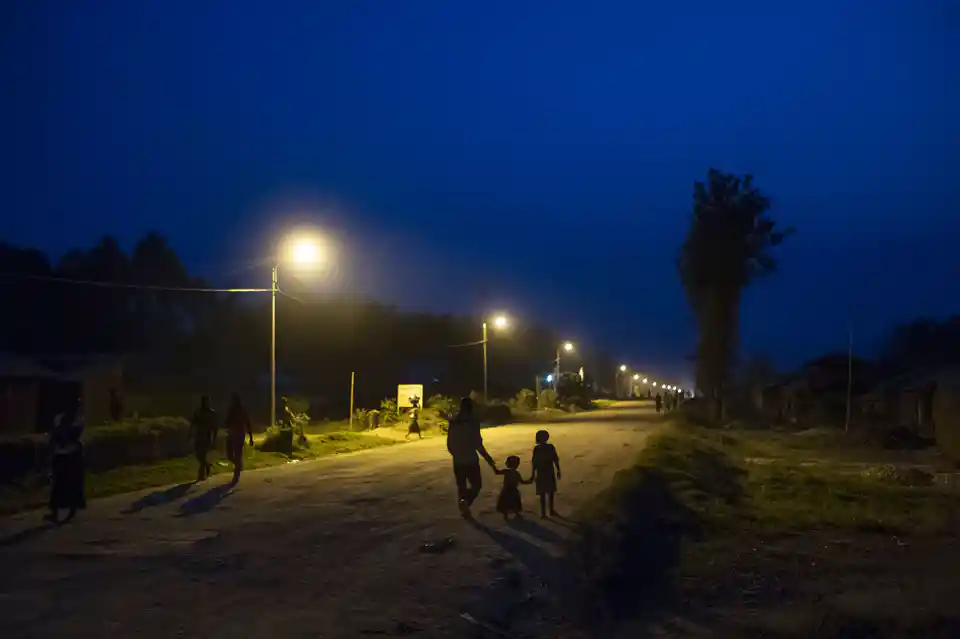
Today’s global energy inequities are staggering.
Video gamers in California consume more electricity than entire nations. The average Tanzanian used only one-sixth the electricity consumed by a typical American refrigerator in 2014.
Globally, the top 10% of countries consume 20 times more energy than the bottom 10%. And 1.1 billion sub-Saharan Africans share the same amount of power generation capacity as Germany’s 83 million people. At least half have no access to electricity at all.



These stark energy inequalities are fueling thorny debates around financing Africa’s energy future as world leaders and their negotiators prepare for COP26, the United Nations climate conference in Glasgow, Scotland, in November.
One increasingly common theme from wealthy countries – including those responsible for the majority of greenhouse gas emissions over time– is a vow that they will cease public funding for all (or nearly all) fossil fuel projects in less developed countries, even as they continuefinancing, and in many cases heavilysubsidizing, fossil fuels in their own.
It is generally easier for countries that offer overseas development finance for energy projects to make low-carbon rules for others, rather than for themselves. For example, China, Japan and South Korea – some of the world’s highest coal-consuming nations – have each recently pledged to stop funding coal projects overseas and increase investments in renewables. But they have made no equivalent commitments at home.
The U.S. Treasury and the United Kingdom’s development finance institution, CDC Group, have taken a more nuanced approach. They are limiting all coal and oil-based power generation projects and leaving a narrowwindow available for natural gas projects in poor countries that pass a rigorous screening process. This is roughly similar to the approach of the World Bank.
As experienced clean energy policy researchers, we believe the blunt exclusion of all nonrenewable energy projects from development finance is an inequitable and ineffective climate strategy that gaslights over 1 billion Africans.
Tiny climate gains, major development losses
Focusing on limiting the emissions of the world’s poorest countries while emissions continue to rise in industrialized countries is clearly misdirected in our view. Given stark inequalities in energy use and emissions, this could instead entrench poverty and widen inequality induced by worsening climate change, while simultaneously accomplishing very little to reduce global greenhouse gas emissions.
Together, the U.S., U.K., European Union, Japan and Russia have almost the same population – 1.1 billion people – as sub-Saharan Africa, but 35 times more gas-fired power plants in operation or under development, and 52 timesmore coal plants.
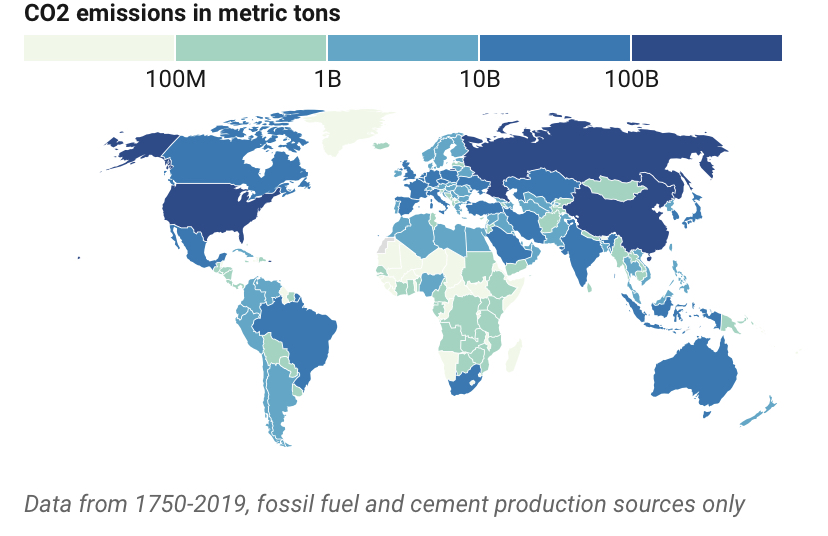
When it comes to carbon dioxide emissions, sub-Saharan Africa is collectively responsible for barely half a percent of all global emissions over time, while the U.S., U.K., E.U., Japan and Russia are responsible for more than 100 times that amount, or about 57%.
The largest carbon dioxide emitters over time
Adding up all carbon dioxide emissions from fossil fuels and cement production over time, the U.S., China and Russia have emitted the most by far, the majority of it in the past 50 years.CO2 emissions in metric
It has been clear for decades that the world needs to rapidly and aggressively cut its greenhouse gas emissions to keep global warming below 1.5 degrees Celsius and avoid the worst impacts of climate change. Many regions in Africa, including the Sahel and Mozambique, are already facing the effects of climate change, including worsening droughts, food insecurity and severe storms. Adapting to climate change and building resilience requires the very energy, economic development and infrastructure currently lacking in some of the most affected regions and those least prepared to adapt.
Climate colonialism and legacies of colonization
Other experts agree that this direction of climate policy is not just ineffective, it’s rootedin the historic inequities of colonialism.
The philosopher Olúfẹ́mi O. Táíwò defines climate colonialism as the “deepening or expansion of foreign domination through climate initiatives that exploits poorer nations’ resources or otherwise compromises their sovereignty.”
Colonialism’s legacy is a contributing factor to a wide range of issues, from conflict to corruption, and to the poor state of electricity access across much of Africa today.
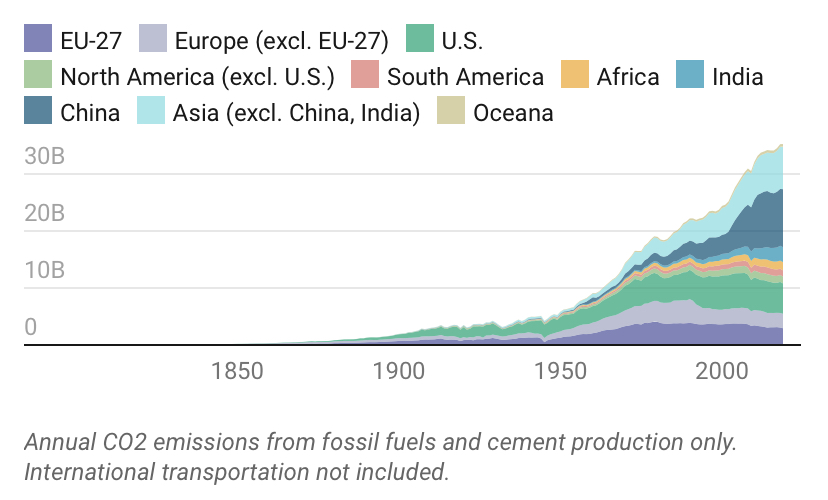
How annual carbon emissions grew over the past 200 years
Europe and North America dominated global annual carbon dioxide emissions for most of the past 200 years. Today, Asia is the largest source.
It has been clear for decades that the world needs to rapidly and aggressively cut its greenhouse gas emissions to keep global warming below 1.5 degrees Celsius and avoid the worst impacts of climate change. Many regions in Africa, including the Sahel and Mozambique, are already facing the effects of climate change, including worsening droughts, food insecurity and severe storms. Adapting to climate change and building resilience requires the very energy, economic development and infrastructure currently lacking in some of the most affected regions and those least prepared to adapt.

Climate colonialism and legacies of colonization
Other experts agree that this direction of climate policy is not just ineffective, it’s rootedin the historic inequities of colonialism.
The philosopher Olúfẹ́mi O. Táíwò defines climate colonialism as the “deepening or expansion of foreign domination through climate initiatives that exploits poorer nations’ resources or otherwise compromises their sovereignty.”
Colonialism’s legacy is a contributing factor to a wide range of issues, from conflict to corruption, and to the poor state of electricity access across much of Africa today.

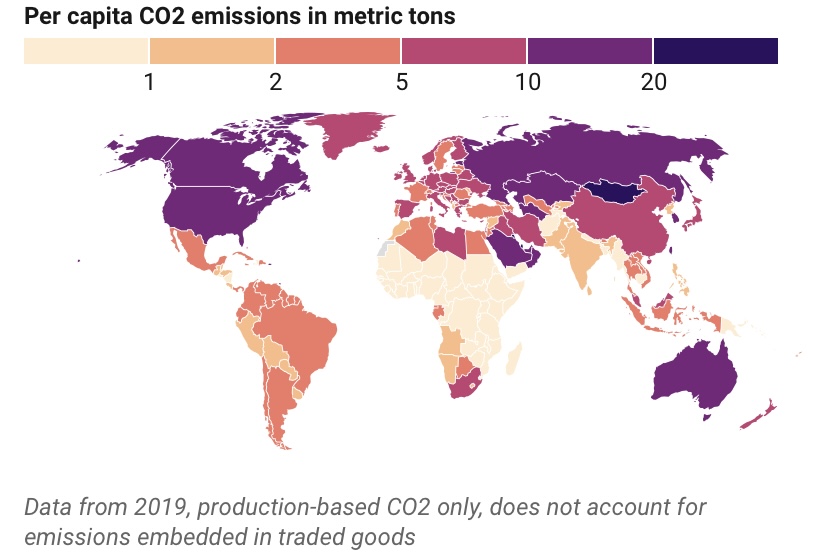
Annual carbon dioxide emissions produced per capita
Africa produced about 1.1 metric tons of climate-warming carbon dioxide emissions per person in 2019, well below the global average of 4.7. The U.S. produced 16.1 metric tons per capita.
While industrializing nations in the 1900s were building electricity grids through massive public spending campaigns, like Franklin Roosevelt’s New Deal in the United States and the Electricity Supply Act of 1926 in the U.K., most of Africa was being actively pilfered of its rich natural resources. Much of the infrastructure built in colonial Africa during that time was built only to facilitate resource extraction operations, such as mined commodities, oil, timber, rubber, tea, coffee and spices.
In 1992, a coalition of low-income nations successfully advocated for the U.N.‘s climate mitigation pathways to include their right to development, and a “common but differentiated responsibility” to address the dual problems of development and climate change. This language has long been the basis of equity considerations in climate policy, including in the 2015 Paris Agreement, which expects deeper emissions cuts from developed countries based on their “respective capabilities”.
A transition from what?
Nigerian Vice President Yemi Osinbajo recently described “energy transition” as “a curious term” when applied universally, given the energy shortfalls in countries like Nigeria. He has argued for an energy transition in which Africa can develop quickly and grow. Increasing electricity in industrializing regions of sub-Saharan Africa would first power income-generating activities and public services, both drivers of economic growth.
Equitable and effective climate negotiations will require nuanced policy considerations that balance the priorities of alleviating energy poverty with urgent climate change mitigation and adaptation. A just energy transition would leave African governments to make and implement policies and deliver on their own national climate commitments under the Paris Agreement rather than shouldering the West’s.