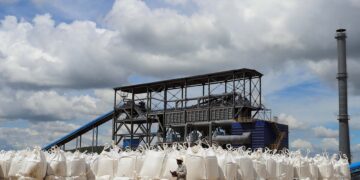
Zimbabwe has suspended the export of raw minerals and lithium concentrates in a move the government states is intended to strengthen domestic beneficiation, enhance regulatory oversight, and retain greater value within the national economy. The decision, announced on 25 February 2026 by Mines and Mining Development Minister Polite Kambamura, was reported by Xinhua and subsequently covered by regional and international media including Al Jazeera and Bloomberg.
In a ministerial statement, Kambamura indicated that the suspension applies without exception and is binding on the Zimbabwe Revenue Authority, the Minerals Marketing Corporation of Zimbabwe, and sector regulators. The Ministry of Mines and Mining Development stated that only companies holding valid mining titles and operating approved beneficiation facilities will be authorised to export minerals. The ministry further reserved the right to test consignments to verify mineral composition and warned that the continuation of expired export permits constitutes a serious offence that may result in the withdrawal of both export licences and mining titles. Regulatory details are expected to be clarified following consultations with industry stakeholders through the Ministry of Mines and Mining Development.
Zimbabwe holds substantial deposits of gold, platinum group metals, chrome and lithium. According to the United States Geological Survey, Zimbabwe is among the leading African producers of lithium, a mineral that has become strategically significant in the global energy transition due to its role in battery manufacturing. The mining sector contributes significantly to export earnings and gross domestic product, as noted by the World Bank and the African Development Bank, both of which identify mineral exports as central to Zimbabwe’s external trade profile.




The policy shift aligns with a broader continental discourse on value addition and resource sovereignty. Across Africa, governments have sought to recalibrate extractive frameworks to promote domestic processing, industrialisation and greater fiscal returns. The African Union’s Africa Mining Vision calls for mineral resources to underpin broad based development rather than primarily serving as raw exports. Zimbabwe’s move can be situated within this continental policy environment, where beneficiation is framed not only as an economic strategy but also as a governance and accountability mechanism.
Industry bodies such as the Chamber of Mines of Zimbabwe have previously highlighted both the opportunities and constraints associated with local processing, including capital intensity, power supply reliability and market access. Analysts note that beneficiation policies require complementary investments in energy infrastructure, transport logistics and technical capacity to achieve sustainable outcomes. In this context, the government’s emphasis on compliance and verification suggests an attempt to consolidate regulatory oversight alongside industrial policy objectives.
International coverage has reflected a range of perspectives. While some reporting has focused on potential short term supply implications for global lithium markets, regional commentary has emphasised the domestic rationale of maximising value retention and strengthening accountability within the extractive sector. Zimbabwe has previously restricted the export of unprocessed lithium ore in 2022, signalling a phased approach to tightening controls over mineral exports. The current suspension extends that logic to a wider category of raw minerals and concentrates.
The long term impact of the measure will depend on implementation, industry adaptation and the pace at which domestic processing capacity can be expanded. For Zimbabwe and for the wider Southern African region, the development underscores ongoing efforts to reposition mineral wealth within national development strategies, while navigating global demand dynamics and investment considerations. As debates on critical minerals intensify, African producers continue to articulate approaches that seek to balance participation in global markets with aspirations for structural transformation at home.