Global markets are used to a familiar Zimbabwe story. It is the archetype of policy failure, hyperinflation and international isolation. Less familiar, but increasingly important for investors and policymakers, is how Harare is now trying to rewrite that narrative. The method is not spectacular policy announcements or ideological theatrics. It is restraint.
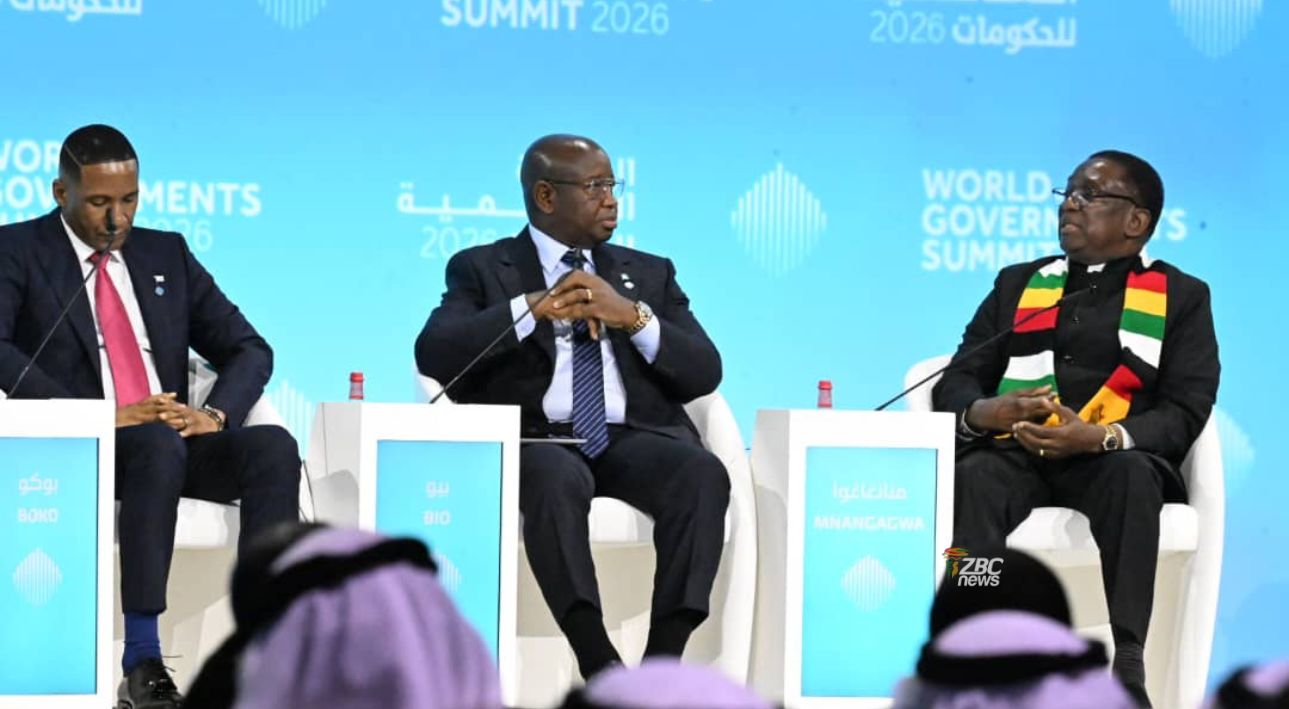
That restraint was on display at the World Governments Summit in Dubai on 5 and 6 February 2026. On day one, as heads of state and global executives gathered to discuss governance in an era of fragmentation, Zimbabwe’s President Emmerson Mnangagwa joined a panel on leadership in a world of competing blocs. During the session he was pressed to comment on the political crisis in Venezuela. The question sounded like an inquiry into Latin American affairs. In reality, it functioned as a test of alignment at a moment when United States influence is openly contested by a more assertive Global South.
Mnangagwa refused to supply the expected soundbite. He pointed to Zimbabwe’s geographical and political distance from Caracas. He referred to the limits of second hand information and to the risk of judging complex domestic disputes from afar. He declined both condemnation and endorsement. For commentators hoping for a headline, the answer was underwhelming. For diplomats and investors watching Harare’s external posture, it was entirely consistent.



For a small, heavily sanctioned economy seeking re‑entry into international capital markets, flamboyant alignment is a luxury. Zimbabwe has learnt over two decades that rhetorical defiance carries a balance sheet cost. Targeted United States and European Union measures, combined with arrears to multilateral lenders and a reputation for policy volatility, pushed the country to the margins of global finance. Access to long term credit dried up. Foreign direct investment became sporadic and clustered in a few extractive and enclave sectors. Sovereign risk premia soared. A country that once aspired to be a regional breadbasket became a case study in how political choices reshape financial possibilities.
Harare’s current strategy is to lower those premia, not through abrupt capitulation but through predictability. It is staying out of distant conflicts. It is moderating its public tone. It is quietly negotiating around the most explosive legacy issue in its modern history. That issue is land.
For two decades, international coverage of Zimbabwe’s fast track land reform has been dominated by images of chaotic farm occupations and collapsing commercial agriculture. That story was not invented. The early 2000s were indeed brutal and economically costly. Exports fell and formal sector jobs evaporated. Yet it is no longer the whole story. Global investors and analysts who continue to treat it as the only story may now be mispricing both risk and opportunity.
A substantial body of peer reviewed research has emerged that complicates the conventional wisdom. Scholars such as Ian Scoones and his colleagues, through detailed longitudinal work on resettled areas, have shown that some beneficiaries, particularly smallholder farmers in A1 schemes, have stabilised production over time. They have invested in boreholes and small scale irrigation. They have diversified crops into tobacco, maize and horticulture. In several districts, output has recovered to levels that compare reasonably with late colonial and early independence benchmarks, although with far more people directly engaged in production and without the same levels of large scale capital. The picture is uneven and constrained by access to credit and inputs, but it is not the image of permanent collapse often assumed in distant capitals.
Political economists such as Jason Hickel have gone further and located Zimbabwe’s land struggle within a longer history of colonial dispossession and asymmetric global economic rules. They argue that questions of property and redistribution in post colonial states cannot be analysed as if they were technical anomalies. Instead, they are part of a wider confrontation with a global order that has historically protected certain property claims while ignoring others. In this reading, Zimbabwe’s land reform is both a national policy and a challenge to the way in which international law, investment treaties and financial conditionality have been used to entrench inherited distributions of wealth.
These studies do not romanticise the process. They do not deny the macroeconomic damage inflicted by the manner and timing of reform. They acknowledge the violence, the policy inconsistency and the loss of export earnings. What they do challenge is the reflex assumption, common in Western policy circles and in some financial commentary, that land reform was an unmitigated economic catastrophe with no plausible developmental upside. They also expose a moral asymmetry. Investors insist, correctly, on security of property rights. Yet there has been far less appetite in global debates to confront how many of those rights were first acquired, and whose dispossession underwrote the creation of commercial agriculture in the first place.
It is against this backdrop that Zimbabwe’s current land settlement with white former commercial farmers needs to be understood. Harare has agreed, in principle, to compensate dispossessed farmers for improvements on the land, in line with its constitutional obligations. Crucially, this is not a reversal of land reform. The land itself is not being returned. The state accepts that abrupt expropriation without compensation for fixed investments created a liability. Negotiations involving the government, farmers’ representatives and international partners are exploring how that liability can be structured and financed over time without overwhelming an already constrained fiscus and without reopening settled questions of ownership.
From a narrow balance sheet perspective, this looks like another contingent claim on a stressed sovereign. From a broader political economy perspective, it is a necessary step towards normalising relations with multilateral lenders and Western governments, while signalling to current and future investors that Harare is prepared to honour negotiated obligations. For pan‑African observers, it is also a test case. Can a post colonial state defend redistributive justice and at the same time embed credible, forward looking property rights. Can it insist that land will not be returned to its previous patterns of ownership while still treating compensation as a serious contractual commitment.

The answer will depend less on the language of press statements and more on the consistency of conduct. That is where Mnangagwa’s outward restraint becomes economically relevant. Zimbabwe has adopted what can be called strategic quietism on divisive global issues. On Ukraine, on the status of Taiwan, on contested security questions in the Indo‑Pacific, Harare has largely avoided dramatic public positions. It has preferred general affirmations of sovereignty, dialogue and non interference. It has resisted being drawn into anti China or anti Russia rhetoric championed by some Western capitals. It has equally avoided the kind of anti American grandstanding that once delighted anti imperialist audiences.
This is not principled pacifism. It is a hedging strategy by a state conscious of how quickly today’s applause can turn into tomorrow’s sanctions list. In a world where geopolitical risk is increasingly priced into spreads on emerging market debt, avoiding the perception of being a proxy for any single bloc has become a form of risk management. For Bloomberg’s readers, the key question is not whether Zimbabwe’s foreign policy is morally satisfying. It is whether that posture is reducing or exacerbating macro financial risk.
Three dynamics are central here. First, sanctions are no longer being debated only in Washington and Brussels. They are being contested in African and multilateral forums as instruments that can entrench rather than correct economic fragility. A de‑westernising narrative has gained force. African policymakers and scholars argue that punitive measures often fall heaviest on ordinary citizens and complicate the very governance reforms they are supposed to incentivise. Zimbabwe has become Exhibit A in these arguments. Even critics of the ruling party concede that a permanently sanctioned, cash starved state is less likely, not more likely, to deliver inclusive growth or institutional strengthening.
Second, the intellectual climate around land and development has shifted in subtle but important ways. Research that foregrounds structural inequality, historical dispossession and global value chains has eroded the confidence with which some commentators once dismissed redistributive programmes outright. This does not mean land reform as implemented in Zimbabwe is now being celebrated. It does mean that blanket calls for reversal have given way, in serious academic and policy circles, to more nuanced questions. How can an irreversible reality be made to work better. How can tenure security be improved for smallholders who now occupy the land. How can compensation obligations be met without derailing macroeconomic stabilisation. For investors, that evolution matters. A state that feels its foundational redistributive act is at least partially recognised as legitimate is more likely to compromise on the modalities of compensation, tenure and investment frameworks.
Third, there is a growing recognition among non Western creditors, notably China and some Gulf states, that permanent association with pariah status carries reputational and financial costs. These partners do not share Western conditionality on human rights. They do, however, value stability, repayment and predictability. Quiet encouragement of Harare’s re‑engagement with the International Monetary Fund and the World Bank, and support for structured compensation mechanisms, aligns their interests with those of traditional Western lenders more than ideological rhetoric might suggest. A Zimbabwe that is partially normalised is easier to finance and less likely to seek short term relief through disruptive policy shifts.
All of this creates an opportunity for Zimbabwe if it can maintain policy discipline. Strategic silence is not enough. It must be matched by incremental but observable reforms. A clearer, bankable land tenure regime is needed so that both smallholders and larger investors can use land as collateral with confidence. Public finances must become more transparent and quasi fiscal activities more contained. The monetary framework must avoid the cycles of abrupt currency reconfiguration that have plagued the last decade. Credible commitments on election management and basic civil liberties remain essential, not simply as Western talking points but as domestic foundations for a predictable policy environment.
For investors, the analytical challenge is to see beyond old caricatures without discarding legitimate concerns. Zimbabwe remains a high risk environment. It carries the memory of abrupt policy reversals, contested elections and institutionalised patronage. Yet it is not frozen in the conditions of 2008. A de‑westernised reading of its trajectory, one that takes seriously African scholarship on land, acknowledges the politics of sanctions and recognises Harare’s attempt to move from theatrical resistance to negotiated normalisation, may produce a more accurate risk assessment than one based solely on familiar Western narratives.
Mnangagwa’s cautious comments in Dubai on 5 February did not move any index on their own. They did, however, illuminate a broader recalibration. The leadership is stepping away from applause lines that once played well in anti imperialist forums and turning, slowly and unevenly, towards a quieter engagement with the very institutions and governments that long cast Zimbabwe as an outlier. It is seeking to lock in the political gains of land redistribution while shedding the financial penalties that followed it.
Extending that credibility will not be easy. It will involve accepting scrutiny from institutions many Zimbabweans still view with suspicion, while insisting that future engagement does not recreate old hierarchies. It will demand a domestic conversation about accountability that is not driven solely by external pressure, but by the expectations of citizens who have borne the brunt of economic adjustment. It will require the government to treat research on land, from Scoones, Hickel and a range of African scholars, not as ideological cover but as a resource for designing policies that deepen equity and productivity at the same time.
If Harare can sustain that delicate balance, markets will eventually have to update their priors. The country will still be risky, but the nature of that risk will be different. It will be less about sudden geopolitical rupture and more about the slower, more measurable work of institutional reform. For investors prepared to do the intellectual work of de‑westernising their analysis without abandoning rigour, Zimbabwe may become less of an anomaly and more of a bellwether. It will test whether a post colonial state can insist on the legitimacy of its own redistributive choices and still be treated as a serious counterpart in global finance.

In that sense, the muted exchange on Venezuela in Dubai matters. It marks the distance between performance and policy. It suggests that for Zimbabwe, the route back to international financial respectability does not run through televised confrontation. It runs through the quieter, harder and ultimately more consequential tasks of honouring agreements, stabilising institutions and persuading sceptical audiences that strategic restraint is not a mask for paralysis. It is the price of being taken seriously in a world where applause is fleeting but reputation, and the risk premia that flow from it, endure.
The views expressed in this article are those of the writer and do not necessarily reflect those of this publication.