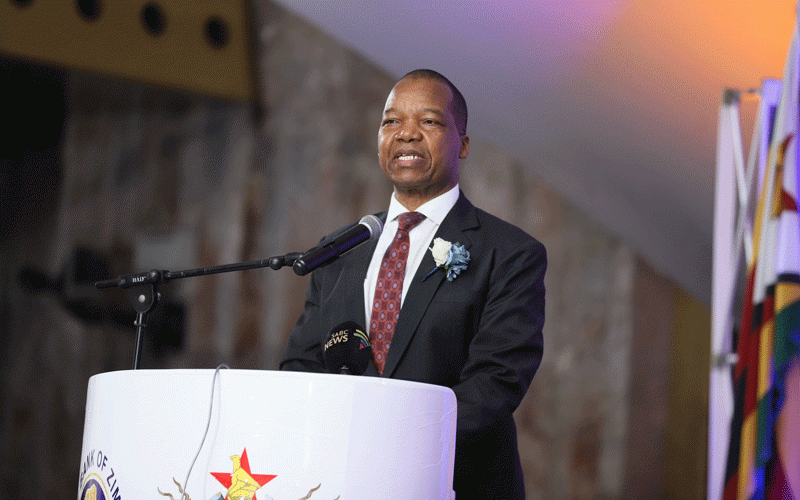
Zimbabwe’s Mutapa Investment Fund (MIF), the state-owned investment vehicle managing some of the country’s largest public enterprises, is undergoing a significant transition aimed at improving transparency, efficiency, and investor confidence. The fund’s 2024 Annual Report, released in December, outlines steady asset growth, portfolio restructuring, and a renewed focus on governance as the government seeks to reposition MIF as a credible instrument of national investment policy.
Originally established in 2014 as the Sovereign Wealth Fund of Zimbabwe, the entity was restructured under Statutory Instrument 156 of 2023 and rebranded as the Mutapa Investment Fund. It now serves as the central holding company for more than twenty-five state-owned enterprises, including utilities, mining companies, transport entities, and telecommunications providers. According to the 2024 report, the fund’s primary goal is the professional management of public assets to deliver long-term value while contributing to Zimbabwe’s broader economic goals under Vision 2030.
Despite operating in a challenging economic environment, MIF reported a 22 per cent increase in total portfolio value and an operating surplus of ZWL 425 billion. The performance was driven largely by improved valuations in mining and energy assets, particularly through its stakes in Hwange Colliery, ZESA Holdings, and Kuvimba Mining House. The introduction of the Zimbabwe Gold (ZiG) currency also contributed to more stable reporting and valuation adjustments. The fund’s leadership noted that these results were achieved through restructuring, better risk management, and the introduction of a performance monitoring framework across all subsidiaries.



The government’s reforms have also altered the Fund’s statutory purpose. Policy amendments passed in late 2024 repealed parts of the original Sovereign Wealth Fund Act, shifting emphasis from fiscal savings toward developmental and commercial investment. The IMF’s 2025 Data Quality Assessment Mission acknowledged that this consolidation of public assets had improved fiscal reporting and strengthened oversight of quasi-fiscal activities. However, the IMF advised the authorities to ensure greater operational independence for MIF and to enhance disclosure on investment valuations and liabilities.
Independent researchers have taken a similarly balanced view. In their 2025 study, Understanding the Mutapa Investment Fund of Zimbabwe, economists Moyo, Nyoni, and Chivi highlighted improved strategy and institutional visibility but warned that liquidity and governance challenges remain. A separate analysis by Rius and Andreoni (SOAS University of London, 2025) described the Fund as having moved “from dormant to catalytic,” arguing that Zimbabwe’s model could pioneer a hybrid public-private investment framework for resource-based economies if accountability standards are sustained.
MIF’s holdings span critical sectors of the Zimbabwean economy. In transport, the Fund is overseeing the rehabilitation of the National Railways of Zimbabwe through an $80 million infrastructure bond. In telecommunications, restructuring efforts are underway at Telecel Zimbabwe and NetOne to expand digital infrastructure and reduce operating losses. In agriculture and aviation, both the Grain Marketing Board and Air Zimbabwe are being repositioned under turnaround plans. Collectively, these enterprises accounted for roughly ZWL 1.8 trillion in assets by the end of 2024. The Fund also launched an Energy and Infrastructure Sub-Fund, which has begun financing renewable energy projects valued at approximately US$180 million, supporting Zimbabwe’s transition toward cleaner energy generation.
Nevertheless, questions about governance and accountability persist. Parliamentary committees and civil society organisations have called for clearer disclosure of MIF’s decision-making processes and investment criteria. The Fund has pledged to adopt international reporting standards and to publish audited statements annually in line with International Forum of Sovereign Wealth Funds principles. Commentators such as Manduna (2025) and Benyera (2024) caution that transparency must remain central to the reform process, warning that over-centralisation of state assets could risk inefficiency and political capture if not accompanied by independent oversight.
The Fund’s growing influence has also drawn attention from regional and international observers. According to comparative research by SOAS (2025), MIF now ranks among Africa’s mid-tier sovereign funds by asset base, trailing Nigeria’s NSIA but ahead of Botswana’s Pula Fund in diversification. In 2024, it paid ZWL 1.2 billion in dividends to the Treasury — its first major remittance since restructuring — marking a step toward fiscal contribution and signalling early returns on restructured state assets.
Looking ahead, the Fund plans to issue a Mutapa Infrastructure Bond (MIB 2026) valued at USD 500 million, targeting investors interested in transport, logistics, and energy corridor development across Southern Africa. The proposed bond has already attracted expressions of interest from regional pension funds and Middle Eastern sovereign investors. Market analysts believe that if credit ratings improve and regulatory reforms continue, MIF could become a platform for cross-border infrastructure finance within the SADC region.
Investor sentiment towards Zimbabwe remains mixed. Political uncertainty and currency instability continue to shape perceptions, yet there are signs of cautious optimism. A senior analyst at the African Development Bank told The Southern African Times that “Mutapa reflects a gradual shift toward structured, accountable state investment — the question is whether it can maintain momentum.” For institutional investors, MIF’s emphasis on renewable energy, logistics, and mining beneficiation aligns with long-term regional growth themes and global ESG investment priorities.
The Fund’s performance has also generated interest from diaspora investors, many of whom view Mutapa as a possible conduit for engaging with Zimbabwe’s economy through more structured, asset-backed channels. Whether these expectations translate into consistent inflows will depend largely on macroeconomic stability and continued reform discipline.
In regional context, MIF represents a pragmatic experiment in state capitalism — an attempt to reconcile state ownership with commercial principles. Its evolution offers lessons for other African governments balancing public accountability with investment ambition. Analysts describe the Fund as neither a triumph nor a failure, but an experiment still in motion: its credibility will hinge on whether the early financial gains are matched by sustained transparency and measurable public value.

For UK-based investors and analysts tracking Southern Africa, the Mutapa Investment Fund has become a bellwether for how Zimbabwe’s reform agenda is unfolding in practical terms. Its gradual professionalisation and its cautious engagement with external markets suggest that the country is seeking to rebuild credibility one financial statement at a time. The coming year will test whether MIF can maintain its trajectory of cautious progress — or whether political and structural constraints will slow its ascent.
As Zimbabwe enters 2026, the Fund stands as both symbol and test. If it can demonstrate consistent governance, clear reporting, and tangible returns, it could position itself as one of Africa’s few examples of a successful state-led investment reform. For now, investors are watching closely — hopeful but realistic that Zimbabwe’s modernisation effort remains a work in progress.