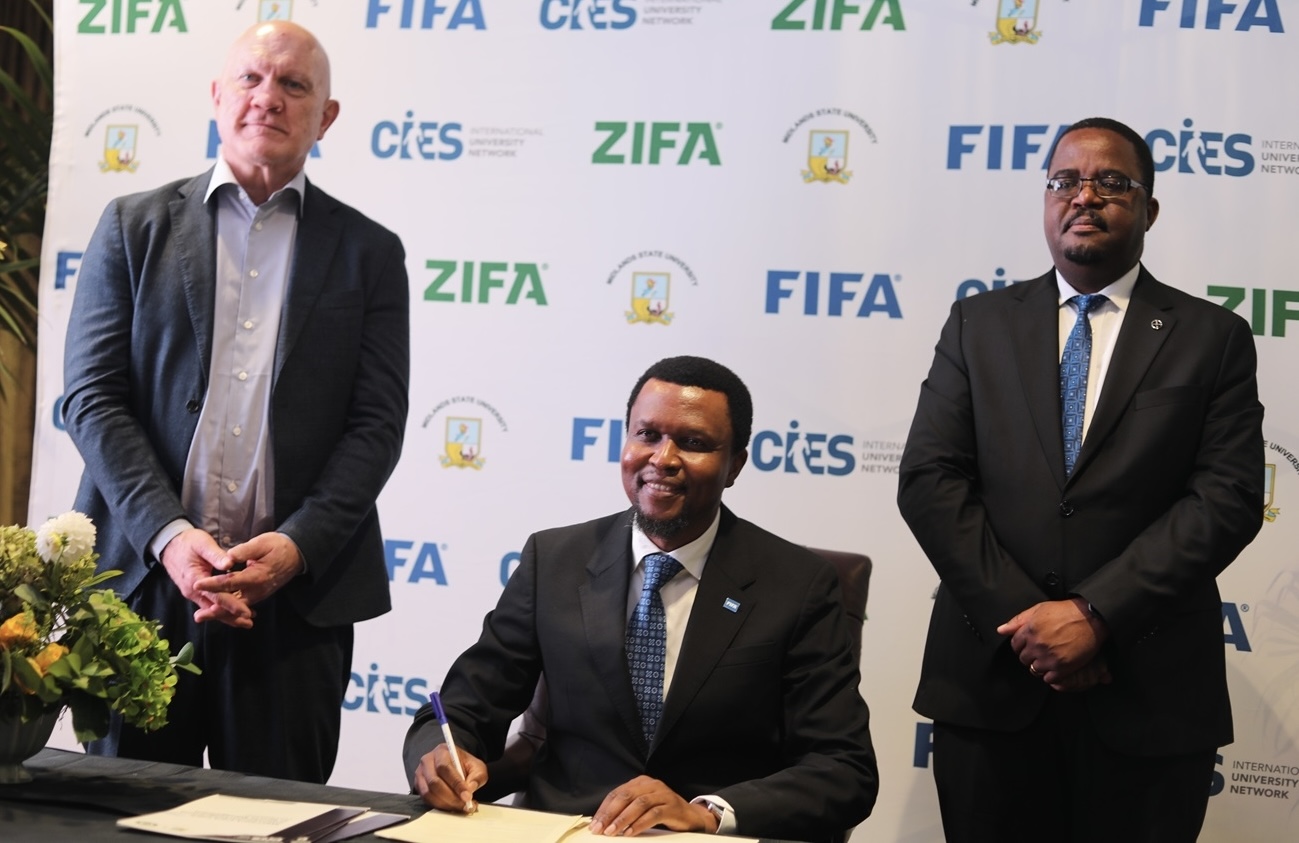
Zimbabwe has formally entered a global framework for professional sports governance following the launch of the FIFA CIES International Programme in Sports Management, an initiative that links national institutions to an international education network shaping the future of sport administration.
The programme, launched on 2 February 2026 in Harare, is delivered through a partnership between Midlands State University, the Zimbabwe Football Association and the International Centre for Sports Studies. It positions Zimbabwe within a worldwide university network supported by FIFA, which aims to professionalise sports management through structured academic training grounded in local institutional contexts.
The launch ceremony drew representatives from government, academia, sport and international football administration, reflecting the increasingly complex ecosystem in which modern sport operates. Among those present were senior officials from the Ministry of Sport, Recreation, Arts and Culture, executives from ZIFA, leadership from Midlands State University and representatives of the FIFA Regional Office for Southern Africa, alongside figures from the Zimbabwe Olympic Committee and the FIFA CIES International University Network.



Speakers consistently emphasised the growing importance of governance, financial oversight and ethical leadership in sport, particularly in emerging and transitional economies where institutions face heightened scrutiny and resource constraints. From this perspective, the programme is positioned not only as a football specific qualification, but as a broader management intervention aimed at strengthening organisational capacity across the sports sector.
ZIFA president Nqobile Magwizi described the initiative as part of a longer term strategy to invest in human capital as a foundation for institutional resilience and competitive credibility within Zimbabwean football. Midlands State University, meanwhile, framed the collaboration as an expression of its commitment to international engagement and applied scholarship, aligning academic rigour with practical challenges faced by sports organisations across Africa and beyond.

The FIFA CIES International Programme, established in 2004, now operates in more than twenty countries across Africa, Asia, Europe and the Americas. Its expansion into Zimbabwe marks the network’s twenty first programme and reflects a shift towards decentralised knowledge production in global sport, where expertise is increasingly cultivated within local institutions rather than imported through short term consultancy or externally imposed governance models.
According to representatives of CIES, the Zimbabwean programme is designed to balance international standards with contextual relevance, equipping participants with analytical, managerial and ethical tools tailored to their operating environments. This approach resonates with wider debates in global sport about sustainability, accountability and the need for governance frameworks that recognise regional realities rather than replicating singular Western templates.
During the launch event, programme directors outlined the curriculum and delivery structure, followed by a discussion involving representatives of all three partner institutions. Former participants from the South African edition of the programme also shared reflections on how the qualification had influenced their professional development, offering comparative insights from within the region.
The first intake of students is scheduled to begin on 20 April 2026, with the programme hosted at Midlands State University’s Harare campus. Further information is available through Midlands State University, ZIFA and CIES.
At a time when sport is increasingly entangled with questions of governance, finance and public trust, Zimbabwe’s inclusion in the FIFA CIES International University Network signals an effort to engage global standards on its own terms. The initiative reflects a broader African trend towards embedding professional education within local institutions, advancing sport as a site of leadership development, institutional learning and long term social investment rather than a purely commercial endeavour.