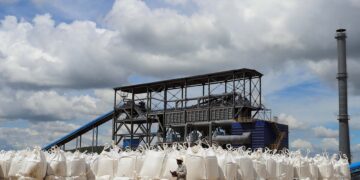
Zambia, the continent’s second largest copper producer after the Democratic Republic of Congo, has reported an 8 percent rise in its annual copper production for 2025. According to official figures released by the Ministry of Mines and Minerals Development, the southern African nation produced 890,346 metric tons of copper during the year. This marks a notable increase from the 825,513 metric tons produced in 2024, reaffirming the sector’s central role in Zambia’s economic framework.
At a press briefing in Lusaka, the capital, Minister of Mines and Minerals Development Paul Kabuswe attributed the rise to stronger output from key mining entities including Mopani Copper Mines, Konkola Copper Mines, and Kansanshi Mine. The increased productivity at these sites, he noted, stems from targeted government interventions aimed at resuscitating mining firms previously burdened by structural inefficiencies and global price volatility.
The minister further underscored that the government’s strategy includes encouraging large scale investments and expanding operational capacity across major mining ventures. According to Kabuswe, these efforts are part of a broader national vision that aims to scale up copper output to three million metric tons annually by 2031. This long term goal reflects the country’s ambition to reposition itself as a key contributor to the global copper supply chain in light of the metal’s increasing demand, particularly in renewable energy technologies and electric vehicles.



Although the copper sector continues to face periodic challenges including fluctuating commodity prices and logistical constraints, the 2025 data reveals a cautiously optimistic trajectory. Analysts observe that this growth is not merely a reflection of external market forces but is also the outcome of renewed confidence in domestic policy frameworks that aim to balance investor interests with local economic development.

Zambia’s mining narrative has historically been characterised by external dependencies and commodity-driven vulnerabilities. However, recent policy recalibrations suggest a nuanced approach that seeks to reframe the industry’s role within a broader development context. This includes improving transparency, enhancing community participation, and fostering a more equitable distribution of resource-generated wealth.
Across the African continent, mineral rich economies are re-evaluating their long term extraction models in response to both global energy transitions and local developmental aspirations. Zambia’s evolving copper trajectory exemplifies a shift away from a singular narrative of resource extraction toward a more integrated vision of national self-determination and regional cooperation. The emphasis on increased production is accompanied by calls for value addition, skills development, and stronger interlinkages with other sectors of the economy.

In aligning its copper ambitions with both national priorities and global sustainability discourses, Zambia may be contributing to a broader reimagining of African resource governance. It is within this evolving landscape that the recent production gains acquire significance not only as industrial metrics but as signals of a more layered and strategic engagement with mineral wealth.