Thursday, July 2, 2026
  • Login
The Southern African Times
  • Home
  • Southern Africa
  • Business
    • African Start ups
    • African Continental Free Trade Area
  • Technology
    • Lifestyle
      • Health
      • Culture
      • Food and Drink
      • Entertainment
  • Opinion
  • Sports
  • SAT Jobs
    • Events
  • About Us
    • Advertise with Us
    • Contact Us
No Result
View All Result
  • Home
  • Southern Africa
  • Business
    • African Start ups
    • African Continental Free Trade Area
  • Technology
    • Lifestyle
      • Health
      • Culture
      • Food and Drink
      • Entertainment
  • Opinion
  • Sports
  • SAT Jobs
    • Events
  • About Us
    • Advertise with Us
    • Contact Us
No Result
View All Result
The Southern African Times
No Result
View All Result
Home Opinion

Vaccine producers must step up

by SAT Reporter
November 8, 2021
in Opinion
0
Vaccine producers must step up

The world stands at a critical juncture of the COVID-19 pandemic. Countries that lack the first round of vaccine coverage are extraordinarily vulnerable to the highly infectious Delta variant, and are also seedbeds for new variants that could quickly spread worldwide. The LancetCOVID-19 Commission, which I chair, is working urgently with the United Nations system to strengthen the multilateral response. Governments of countries where vaccines are being produced – the United States, European Union members, the United Kingdom, India, Russia, and China – need to cooperate under UN leadership to ensure that a sufficient supply of vaccine doses reaches the poorest countries.

The high-income countries now have more than 50 percent of their population fully vaccinated. Yet the fully vaccinated population in Africa remains under 4 percent. This lack of vaccine coverage in Africa, and in low-income countries elsewhere, poses an imminent danger to these populations.

U.S. President Joe Biden has called for a vaccine summit on September 22. This is potentially a highly significant step forward. It is important that the U.S. should hold this meeting in cooperation with China, India, Russia, and the other vaccine-producing countries, and with the UN system. Only the UN, with its universal membership and its operational capacity in low-income countries, has the ability to coordinate the rapid global scale-up of vaccine coverage.


ADVERTISEMENT

In April 2020, the UN created the COVID-19 Vaccine Global Access (COVAX) facility to provide vaccines to lower-income countries. These countries expected COVAX to provide timely deliveries. Yet COVAX has been unable to buy a sufficient volume of vaccine doses mainly because high-income countries have repeatedly cut to the front of the queue. Moreover, the vaccine-producing countries’ governments have imposed export quotas so that COVAX is often unable to secure even the vaccines for which it has contracts. The company shareholders are of course happy with these arrangements, because the rich countries pay more for the doses than COVAX would.

The supply crisis facing low-income countries in Africa and elsewhere will not resolve itself. On the contrary, high-income countries are now beginning to offer a third dose, even before highly vulnerable groups in the poorest countries (the elderly, health workers, the immunocompromised, and others) have received their primary vaccination.

Global opportunities for scaling up vaccine production are also being hampered by some governments’ continued insistence on enforcing the patents on key vaccine technologies, even though these patents are held by academic institutions that were funded by the governments (notably by the U.S. National Institutes of Health). Likewise, public money funded the clinical trials and rollout of the vaccines. Despite the global urgency of the pandemic, life-saving public goods have been privatized.
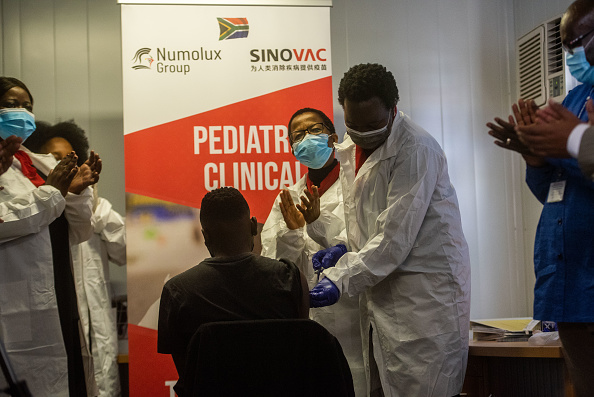
The first child to be vaccinated at MeCRU Clinical Research Unit in South Africa, September 10, 2021. /Getty

The World Health Organization has set minimum targets for vaccine coverage in every country – at least 10 percent of the population by end-September 2021, 40 percent by end-2021, and 70 percent by end-June 2022 – that the current vaccine allocation system will not achieve. At this moment of great global peril, the governments of the vaccine-producing countries should take the following steps:

First, when governments meet this week at Biden’s vaccine summit, they should chart a path to achieve the WHO targets in all countries, including 40 percent of global coverage by the end of this year. The vaccine producers should cooperate fully by disclosing all existing orders (and prices) on their books, so that the UN and governments can prioritize under-served countries.

Second, the UN system, with the full support of governments and companies, should set delivery timelines for every low-income country aligned with the WHO targets. The WHO and COVAX, and other UN agencies such as UNICEF, should work with the recipient countries to scale up the “last-mile” deployment systems for the arrival of the vaccine doses.

Third, the new $650 billion allocation of special drawing rights just approved by the International Monetary Fund should be used, in conjunction with other emergency financial resources, to ensure that short-term financing constraints pose no obstacles to the supply of vaccines.

Fourth, the governments of the vaccine-producing countries should agree, in line with long-standing trade agreements on public health, to waive intellectual property rights and to promote technology sharing in order to increase global vaccine production. Promising vaccines that are now in clinical trials should also be supported with official financing for rapid production and deployment upon regulatory approval.

Lastly, governments in all countries should make clear to the public that the vaccines are not sufficiently effective on their own to suppress the community transmission of the coronavirus. Additional public health measures – including face masks, physical distancing, contact tracing, and limits on indoor gatherings – are still needed.

The bottom line is that we must treat universal vaccine coverage as an urgently needed global public good, not as an eventual outcome of market forces. Biden’s vaccine summit this week can provide the vital breakthrough we need, by empowering the UN with the vaccine doses and finances it needs to ensure immunization for all.

Jeffrey D. Sachs is the Director of the Center for Sustainable Development at Columbia University and President of the UN Sustainable Development Solutions Network.


Previous Post

EMERGING MARKETS-Stocks, FX firm after China data; S.Africa budget eyed

Next Post

COVID-19 response: Shareholder value versus stakeholder interest

SAT Reporter

Related Posts

LONG READ | The Oldest Alibi: South Africa’s Xenophobia and the Economic Ruin It Presages
Opinion

LONG READ | The Oldest Alibi: South Africa’s Xenophobia and the Economic Ruin It Presages

by Times Reporter
June 30, 2026
President Cyril Ramaphosa’s Opinion: How South Africa’s Natural Splendour Can Drive Inclusive Growth
Opinion

Op-Ed by President Ramaphosa | Protest Is Both a Right and a Responsibility

by Times Reporter
June 29, 2026
The Insurance Hack More Drivers Should Know
Opinion

The Insurance Hack More Drivers Should Know

by Times Reporter
June 22, 2026
Southern African Times Announces Brendan Amadi as Recipient of the 2026 Editorial Recognition of the Year Award
The Editorial Board

Southern African Times Announces Brendan Amadi as Recipient of the 2026 Editorial Recognition of the Year Award

by The Editorial Board
June 19, 2026
LONG READ | No Longer the World’s Dustbin: China’s Waste Ban and Africa’s Circular Economy Moment
Opinion

LONG READ | No Longer the World’s Dustbin: China’s Waste Ban and Africa’s Circular Economy Moment

by Times Reporter
June 12, 2026
Next Post
COVID-19 response: Shareholder value versus stakeholder interest

COVID-19 response: Shareholder value versus stakeholder interest

Browse by Category

  • Africa AI
  • African Continental Free Trade Area
  • African Debt
  • African Start ups
  • Agriculture
  • AI Africa
  • Algeria
  • All News
  • Analysis
  • Angola
  • Arts / Culture
  • Asia
  • Botswana
  • BOTSWANA
  • BREAKING NEWS
  • BRICS
  • Burkina Faso
  • Burundi
  • Business
  • Business
  • Business Wire
  • Cameroon
  • Central Africa
  • Chad
  • China
  • Climate Change
  • Climate Changev
  • Community
  • Congo Republic
  • Conservation
  • Côte d’Ivoire
  • COVID 19
  • CRYPTOCURRENCY
  • Culture
  • Democratic Republic of Congo
  • Diplomacy
  • Eastern Africa
  • Economic Development
  • Economy
  • Education
  • Egypt
  • Elections 2024
  • Energy
  • Entertainment
  • Environment
  • Eritrea
  • Ethiopia
  • Europe
  • Fashion
  • Feature
  • Finance
  • Financial Inclusion
  • Food
  • Food and Drink
  • Foods
  • GABON
  • Ghana
  • Global
  • Global Africa
  • Guinea
  • Health
  • Humanitarian Aid
  • Immigration
  • in Southern Africa
  • International news
  • International Relations
  • Investment
  • Ivory Coast
  • Just In
  • Kenya
  • Lesotho
  • Libya
  • Life Style
  • Lifestyle
  • Literature
  • Malawi
  • Malawi
  • Mali
  • Markets
  • Mauritius
  • Middle East
  • Mining in Africa
  • Morocco
  • Mozambique
  • Namibia
  • Niger
  • niger
  • Nigeria
  • North Africa
  • North-Eastern Africa
  • Obituaries
  • Obituary
  • Opinion
  • PARTNER CONTENT
  • Politics
  • Property
  • Racism
  • Rwanda
  • Rwanda
  • SADC
  • SAT Interviews
  • SAT Investigation
  • SAT Jobs
  • Saudi Arabia
  • Senegal
  • Seychelles
  • Somaliland
  • South Africa
  • South Sudan
  • Sports
  • Startup Africa
  • STOCK EXCHANGE
  • Sudan
  • Sustainability
  • Sustainablity
  • Tanzania
  • Technology
  • Telecommunications
  • The Editorial Board
  • The Power Of She
  • Togo
  • Trade
  • Travel
  • Travel
  • Tunisia
  • Uganda
  • Uncategorized
  • Wealth
  • West Africa
  • World
  • World
  • ZAMBIA
  • Zambia
  • ZIMBABWE
  • Zimbabwe

Browse by Tags

#NewsUpdate #SouthAfrica #SouthernAfricanTimes #TheSouthernAfricanTimes AfCFTA africa African Continental Free Trade Area African development African Development Bank African economies African economy African Union Agriculture Angola Botswana China Climate change critical minerals Cyril Ramaphosa Economic Development economic growth energy transition governance industrialisation Inflation Infrastructure Infrastructure Development International relations Investment Kenya Mozambique Namibia news Nigeria Regional Integration renewable energy Rwanda SADC South Africa Southern Africa sustainable development Tanzania United States Zambia Zimbabwe
ADVERTISEMENT

WHO WE ARE

The Southern African Times is a regional bloc digital newspaper that covers Southern African and world news. The paper also gives a nuanced analysis on news and covers a wide range of reporting which include sports, entertainment, foreign affairs, arts and culture.

Welcome Back!

Login to your account below

Forgotten Password?

Retrieve your password

Please enter your username or email address to reset your password.

Log In
  • Home
  • Southern Africa
  • Business
    • African Start ups
    • African Continental Free Trade Area
  • Technology
    • Lifestyle
      • Health
      • Culture
      • Food and Drink
      • Entertainment
  • Opinion
  • Sports
  • SAT Jobs
    • Events
  • About Us
    • Advertise with Us
    • Contact Us
Not enough quota to unlock this post
Unlock left : 0
Are you sure want to cancel subscription?