

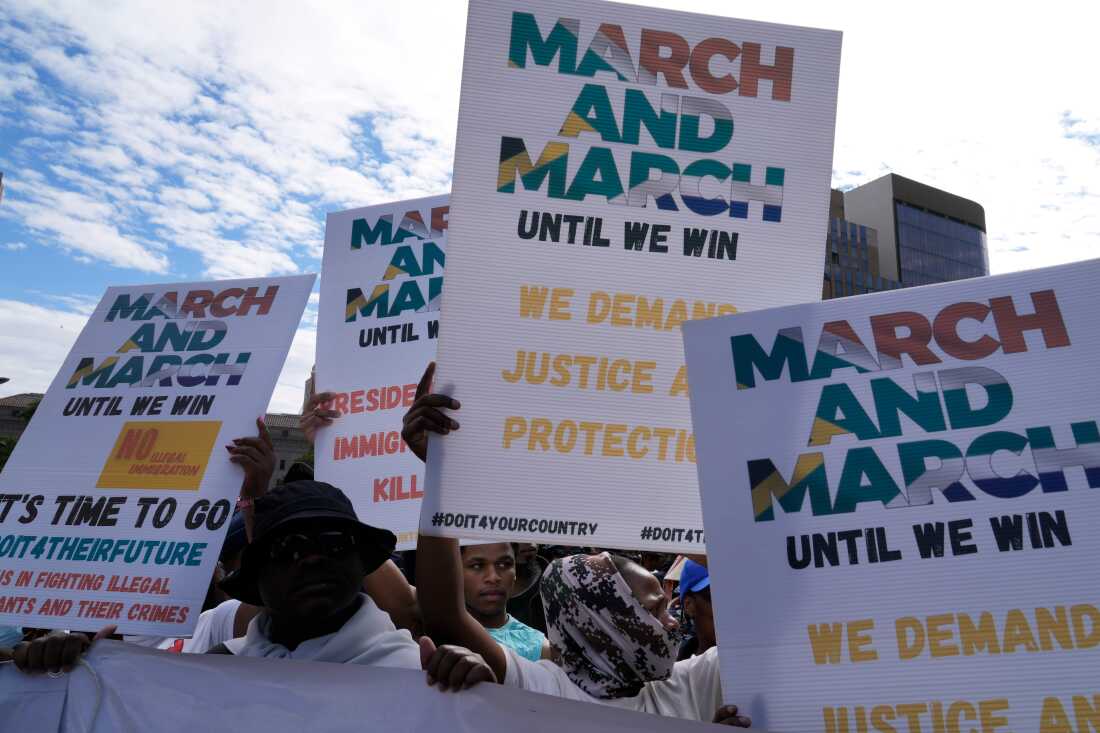
Today is the 30th of June 2026. By the calendar of the vigilante organisation that styles itself March and March, it is a terminus. All undocumented immigrants in South Africa, they proclaimed, must be gone by today. The South African government has declared the deadline legally void, which is constitutionally accurate and, given the violence already visited upon thousands of African nationals since April, politically insufficient.
What unfolds in the days to follow will matter far beyond the immediate question of individual safety, however urgent that question already is. It will bear upon the institutional credibility of the continent’s most commercially significant economy, upon the structural viability of the African Continental Free Trade Area, and upon whether Africa’s integration narrative, the most compelling long-term investment thesis available to the global allocator, can withstand the centrifugal pressures of domestic political opportunism. It will also provide yet another data point in one of the oldest and most reliably self-defeating calculations in the lexicon of political economy: the proposition that expelling the foreigner will cure the ailments the foreigner did not cause.
The intellectual architecture of this proposition has been comprehensively dismantled, across centuries and jurisdictions, and yet it retains its political potency precisely because it requires nothing of its adherents beyond a willingness to substitute grievance for analysis. Hannah Arendt, in “The Origins of Totalitarianism,” identified the manufacture of a pariah class as among the most dependable instruments available to a political order under structural strain: the dispossessed are offered the consolation of a target more proximate and more vulnerable than the system that dispossessed them. Post-apartheid South Africa is not Weimar Germany, and the comparison should not be pressed beyond its utility. But the underlying mechanism is recognisable, and so is its trajectory.



The historical record, when examined with any seriousness, is unsparing. In August 1972, President Idi Amin Dada of Uganda issued his expulsion decree against the country’s Asian community, some 80,000 people, granting them ninety days to depart and denouncing them as “bloodsuckers” who had been “sabotaging Uganda’s economy and encouraging corruption.” He framed the exercise, with a rhetorical flourish that will be familiar to any observer of current South African events, as “giving Uganda back to ethnic Ugandans.” The Asian community, though representing a small minority of the population, controlled the overwhelming preponderance of Uganda’s commercial and industrial infrastructure. The consequences of their departure were unambiguous and catastrophic. Between 1972 and 1975, GDP contracted by 5 per cent. Manufacturing output fell from 740 million Ugandan shillings in 1972 to 254 million by 1979. The real value of wages and salaries collapsed by 90 per cent within a decade. The businesses were not redistributed into prosperity; they were driven into ruin. Uganda spent subsequent decades attempting to persuade the expelled community to return.
Three centuries earlier, on the 22nd of October 1685, Louis XIV of France signed the Edict of Fontainebleau, revoking the protections that had been guaranteed to French Protestants, the Huguenots, under the Edict of Nantes. Somewhere between 200,000 and 400,000 of them fled, carrying with them the skills, capital, and commercial networks that had sustained France’s most productive industries. Contemporary observers were acutely aware of what was being squandered. The renowned French military engineer Sébastien Vauban wrote a memorandum in 1688 lamenting that the exile of the Huguenots had weakened France because they had carried with them millions of livres in capital and accelerated the ruin of French trade. His contemporaries described a nation “bleeding talent from every vein.” The beneficiaries were unambiguous. England received weavers and financiers. Prussia, under Frederick William, issued the Edict of Potsdam and welcomed Huguenot craftsmen whose expertise proved foundational to the Hohenzollern state’s industrial modernisation. The Cambridge Economic History of Europe records that no one has ever seriously disputed the enormous and decisive gains that accrued to the northern Netherlands, England, and Prussia from the immigration of skilled Huguenot refugees. France gained a generation of religious conformity. Its competitors gained the capacity for economic modernity.
These are not merely antiquarian curiosities. They are the operational precedents of a policy that is now being rehearsed, in attenuated form, across a swathe of the democratic world, and which is gaining renewed traction in South Africa at precisely the moment when its consequences are most consequential.
The global conjuncture is worth acknowledging directly. The Trump administration’s mass deportation programme and systematic ICE raids of 2025 and 2026, which triggered civil protests across the United States and drew condemnation from human rights bodies, were premised on the same structural logic that animates March and March: that the removal of the undocumented worker will restore the native-born labourer to a condition of security and sufficiency. The American agricultural sector, care economy, and hospitality industry are providing an empirical refutation of that thesis in real time. In Germany, the Alternative für Deutschland’s second-place finish in the 2025 federal election, built upon a nativist platform that frames migration as an existential cultural and economic threat, has succeeded in mainstreaming a discourse once confined to the farthest periphery of respectable political exchange. In France, the consolidation of the National Rally under Marine Le Pen, demonstrated by the parliamentary gains of the 2024 snap elections, signals that this is not a cyclical aberration but a durable reconfiguration of the political landscape. In the United Kingdom, the hostile environment architecture, that deliberately dehumanising bureaucratic regime designed to render immigrant life so intolerable that departure becomes preferable to endurance, produced labour shortages in the National Health Service, agricultural sector, and logistics industry that continue to preoccupy policymakers who championed its creation. The Cambridge historian David Edgerton has argued that what these movements share is not economic analysis but a form of nostalgic sovereigntism, the conviction that national greatness was lost when it was opened and can be recovered when it is closed. The empirical record, across every jurisdiction in which the experiment has been conducted, tells a different story.
In South Africa’s particular case, that record is available, meticulously compiled, and systematically ignored. A joint investigation by the OECD and the International Labour Organisation established that immigrant workers contribute between 8.9 and 9.1 per cent of the country’s gross domestic product and may raise income per capita by up to 5 per cent. Statistics South Africa’s March 2026 migration report confirmed that migrant-headed households generate in excess of R433 billion in annual economic activity, the overwhelming majority of it derived from formal labour income. As regards the central political allegation, that immigrants are responsible for South Africa’s catastrophically elevated crime levels, the prison population data is instructive in its clarity: foreign nationals, constituting roughly 4 to 7 per cent of the resident population, are represented in the country’s correctional facilities at a proportion below that demographic share. South Africa’s crime pathologies are endogenous and deep-rooted, the cumulative product of spatial inequality, the material residue of apartheid’s social engineering, and decades of inadequate policing and prosecutorial capacity. No Zimbabwean spaza owner and no Malawian construction worker created those conditions. No march, however large and however well-organised, will dissolve them by removing either.
Frantz Fanon, in “The Wretched of the Earth,” diagnosed with clinical lucidity the tendency of post-colonial societies under economic duress to invert their legitimate grievances, to redirect the energy of dispossession horizontally, against the proximate neighbour, rather than vertically, against the structural systems that perpetuate immiseration. The anger circulating in South Africa’s streets is, in significant measure, legitimate. The unemployment is real. The service delivery failures are real. The inheritance of apartheid is real. What is not real is the causal relationship between those conditions and the presence of African nationals who came to South Africa in search of what South Africa’s own citizens deserve and have too long been denied.
The investment and integration stakes are considerable. South Africa accounts for over 40 per cent of all intra-African trade. Its Johannesburg Stock Exchange carries a market capitalisation of $1.5 trillion, representing close to 74 per cent of all tracked African equity value and constituting the most credible institutional entry point for international capital onto the continent. The African Continental Free Trade Area, which envisions a single continental market of $3.4 trillion, depends upon the political solidarity and cross-border trust of its member states to function as anything other than an aspirational document. In May 2026, South African Tourism publicly acknowledged a wave of booking cancellations from across Africa. African ambassadors boycotted the Africa Day ceremonies in Pretoria. Ghana formally petitioned the African Union. Nigeria repatriated citizens and summoned South Africa’s acting High Commissioner. These are not diplomatic inconveniences. They represent the early stages of a trust deficit that, if allowed to compound, will obstruct the very integration agenda upon which South Africa’s long-term economic relevance depends. Intra-African trade currently accounts for a dispiriting 14 per cent of the continent’s total commercial exchange, against roughly 60 per cent in Europe. That deficit is not primarily a function of tariff structures. It is, at its root, a solidarity deficit.
What is now required, with an urgency commensurate with the gravity of the moment, is clarity at every institutional level. The South African government must move from constitutional correctness to the unambiguous criminal prosecution of organised vigilante violence. The country’s asylum framework, whose rejection rates Amnesty International has described as unjustifiable and which leaves over 161,000 individuals in procedural limbo as of this month, requires root-and-branch reform. SADC must recognise this episode as a structural threat to regional economic coherence. The AfCFTA Secretariat must state, explicitly and repeatedly, that the protocols it administers are incompatible with the toleration of Afrophobia by member states. Normative pressure, consistently applied by institutions with genuine continental authority, is not a substitute for state action, but in the current political environment, it is not negligible.
Writing from Harare, where this crisis arrives not as abstraction but in conversations about cousins in Johannesburg, about remittance flows disrupted, about the Zimbabwean professionals who built their livelihoods in Gauteng and now weigh whether to remain, I return to Chinua Achebe’s observation in “Things Fall Apart”: that a man who does not know where the rain began to beat him cannot say where he dried his body. South Africa’s rain began long before March and March staged its first march. It began in a transition that redistributed political power without adequately redistributing economic opportunity. The migrants sheltering in Johannesburg’s winter did not cause that failure. Removing them will not resolve it. What it will accomplish, as Amin’s Uganda and Louis XIV’s France established with rather costly precision, is to dispatch with the very human capital whose presence was one of the economy’s more reliable assets.
Today’s deadline will pass. The violence it has catalysed will leave sediment in diplomatic relationships and investment perceptions that dissipates considerably more slowly than the marches themselves. Africa’s integration story remains the most structurally compelling long-term investment narrative available to the patient allocator. It is, however, a narrative predicated on solidarity. What South Africa’s streets have looked like this June is the antithesis of that solidarity, and the continent, which cannot afford the sentiment, can still less afford the bill.


Written by Farai Ian Muvuti is Chief Executive of The Southern African Times and Founder of Sankofa Capital Ltd, an advisory and investment diplomacy firm with operations across Africa and the United Kingdom.


