Thursday, May 14, 2026
  • Login
The Southern African Times
  • Home
  • Southern Africa
  • Business
    • African Start ups
    • African Continental Free Trade Area
  • Technology
    • Lifestyle
      • Health
      • Culture
      • Food and Drink
      • Entertainment
  • Opinion
  • Sports
  • SAT Jobs
    • Events
  • About Us
    • Advertise with Us
    • Contact Us
No Result
View All Result
  • Home
  • Southern Africa
  • Business
    • African Start ups
    • African Continental Free Trade Area
  • Technology
    • Lifestyle
      • Health
      • Culture
      • Food and Drink
      • Entertainment
  • Opinion
  • Sports
  • SAT Jobs
    • Events
  • About Us
    • Advertise with Us
    • Contact Us
No Result
View All Result
The Southern African Times
No Result
View All Result
Home Opinion

Underlying issues in Blinken’s visit to sub-Saharan Africa

by SAT Reporter
November 17, 2021
in Opinion
0
Underlying issues in Blinken’s visit to sub-Saharan Africa

United States Secretary of State Antony Blinken landed in Nairobi, Kenya’s capital city, on Tuesday night on a three-nation visit that will see him also visit Nigeria and Senegal. According to a statement released by the State Department on November 11, Blinken will meet with the respective presidents for broad discussions on “the COVID-19 pandemic and building back to a more inclusive global economy, combating the climate crisis, revitalizing our democracies and advancing peace and security.”

According to experts, the broadness of the agenda, without mentioning specific outcomes, is aimed at managing any high expectations that the host leaders and even the overall African leadership might have of Blinken’s visit.

Others see it as symbolic, coming a couple of weeks before the eighth Forum on China-Africa Cooperation (FOCAC) on November 29-30 in Dakar, Senegal. The triennial Sino-Africa meeting acts as an important forum where African leaders seriously consider the development models that have led to the continent’s economic stagnation since independence. The talks with the U.S. are attempting to steal this thunder. Apart from the U.S.’ pontifications on democracy and human rights, Africa has real issues to grapple with.


ADVERTISEMENT

Blinken’s touchdown in the Kenyan capital on Tuesday night was preceded by twin explosions in Kampala, Uganda’s capital, in the morning. The apparent return of terrorist activities in the region has brought back sad memories of a traumatic period when terrorist groups bombed people indiscriminately.

Observers also note that terrorism seems to be making a comeback after a long hiatus during the term of former U.S. President Donald Trump between 2017 and the beginning of 2021. This is really an interesting development and might give hints of geopolitical, covert operations between the Republicans and Democrats.

Curiously, Blinken’s itinerary excludes Ethiopia, a currently veritable hotspot of civil unrest in the region, which is in turmoil with the ongoing turf fighting between Tigray rebels and the country’s defense forces. It seems that U.S. President Joe Biden’s administration has delegated the responsibility of coordinating regional peace initiatives to Kenya after the country officially became a non-permanent member of the United Nations Security Council in January 2021.
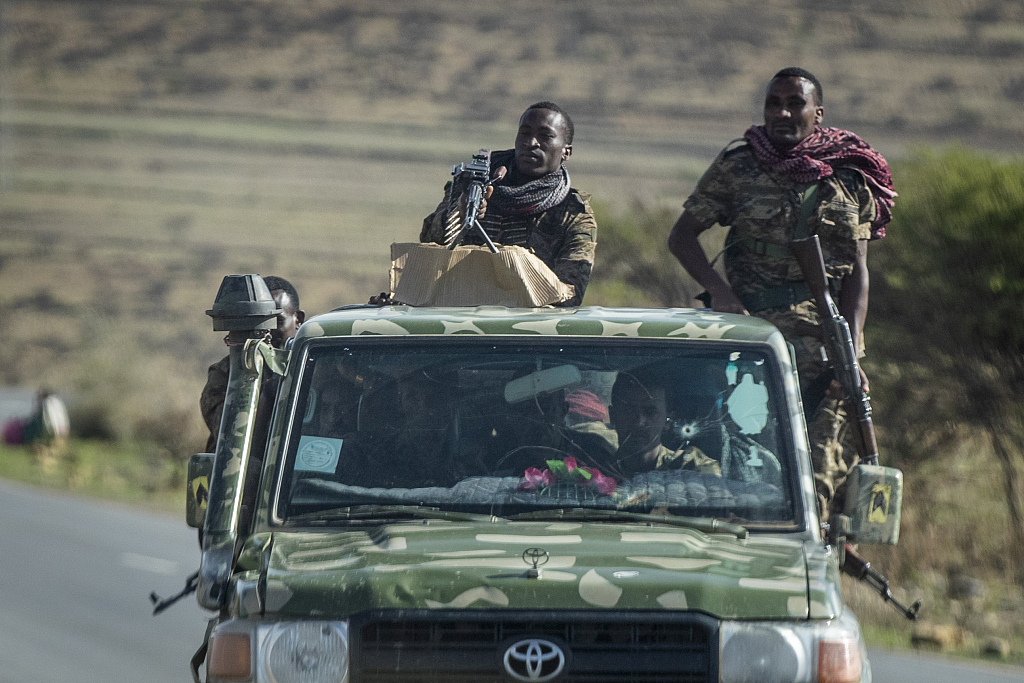
Soldiers of Ethiopian government forces on board a pick-up truck on a road near Agula, north of Mekele, in the Tigray region of northern Ethiopia, May 8, 2021. /VCG

This could have been why President Uhuru Kenyatta made a trip to Ethiopia’s capital, Addis Ababa, for a meeting with Prime Minister Abiy Ali on November 14. It is expected that Blinken’s meeting with Uhuru will include a debriefing session on the issues discussed by the two African neighbors. The issue of regional security, particularly in Somalia and Ethiopia, was also the subject of the meeting between Biden and Uhuru held in Washington, D.C., on October 14.

Truth be told, the U.S. is finding it too expensive to keep intervening in solving conflagrations the world over. It really does not have any practical solutions to the conflicts on the African continent – previous interventions in Somalia, for instance, were extremely traumatic experiences that the U.S. would like to forget. 

Climate change is another issue that should form a big part of Blinken’s agenda. Having returned to the Paris Agreement after Biden took power, the U.S. is expected to walk the talk and finance poor countries in Africa to adapt to and mitigate the environmental scourge. Countries like Kenya and Nigeria can absorb emerging green technologies and need a little bit of capacity building to gradually replace cheap but polluting technologies.

Moreover, the United Nations Environment Program is headquartered in Kenya’s capital city, Nairobi, making it key in global efforts to fight climate change. But the country needs to leverage this position more to serve as a model for environmental conservation.

Nigeria is pivotal in efforts aimed at stabilizing West Africa. In addition to the country suffering grievously from the Boko Haram Islamic jihadists, it is located in a region fraught with insecurity from terrorists and rebels. It is doubtful that Blinken has any solutions to the status quo, but his show of concern might just be impressive.   

Senegal looks like an annex to Blinken’s tour for the simple reason that Dakar is FOCAC’s venue. It could be a coded message that the U.S. still holds sway in Africa and no one should write it off when it comes to influencing the continent’s destiny.

Although Africa was not hard hit by the pandemic like other continents, it still suffered grave socio-economic ramifications. Observers are also waiting to see what actual support Blinken will promise to contend with what steadfast partners like China have offered the continent to bring it back on its feet. Africa has also been a victim of the West’s vaccine colonialism, a phenomenon that has adversely affected the continent’s fight against COVID-19. A paltry four percent of Africa’s population is fully vaccinated, compared to 41.3 percent of the global population.

Rather than trying to stop Africa from moving to the East, the U.S. needs to re-evaluate its relationship with the continent and change with the times.

Stephen Ndegwa is a Nairobi-based communication expert, lecturer-scholar at the United States International University-Africa, author and international affairs columnist. 

Previous Post

‘It’s scary’: Azeem Rafiq says English cricket rife with racism

Next Post

Mobile operator MTN to sell and leaseback South Africa towers for $412 mln

SAT Reporter

Related Posts

France Is Trying to Get New Stripes in Africa – but will it work?
Opinion

France Is Trying to Get New Stripes in Africa – but will it work?

by Development Reimagined
May 14, 2026
When AI Gets It Wrong, Humans Must Get It Right
Opinion

When AI Gets It Wrong, Humans Must Get It Right

by Dr Brighton Chireka
May 14, 2026
Can the United States Still Sanction China Into Compliance?
Opinion

Can the United States Still Sanction China Into Compliance?

by SAT Reporter
May 12, 2026
Op-Ed by President Ramaphosa | Reparations must help to address Africa’s colonial legacy
Opinion

Op-Ed by President Ramaphosa | Everyone in South Africa Must Respect and Uphold Our Laws

by SAT Reporter
May 12, 2026
Who Owns the American Story? Druski’s Viral Satire and Hollywood’s Identity Crisis
Opinion

Who Owns the American Story? Druski’s Viral Satire and Hollywood’s Identity Crisis

by Michelle Mungeni
May 12, 2026
Next Post
Mobile operator MTN to sell and leaseback South Africa towers for $412 mln

Mobile operator MTN to sell and leaseback South Africa towers for $412 mln

Browse by Category

  • Africa AI
  • African Continental Free Trade Area
  • African Debt
  • African Start ups
  • Agriculture
  • AI Africa
  • Algeria
  • All News
  • Analysis
  • Angola
  • Arts / Culture
  • Asia
  • Botswana
  • BOTSWANA
  • BREAKING NEWS
  • BRICS
  • Burkina Faso
  • Burundi
  • Business
  • Business
  • Business Wire
  • Cameroon
  • Central Africa
  • Chad
  • China
  • Climate Change
  • Climate Changev
  • Community
  • Congo Republic
  • Conservation
  • Côte d’Ivoire
  • COVID 19
  • CRYPTOCURRENCY
  • Culture
  • Democratic Republic of Congo
  • Diplomacy
  • Eastern Africa
  • Economic Development
  • Economy
  • Education
  • Egypt
  • Elections 2024
  • Energy
  • Entertainment
  • Environment
  • Eritrea
  • Ethiopia
  • Europe
  • Fashion
  • Feature
  • Finance
  • Financial Inclusion
  • Food
  • Food and Drink
  • Foods
  • GABON
  • Ghana
  • Global
  • Global Africa
  • Guinea
  • Health
  • Immigration
  • in Southern Africa
  • International news
  • International Relations
  • Investment
  • Ivory Coast
  • Just In
  • Kenya
  • Lesotho
  • Libya
  • Life Style
  • Lifestyle
  • Literature
  • Malawi
  • Malawi
  • Mali
  • Markets
  • Mauritius
  • Middle East
  • Mining in Africa
  • Morocco
  • Mozambique
  • Namibia
  • Niger
  • niger
  • Nigeria
  • North Africa
  • North-Eastern Africa
  • Obituaries
  • Obituary
  • Opinion
  • PARTNER CONTENT
  • Politics
  • Property
  • Racism
  • Rwanda
  • Rwanda
  • SADC
  • SAT Interviews
  • SAT Investigation
  • SAT Jobs
  • Saudi Arabia
  • Senegal
  • Seychelles
  • Somaliland
  • South Africa
  • South Sudan
  • Sports
  • Startup Africa
  • STOCK EXCHANGE
  • Sudan
  • Sustainability
  • Sustainablity
  • Tanzania
  • Technology
  • Telecommunications
  • The Editorial Board
  • The Power Of She
  • Togo
  • Trade
  • Travel
  • Travel
  • Tunisia
  • Uganda
  • Uncategorized
  • Wealth
  • West Africa
  • World
  • World
  • ZAMBIA
  • Zambia
  • ZIMBABWE
  • Zimbabwe

Browse by Tags

#NewsUpdate #SouthAfrica #SouthernAfricanTimes #TheSouthernAfricanTimes AfCFTA africa African Continental Free Trade Area African development African Development Bank African economies African economy African Union Agriculture Angola Botswana Business China Climate change Cyril Ramaphosa Economic Development economic growth energy transition governance industrialisation Inflation Infrastructure Infrastructure Development International relations Investment Kenya Mozambique Namibia news Nigeria Regional Integration renewable energy Rwanda SADC South Africa Southern Africa sustainable development Tanzania United States Zambia Zimbabwe
ADVERTISEMENT

WHO WE ARE

The Southern African Times is a regional bloc digital newspaper that covers Southern African and world news. The paper also gives a nuanced analysis on news and covers a wide range of reporting which include sports, entertainment, foreign affairs, arts and culture.

Welcome Back!

Login to your account below

Forgotten Password?

Retrieve your password

Please enter your username or email address to reset your password.

Log In

  • Home
  • Southern Africa
  • Business
    • African Start ups
    • African Continental Free Trade Area
  • Technology
    • Lifestyle
      • Health
      • Culture
      • Food and Drink
      • Entertainment
  • Opinion
  • Sports
  • SAT Jobs
    • Events
  • About Us
    • Advertise with Us
    • Contact Us
Are you sure want to unlock this post?
Unlock left : 0
Are you sure want to cancel subscription?