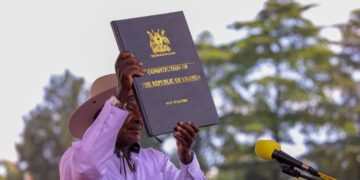
Uganda has enacted a contentious new law aimed at limiting foreign influence, after President Yoweri Museveni signed the amended “Protection of Sovereignty” bill despite ongoing concerns from rights groups and financial institutions.
The legislation criminalises the promotion of what it defines as the “interests of a foreigner against the interests of Uganda” and places strict limits on individuals or organisations acting on behalf of foreign entities. Under the law, engaging in policy development or implementation tied to foreign interests without government approval is prohibited.
Violations carry heavy penalties, including fines and prison sentences of up to 10 years.



The bill has sparked significant debate both domestically and internationally. Critics argue that its broad and loosely defined language could be used to target political opponents, civil society organisations and activists. Rights groups warn that almost any form of dissent could be interpreted as advancing foreign interests, effectively shrinking Uganda’s already constrained civic space.
The government, however, has dismissed these concerns, insisting the law is necessary to protect national sovereignty. Museveni, who has ruled Uganda since 1986, has long accused opposition figures and critics of being backed by foreign actors seeking to influence domestic politics.
In response to mounting pressure, lawmakers revised some of the bill’s most controversial provisions before it was signed into law. Notably, a clause that would have required all Ugandans receiving money from abroad to register as foreign agents was scaled back. The requirement now applies only to individuals receiving funds for explicitly political purposes linked to foreign interests.
This adjustment was seen as an attempt to ease concerns from economic stakeholders. Remittances from Ugandans living abroad are a critical source of foreign exchange for the country, supporting households and stabilising the broader economy.
Michael Atingi-Ego, governor of Uganda’s central bank, had previously warned that earlier versions of the bill risked triggering an “economic disaster” by discouraging financial inflows and weakening foreign exchange reserves.
The World Bank also raised red flags, cautioning that the original draft could expose routine development work to criminal liability, potentially disrupting aid programmes and partnerships.
While the revised law has softened some of these risks, uncertainty remains over how it will be enforced in practice. Analysts say its real impact will depend on whether authorities apply it narrowly as a sovereignty safeguard or more broadly as a political tool.

The move places Uganda among a growing number of countries introducing legislation aimed at regulating foreign influence, a trend that often sits at the intersection of national security concerns and civil liberties.