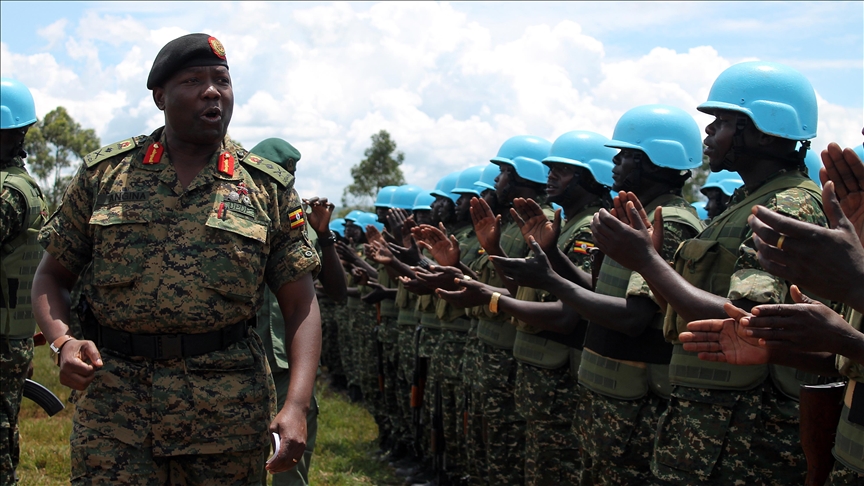
Uganda and the Democratic Republic of the Congo (DRC) have reaffirmed their commitment to restoring stability in eastern DRC, with senior military officials calling on local armed groups to surrender. The appeal, made during a bilateral coordination meeting between the Uganda People’s Defence Forces (UPDF) and the Armed Forces of the Democratic Republic of the Congo (FARDC), underscores ongoing efforts to dismantle insurgencies in the volatile region. The meeting, held in Bunia, the capital of Ituri Province, from 27 to 28 March, was part of the broader joint military operation known as Operation Shujaa, which targets the Allied Democratic Forces (ADF) and other militant factions.
Chris Magezi, acting spokesperson for the UPDF, stated that commanders urged militias to embrace the DRC government’s Disarmament, Demobilisation, Reintegration, and Stabilisation (DDRS) programme. This initiative seeks to integrate former combatants into civilian life and national security structures. According to Magezi, groups that refuse to surrender will be treated as hostile elements and subjected to continued military action.
The Ugandan delegation at the meeting was led by Lieutenant General Kayanja Muhanga, commander of the UPDF’s land forces, while the Congolese delegation was headed by Lieutenant General Jacques Nduru, deputy chief of general staff for operations and intelligence. The discussions evaluated recent military operations, including Uganda’s latest offensive against the Cooperative for the Development of the Congo (CODECO), an armed Lendu militia that has been accused of committing atrocities against civilians and collaborating with the ADF.



Uganda’s military announced last week that its forces had killed 242 CODECO militants in Ituri Province. The operation was launched in response to a surge in attacks targeting civilians and security forces. In addition to combating CODECO, the Ugandan military presence in the region aims to prevent further incursions by the ADF, a Ugandan rebel group linked to the Islamic State in Central Africa. The ADF has been responsible for numerous attacks in both Uganda and the DRC, leading to heightened security cooperation between the two nations.
Uganda’s involvement in eastern DRC follows a series of cross-border security agreements between Kampala and Kinshasa. In November 2021, Uganda deployed troops to the region at the request of the Congolese government after a wave of bombings in Kampala was linked to the ADF. The joint military operations have since intensified, targeting militant strongholds and supply routes in an effort to weaken the insurgents’ operational capacity.

The DRC government’s DDRS initiative is a key component of its strategy to stabilise conflict-affected regions. The programme offers incentives for fighters to lay down their arms, including economic support, vocational training, and reintegration into society. However, past disarmament efforts in the DRC have faced significant challenges, including logistical constraints, local resistance, and accusations of inadequate implementation.
Security analysts suggest that the success of the current military campaign depends on sustained cooperation between Uganda and the DRC, as well as broader support from regional and international actors. The African Union and the East African Community have both endorsed collaborative security efforts to address the insurgency problem in the Great Lakes region. Additionally, the United Nations Organisation Stabilisation Mission in the Democratic Republic of the Congo (MONUSCO) has been monitoring the situation and providing support to Congolese forces.
Despite military gains, concerns persist over the long-term stability of eastern DRC. The region has been plagued by decades of conflict, driven by ethnic tensions, competition over natural resources, and the proliferation of armed groups. The presence of multiple militias with competing interests complicates disarmament efforts, as some factions remain sceptical of government initiatives or fear retribution upon surrender.
The joint Ugandan-Congolese military operations have drawn mixed reactions from local communities. While many civilians support efforts to dismantle militant groups, some have expressed concerns over human rights violations and the impact of prolonged military campaigns on daily life. Humanitarian organisations operating in the region have called for enhanced protection measures for civilians and greater accountability in military operations.
The Ugandan and Congolese governments maintain that their primary objective is to restore peace and security, enabling displaced populations to return home and fostering economic development in affected areas. Both countries have reiterated their commitment to eliminating the militant threat while also promoting political and social initiatives to address the root causes of conflict.
As military operations continue, the success of Uganda and the DRC’s collaborative approach will be measured not only by battlefield victories but also by the effectiveness of long-term peacebuilding strategies. The international community will be watching closely to assess whether these efforts lead to lasting stability or if the region remains trapped in cycles of violence and unrest.
For more updates on regional security and conflict resolution efforts, visit The Southern African Times.