Wednesday, June 3, 2026
  • Login
The Southern African Times
  • Home
  • Southern Africa
  • Business
    • African Start ups
    • African Continental Free Trade Area
  • Technology
    • Lifestyle
      • Health
      • Culture
      • Food and Drink
      • Entertainment
  • Opinion
  • Sports
  • SAT Jobs
    • Events
  • About Us
    • Advertise with Us
    • Contact Us
No Result
View All Result
  • Home
  • Southern Africa
  • Business
    • African Start ups
    • African Continental Free Trade Area
  • Technology
    • Lifestyle
      • Health
      • Culture
      • Food and Drink
      • Entertainment
  • Opinion
  • Sports
  • SAT Jobs
    • Events
  • About Us
    • Advertise with Us
    • Contact Us
No Result
View All Result
The Southern African Times
No Result
View All Result
Home Economy

The biggest economies in the world in 2024: South Africa vs China, Russia and the USA

by SAT Reporter
May 8, 2024
in Economy, in Southern Africa, South Africa
0
The biggest economies in the world in 2024: South Africa vs China, Russia and the USA

The IMF’s latest global economic outlook shows that South Africa is on track to reclaim its crown as Africa’s biggest economy in 2024. However, the continent’s heavyweight still performs far below the biggest markets on the global stage, including those in its own bloc.

On the global stage, two prominent groups are vying for influence: the long-established G7 and the ambitious BRICS+ economies.

The G7, formed in 1975, brings together major industrial democracies—Canada, France, Germany, Italy, Japan, the UK, and the USA. They meet annually to coordinate on global economic policy.


ADVERTISEMENT

As of 2023, the G7 economies represented 26.4% of the world’s GDP and contributed 14.4% to the global GDP growth over the previous decade. Among its members, the G7 includes the USA, which is the largest and most industrialized economy globally.

On the other hand, BRICS, which officially came into being in 2009, originally included Brazil, Russia, India, China, and South Africa, with South Africa joining in 2010. By 2024, the group expanded to become BRICS+, welcoming Egypt, Ethiopia, Iran, and the UAE.

This expansion is part of BRICS+’s broader aim to bolster its influence over global economic governance and position itself as a voice for the Global South, offering an alternative to the G7 model.

Both alliances boast members with significant economic clout. For instance, within the BRICS+ bloc, South Africa is on the brink of becoming Africa’s largest economy, while China holds the position of the world’s second-largest economy.

BRICS+ economies have been experiencing rapid growth due to a combination of factors such as large populations, abundant natural resources for export, increasing urbanisation and industrialisation, and government policies to attract investment within the bloc.

However, the growth has not been uniform across all members, with China seeing the biggest boom in growth to make it the second largest economy in the world.
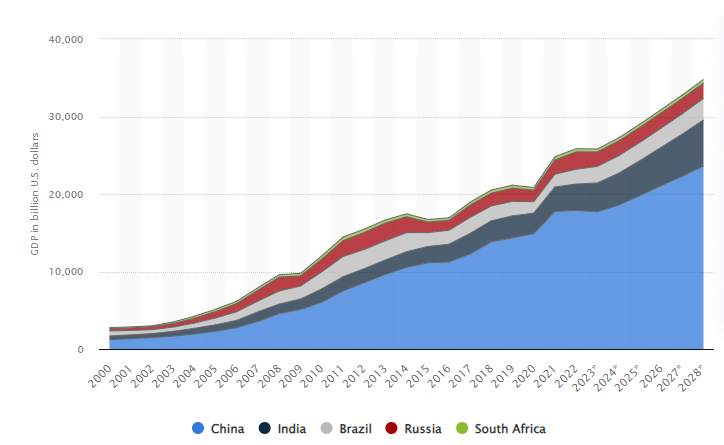
 

Gross domestic product (GDP) of the core BRICS countries from 2000 to 2028. Source: Statista

Research from the Hinrich Foundation, a global trade think tank, reveals that the landscape of global trade has been progressively dividing – with BRICS+ and the G7 at the centre of it.

The research shows that countries are shifting to now trade more frequently with their geopolitical allies.

The shift amounts to nearly $270 billion (R4.99 trillion) diverted to trade within blocs in 2023 compared with 2018.
Total South African trade with BRICS increased from R487 billion in 2017 to R702 billion in 2021.
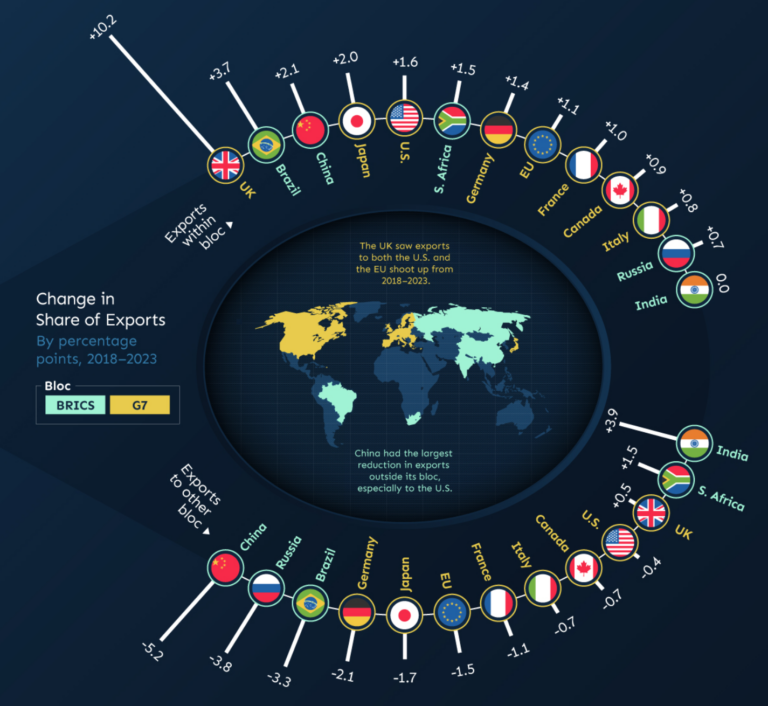
Change in share of exports between and within G7 and BRICS. Graphic: The Hinrich Foundation

Current GDPs

Looking at live data provided by the International Monetary Foundation, the total GDPs of the G7 countries still greatly outweighs that of BRICS.

International Monetary Fund GDP valuations for April 2024 indicate that the BRICS+ economies have a combined $28.78 trillion GDP. This is equal to the GDP of the USA, who contributes greatly to the G7’s estimated total of $48.68 trillion GDP.
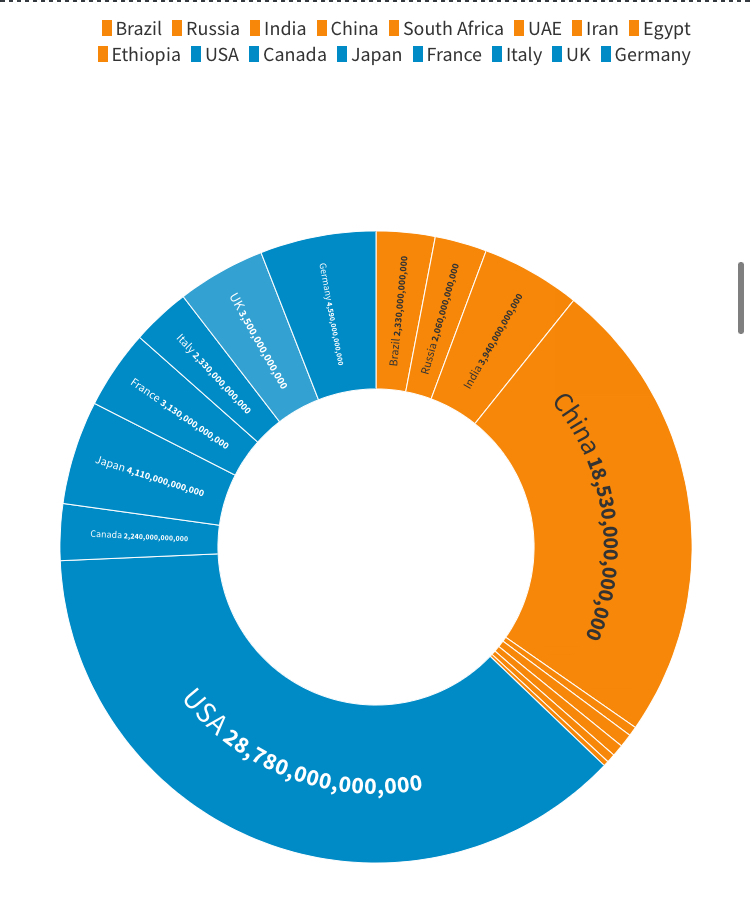
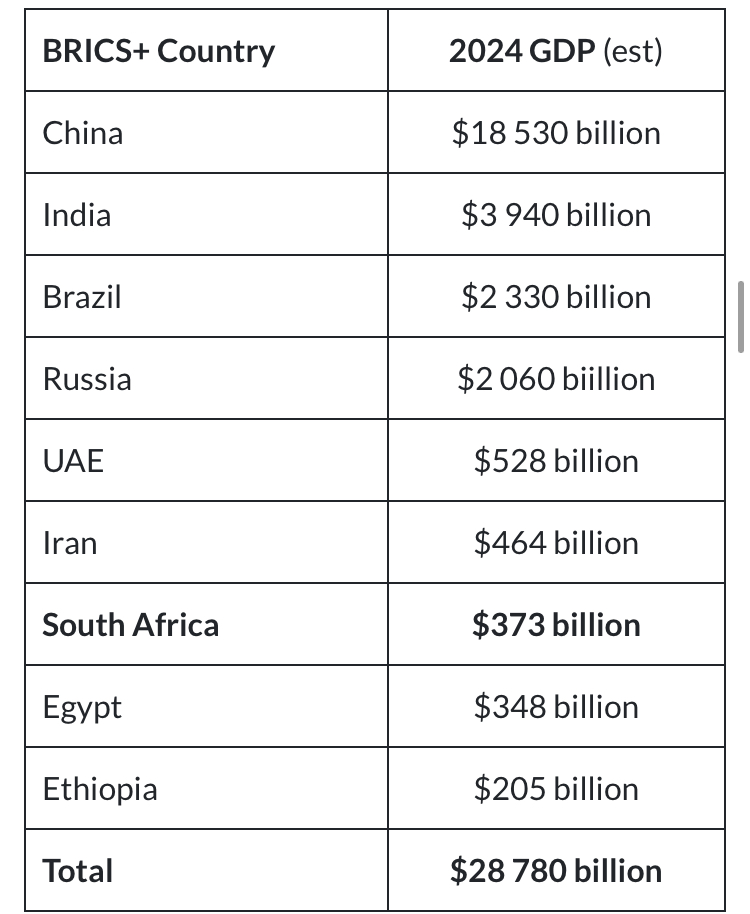
Source: IMF World Economic Outlook (April 2024)

China has the largest GDP out of the BRICS+ nations and has consistently been the largest economy of this bloc.

It is predicted that China’s GDP will overtake that of the U.S. by the end of the 2020s or early 2030s, to become the largest economy in the world, while some also estimate that India will also overtake the U.S. around the middle of the century.
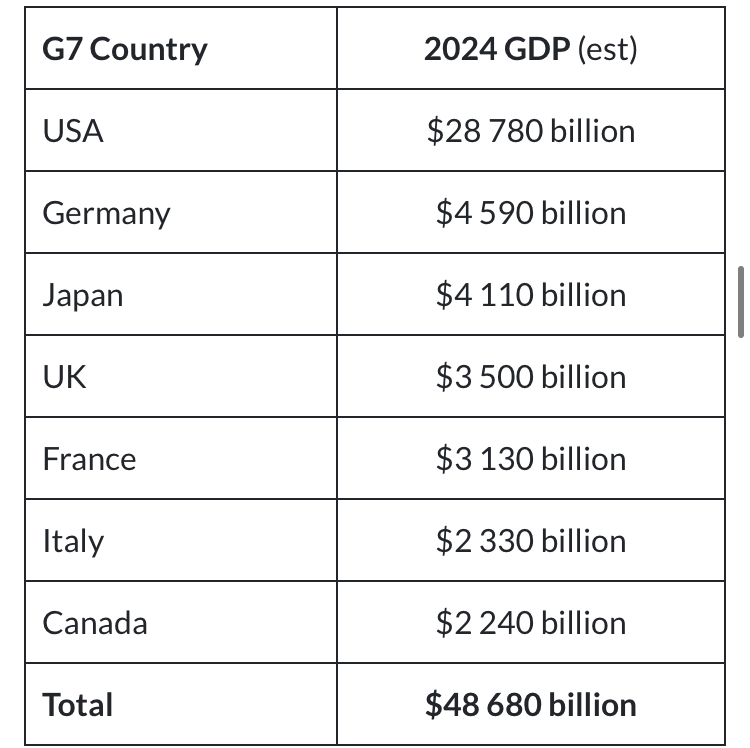
Source: IMF World Economic Outlook (April 2024)

While the GDPs of the G7 trump that of the BRICS+ economies, the majority of these developing countries sport GDP growth forecasts above the G7.

Although the growth forecasts for 2024 are generally lower than those of 2023, the BRICS+ countries are still projected to have a substantially higher average growth rate of 3.6% (above the global average of 3.2%), in contrast to the G7 nations, which have an average of 1%.
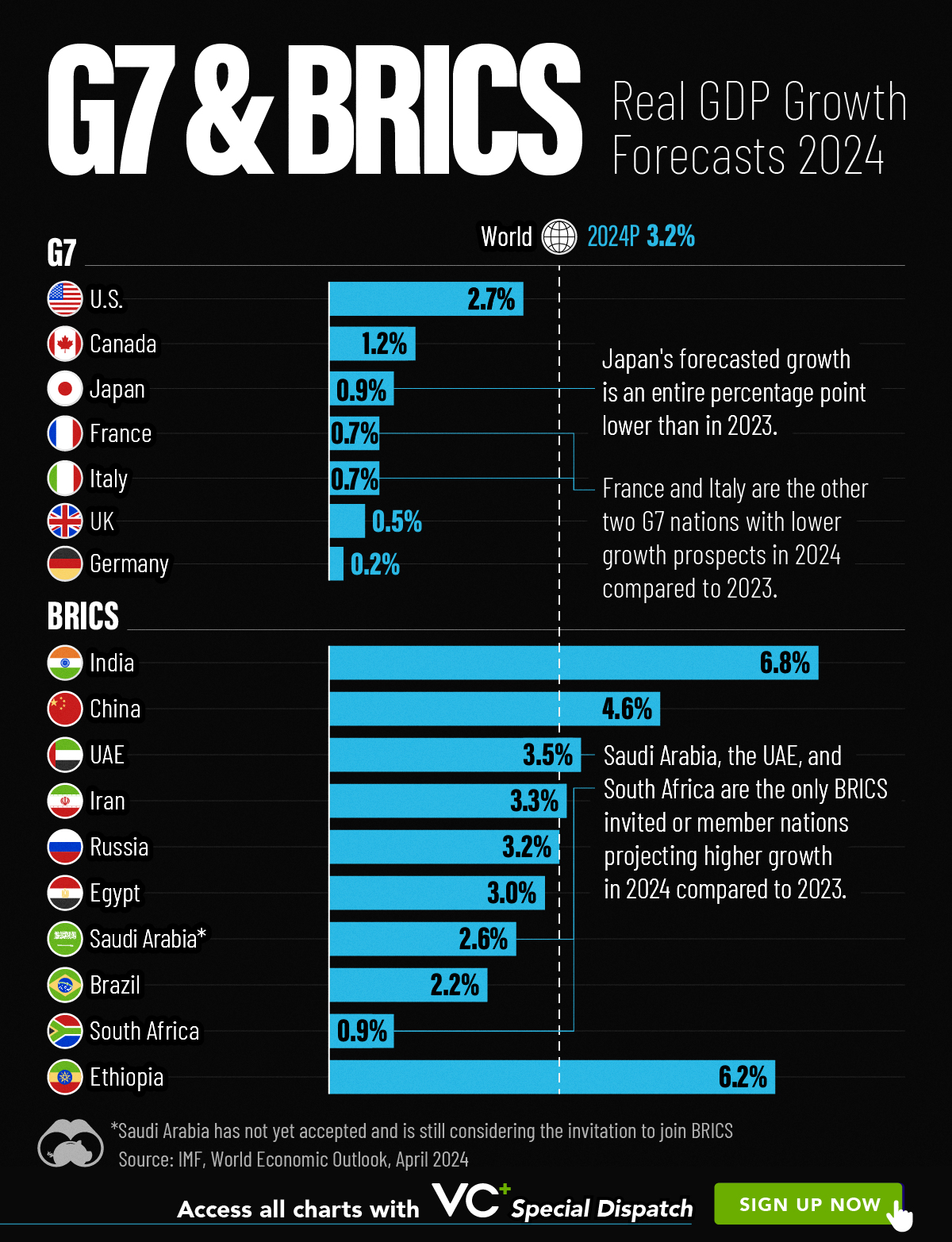
Graphic: Sabrina Lam, Visual Capitalist.

The current members of BRICS+ are projected to achieve an average GDP growth rate ranging from 189% to 205% by the year 2050, a stark contrast to the G7’s average growth rate of 50%, as reported by Goldman Sachs.

The five BRICS countries overtook the G7 countries in terms of share of the world’s total GDP in terms of purchasing power parity (PPP) in 2020. The BRICS+ grouping now hold around 36% of the world’s GDP PPP, compared to 30% held by the G7 countries.

Population size estimates and land size

Looking at population size, the BRICS+ group has a combined population of about 3.6 billion, or 45% of the world’s inhabitants.

This greatly outweighs the G7’s combined 776 million population estimate.
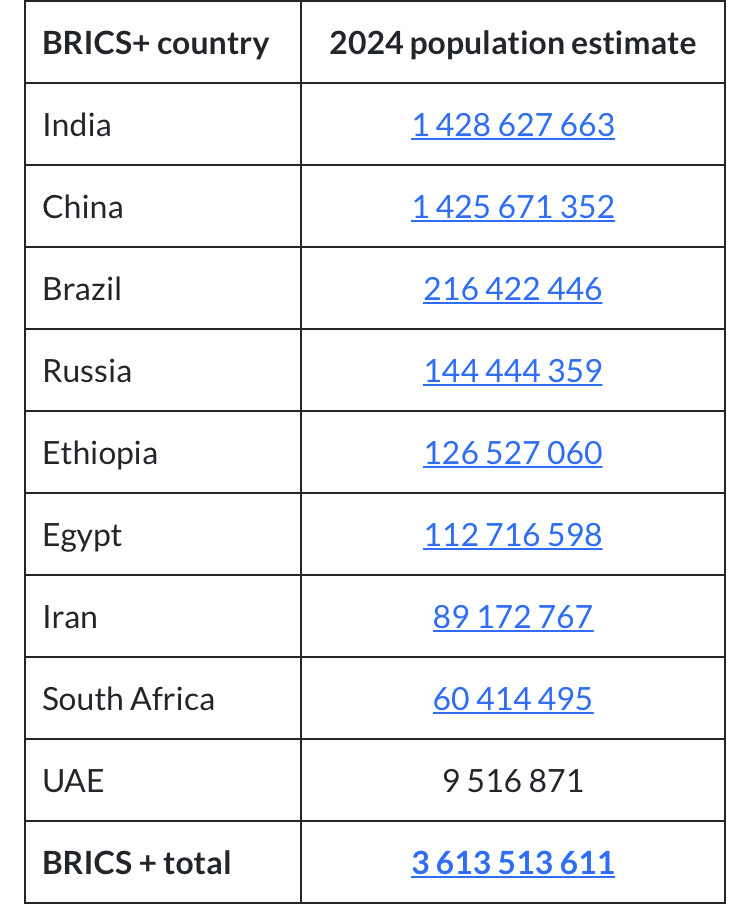
Source: Worldometers – Data sourced from United Nations Population Division estimates

When it comes to land size, the current grouping of the G7 has a land mass of 19.7 million sq km (15.2% of the world), while the newly expanded BRICS + has a landmass of more than double that, at 44.2 million sq km (34.1% of the world).


Previous Post

Ethiopia’s Coffee Export Surges, Bringing in $835 Million in Just 9 Months

Next Post

Zimbabwe’s Diplomatic Renaissance: Re-engagement and Opportunities Abound

SAT Reporter

Related Posts

Ramaphosa challenges report in farm cash scandal
South Africa

Ramaphosa challenges report in farm cash scandal

by SAT Reporter
May 27, 2026
Botswana Calls for Africa Led Trade Partnerships During France Africa Talks
Botswana

Botswana Calls for Africa Led Trade Partnerships During France Africa Talks

by SAT Reporter
May 18, 2026
Zambia’s Mining Expansion Extends Beyond Copper as Uranium Projects Gain Momentum
in Southern Africa

Zambia’s Mining Expansion Extends Beyond Copper as Uranium Projects Gain Momentum

by SAT Reporter
May 18, 2026
South Africa Advances Rail and Port Reforms to Strengthen Regional Trade Connectivity
in Southern Africa

South Africa Advances Rail and Port Reforms to Strengthen Regional Trade Connectivity

by SAT Reporter
May 18, 2026
ANC Rallies Behind Ramaphosa as Farmgate Pressure Mounts
South Africa

ANC Rallies Behind Ramaphosa as Farmgate Pressure Mounts

by SAT Reporter
May 14, 2026
Next Post
Zimbabwe’s Diplomatic Renaissance: Re-engagement and Opportunities Abound

Zimbabwe’s Diplomatic Renaissance: Re-engagement and Opportunities Abound

Browse by Category

  • Africa AI
  • African Continental Free Trade Area
  • African Debt
  • African Start ups
  • Agriculture
  • AI Africa
  • Algeria
  • All News
  • Analysis
  • Angola
  • Arts / Culture
  • Asia
  • BOTSWANA
  • Botswana
  • BREAKING NEWS
  • BRICS
  • Burkina Faso
  • Burundi
  • Business
  • Business
  • Business Wire
  • Cameroon
  • Central Africa
  • Chad
  • China
  • Climate Change
  • Climate Changev
  • Community
  • Congo Republic
  • Conservation
  • Côte d’Ivoire
  • COVID 19
  • CRYPTOCURRENCY
  • Culture
  • Democratic Republic of Congo
  • Diplomacy
  • Eastern Africa
  • Economic Development
  • Economy
  • Education
  • Egypt
  • Elections 2024
  • Energy
  • Entertainment
  • Environment
  • Eritrea
  • Ethiopia
  • Europe
  • Fashion
  • Feature
  • Finance
  • Financial Inclusion
  • Food
  • Food and Drink
  • Foods
  • GABON
  • Ghana
  • Global
  • Global Africa
  • Guinea
  • Health
  • Humanitarian Aid
  • Immigration
  • in Southern Africa
  • International news
  • International Relations
  • Investment
  • Ivory Coast
  • Just In
  • Kenya
  • Lesotho
  • Libya
  • Life Style
  • Lifestyle
  • Literature
  • Malawi
  • Malawi
  • Mali
  • Markets
  • Mauritius
  • Middle East
  • Mining in Africa
  • Morocco
  • Mozambique
  • Namibia
  • Niger
  • niger
  • Nigeria
  • North Africa
  • North-Eastern Africa
  • Obituaries
  • Obituary
  • Opinion
  • PARTNER CONTENT
  • Politics
  • Property
  • Racism
  • Rwanda
  • Rwanda
  • SADC
  • SAT Interviews
  • SAT Investigation
  • SAT Jobs
  • Saudi Arabia
  • Senegal
  • Seychelles
  • Somaliland
  • South Africa
  • South Sudan
  • Sports
  • Startup Africa
  • STOCK EXCHANGE
  • Sudan
  • Sustainability
  • Sustainablity
  • Tanzania
  • Technology
  • Telecommunications
  • The Editorial Board
  • The Power Of She
  • Togo
  • Trade
  • Travel
  • Travel
  • Tunisia
  • Uganda
  • Uncategorized
  • Wealth
  • West Africa
  • World
  • World
  • Zambia
  • ZAMBIA
  • Zimbabwe
  • ZIMBABWE

Browse by Tags

#NewsUpdate #SouthAfrica #SouthernAfricanTimes #TheSouthernAfricanTimes AfCFTA africa African Continental Free Trade Area African development African Development Bank African economies African economy African Union Agriculture Angola Botswana China Climate change Cyril Ramaphosa Economic Development economic growth energy transition governance IMF industrialisation Inflation Infrastructure Infrastructure Development International relations Investment Kenya Mozambique Namibia news Nigeria Regional Integration renewable energy Rwanda SADC South Africa Southern Africa sustainable development Tanzania United States Zambia Zimbabwe
ADVERTISEMENT

WHO WE ARE

The Southern African Times is a regional bloc digital newspaper that covers Southern African and world news. The paper also gives a nuanced analysis on news and covers a wide range of reporting which include sports, entertainment, foreign affairs, arts and culture.

Welcome Back!

Login to your account below

Forgotten Password?

Retrieve your password

Please enter your username or email address to reset your password.

Log In
  • Home
  • Southern Africa
  • Business
    • African Start ups
    • African Continental Free Trade Area
  • Technology
    • Lifestyle
      • Health
      • Culture
      • Food and Drink
      • Entertainment
  • Opinion
  • Sports
  • SAT Jobs
    • Events
  • About Us
    • Advertise with Us
    • Contact Us
Not enough quota to unlock this post
Unlock left : 0
Are you sure want to cancel subscription?