In the sprawling suburbs of Dar es Salaam, the rhythm of daily life has been profoundly disrupted by a deepening water crisis that underscores the intensifying grip of climate change across Africa. For residents such as Prisca Ntaula, a 34-year-old mother of one living in Temboni on the city’s outskirts, the search for clean water has become a defining ordeal.
For nearly three weeks, taps in her neighbourhood have run dry. What was once a simple daily routine—fetching water, washing clothes, cooking—has turned into a consuming struggle. “Since the shortage began, I have spent most of my time searching for water,” Ntaula says wearily. “The little I get, about ten to twenty litres, is only for drinking and cooking. If this continues, we may start seeing outbreaks of diseases like cholera.”
The water scarcity has reshaped domestic priorities, forcing many households to make difficult decisions. For Ntaula, the rising cost of water has forced her to divert money meant for her son’s school fees. “I have spent all the money I saved for my son’s education on buying water,” she explains. “We have no choice—water is life.”



The scale of Dar es Salaam’s crisis is staggering. Home to more than 5.3 million people, Tanzania’s commercial hub depends heavily on the Ruvu River for its domestic and industrial water supply. But as delayed rainfall and soaring temperatures persist, water levels in the river have fallen sharply, constraining production at the Lower Ruvu Water Treatment Plant—the city’s main source of treated water.
According to the Dar es Salaam Water Supply and Sanitation Authority (DAWASA), the shortfall began in November 2025, when prolonged dry conditions reduced the Ruvu River’s flow to critically low levels. “Water service shortages have occurred in many areas due to reduced production linked to the drop in the Ruvu River’s water level following delayed rains,” DAWASA said in a public notice.
In response, the Ministry of Water restricted agricultural use of the Ruvu River and prioritised human consumption. It also began rehabilitating boreholes across the city to supplement the diminished supply. Yet even with these measures, demand continues to outstrip supply. As a result, many residents have turned to private vendors, whose prices have surged amid the crisis.
For vendors such as Novatus Kimaro, the shortages have brought both opportunity and unease. “Since the shortage began, I raised the price of a 1,000-litre water bowser from 20,000 shillings to 30,000 shillings,” Kimaro says, as his phone buzzes with new orders. “People keep calling. The price increase hasn’t stopped anyone.”
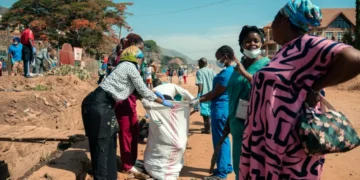
The rise in prices has deepened inequalities in a city where many residents already struggle to meet basic needs. Informal water markets, often the only available option, now shape who gets water and who goes without. Those unable to afford private deliveries queue for hours at boreholes under the relentless heat, clutching yellow jerry cans and waiting for a few litres of relief.

Behind the crisis lies a persistent heatwave that has swept across Tanzania in recent months. In late November, the Tanzania Meteorological Authority (TMA) reported unusually high temperatures nationwide. Moshi station in the Kilimanjaro Region recorded a maximum temperature of 35.7 degrees Celsius on 21 November, about 4.2 degrees above the seasonal average. The authority attributed the heat to high atmospheric moisture and reduced rainfall, conditions aggravated by the effects of climate change.
On 28 November, TMA issued an advisory warning that extreme heat would persist across much of the country, particularly in regions with bimodal rainfall patterns. The agency also urged citizens to stay informed and conserve water. Although December rains were expected to ease the situation slightly, the relief was limited and uneven.
By mid-December, DAWASA had implemented a formal water rationing schedule for Dar es Salaam, urging residents to use available water only for essential activities. Prime Minister Mwigulu Nchemba later called on Tanzanians to conserve food and avoid waste, warning that forecasts indicated below-average rainfall in several regions. The government, he said, was prioritising long-term measures to strengthen the country’s water resilience.
Among those measures is the Kidunda Dam, a 336 billion Tanzanian shilling (about 136 million US dollars) project now 40 percent complete. The dam, once operational, is expected to stabilise water supply to Dar es Salaam by capturing and storing excess water during the rainy season. Minister of Water Jumaa Aweso has acknowledged that climate change has sharply reduced DAWASA’s water production capacity from 534,600 cubic metres per day to 270,000 cubic metres, a shortfall of 264,600 cubic metres.
Aweso noted that the government has since rehabilitated boreholes within DAWASA’s service areas and undertaken efforts to restore the Ruvu River to its natural course at Kitomondo. “We are taking every measure possible to ensure sustainable water supply for Dar es Salaam and surrounding areas,” he said.
Yet, for residents such as Ntaula, these long-term interventions remain distant promises. Each day brings the same exhausting ritual—searching, queuing, and paying for water that is increasingly out of reach. “We hear about projects and future plans,” she says, “but what we need is water now.”
The crisis unfolding in Tanzania’s largest city mirrors a broader continental challenge. Across Africa, climate change is manifesting in prolonged droughts, erratic rainfall, and shrinking water sources. These changes expose vulnerabilities in infrastructure and governance systems that were not designed for such climatic extremes.
However, Africa’s climate story is not one solely of crisis. It is also one of adaptation, resilience, and local innovation. Communities are developing new coping strategies, from rainwater harvesting to small-scale irrigation systems. Governments are increasingly aligning national policies with climate adaptation goals, while regional institutions call for greater investment in sustainable water management.

Dar es Salaam’s experience illustrates that the effects of global warming are deeply human. They are felt not in abstract statistics but in the sleepless nights of parents like Ntaula and in the queues of residents waiting for water under the scorching sun. The crisis calls for a response grounded in regional solidarity and African-led solutions that recognise the continent’s capacity to adapt while demanding accountability from global actors whose emissions drive much of the warming.
As Tanzania navigates its path toward climate resilience, its struggle for water serves as both a warning and a call to action. The continent’s future will depend on the strength of local solutions, equitable access to resources, and the recognition that Africa’s climate story must be told from within—rooted in its people’s lived experiences, ingenuity, and determination to endure.