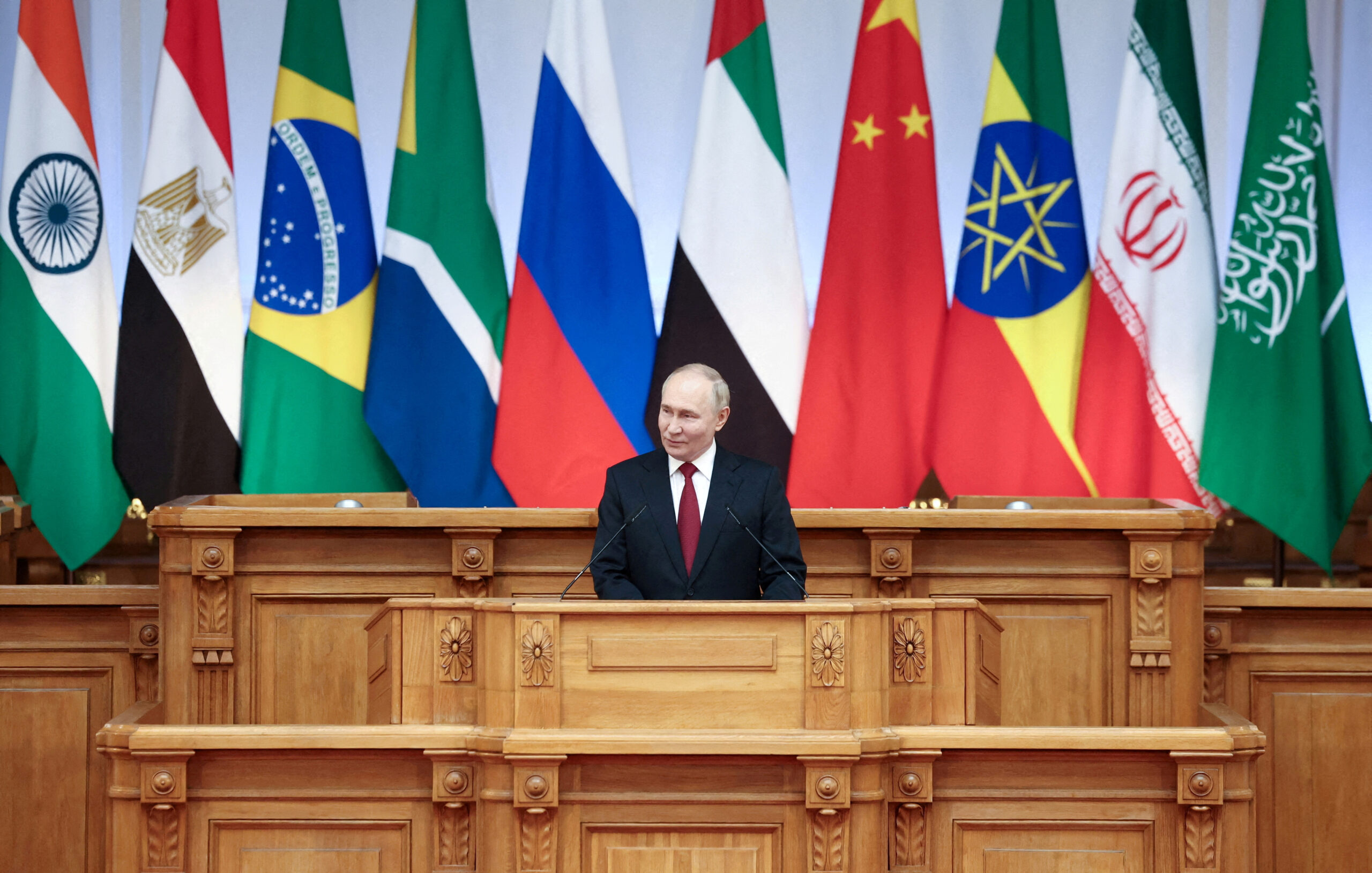
As Moscow prepares to host the 2024 BRICS summit, Russia is pushing for a radical overhaul of the global financial system that would loosen the U.S. dollar’s grip on international trade and payments. The summit, scheduled for 22-24 October in the city of Kazan, will see the leaders of Brazil, Russia, India, China, South Africa, and newly inducted members Egypt, Ethiopia, Iran, and the United Arab Emirates convene. In an effort to sidestep Western economic sanctions, Russia aims to rally support for an alternative payment system, utilising blockchain technology to create digital tokens backed by national currencies.
This bold initiative underscores President Vladimir Putin’s long-standing objective to diminish the U.S.’s financial leverage and position BRICS as a formidable counterbalance to Western economic dominance. According to documents circulated by Russia’s finance ministry and central bank ahead of the summit, the proposed system would interlink BRICS central and commercial banks, enabling seamless currency exchange without recourse to dollar-based transactions. This move is seen as crucial for facilitating trade, particularly with countries like China, where banks face the risk of secondary sanctions from the U.S.
The Kremlin regards the upcoming summit as a demonstration of resilience in the face of Western isolation attempts. By expanding BRICS membership and forging ahead with new financial architecture, Moscow seeks to reshape the post-Cold War order. However, the complexity of reaching a consensus amongst the expanded group, now consisting of nine full members, presents a formidable challenge.



Yaroslav Lissovolik, founder of BRICS+ Analytics, acknowledged the technical feasibility of a new payment mechanism but stressed that realising it would require considerable time and negotiation. He noted that the expanded membership makes consensus-building more complex, with diverse political and economic interests at play.
Russia’s proposal goes beyond payment reform. In parallel with the new financial system, it is advocating the creation of a BRICS grain trading exchange to challenge Western-dominated agricultural bourses. As the world’s largest wheat exporter, Russia is pushing for a BRICS-backed pricing agency to set more equitable global prices for grain and other agricultural commodities.
Further, Moscow is floating the idea of a “BRICS Clear” platform to facilitate the settlement of securities trades among member nations, along with improved collaboration between credit rating agencies. However, the notion of a joint BRICS rating agency, previously considered, remains off the table for now. Instead, the focus is on harmonising existing methodologies.
Despite these ambitious plans, Russia’s efforts to galvanise the bloc have encountered resistance. Lower-level officials, rather than finance ministers or central bankers, represented most BRICS nations at a recent preparatory meeting. This tepid response may signal reluctance among some members to fully endorse Russia’s agenda.
Nevertheless, Kremlin officials remain optimistic about the summit’s potential impact. Yuri Ushakov, a senior Kremlin aide, recently emphasised that BRICS is an institution that “cannot be ignored” on the world stage. Russia expects leaders from all nine member nations, alongside officials from roughly 15 prospective partner countries, to attend the summit. Additionally, Saudi Arabia’s foreign minister has been invited as the Kingdom continues its dialogue about joining the bloc.
Russia’s broader aim is to position BRICS as a cornerstone of an emerging multipolar world. The current Western-led financial institutions, such as the International Monetary Fund, have been accused by Russian officials of favouring the interests of advanced economies at the expense of the developing world. Moscow is pushing for reforms that would better reflect the shifting dynamics of the global economy, with BRICS acting as a vanguard for these changes.

For now, it remains to be seen whether Moscow’s ambitious proposals will gain sufficient traction among its BRICS peers. While Russia’s push for a sanctions-proof financial infrastructure is technically achievable, the political will to implement such far-reaching reforms across the diverse group remains in question.
Meta Description:
Tags:
.