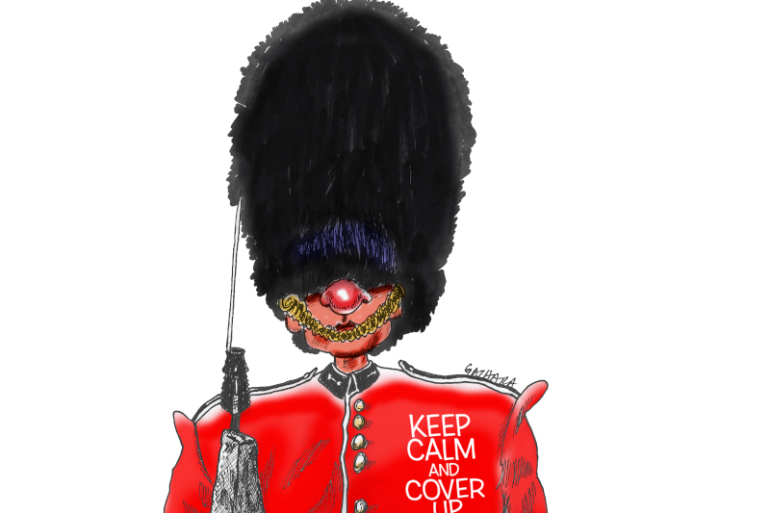
The killing of Agnes Wanjiru, allegedly by a British soldier, in 2012 is once again back in the news. The body of the 21-year-old sex worker and mother of one was found dumped in a septic tank two months after she disappeared following a night out with a group of soldiers in the central Kenyan town of Nanyuki, where the British army has a permanent garrison. By then, the soldiers had already left the country and her family’s attempts to secure justice had been frustrated by both the Kenyan and British authorities.
However, reports in the British press indicating that a British soldier had confessed to killing Wanjiru and showed comrades where he dumped her body, as well as exposing social media posts where the soldiers were laughing at the murder, have galvanised a renewed investigation from the Kenyan police with promises of cooperation from the British.
While the fresh probe is welcome, it must be stressed that the prospects for justice are not as clear-cut as one may presume. Kenya has a terrible record of delivering justice to foreigners who commit abuses against its own citizens. For many, this case will bring to mind the similar case in August 1980 when 19-year-old Frank Sundstrom, a US Navy sailor, confessed to killing 29-year-old Monica Njeri, a mother of two daughters, whom he had paid $23 for sex while on shore leave at the coastal town of Mombasa. Sundstrom pleaded guilty to manslaughter and was released on a $70, two-year “good behaviour” bond and promptly returned to the US. Three years later, the US government would agree to an out-of-court settlement with Njeri’s family of nearly $17,000.



At the time of the killing, 17 years after independence, Kenya’s judiciary was still dominated by the British and the case was prosecuted by Nicholas Harwood and heard by Justice L G Harris, both British, who conspired to reduce the charge from murder, which carried a mandatory death sentence, to manslaughter on the spurious basis that Sundstrom had confessed.
The case caused a firestorm in Parliament where MPs believed the US had arm-twisted the Kenyan judiciary to liberate Sundstrom. In an eerie precursor of things to come, the then-Attorney General James Karugu shocked legislators by declaring himself “legally impotent” to appeal the ruling. The statement presaged that of the current Kenyan minister of defence, Eugene Wamalwa, who this week told a parliamentary committee that Kenya essentially needed British permission to prosecute crimes committed by British soldiers on its own territory. “The defense cooperation agreement that gives us jurisdiction to deal with [the murder of Wanjiru]… has lapsed,” he said on Tuesday.
The Kenyan government’s callousness and recalcitrance in dealing with crimes against Kenyans is a reflection both of its own commission of similar crimes against them and of its colonial roots. The report of the Truth, Justice and Reconciliation Commission which looked into abuses committed against Kenyans between 1963 and 2008 concluded that the pre- and post-independence governments were guilty of gross human rights violations, few of which have been prosecuted. President Uhuru Kenyatta, whose government tampered with the report to remove mention of his father’s abuses and theft as Kenya’s first post-independence ruler and has subsequently done its best to bury it, has continued in the same vein as his predecessors. In 2017, he commended the police for actions taken during that year’s general election, in which they killed dozens of opposition supporters and even stoned the motorcade of then-opposition leader and current Kenyatta ally Raila Odinga.
The attempt to cover up the Wanjiru case by both the Kenyan and British governments is also a potent reminder that no British settlers, officials, troops, or police officers have ever been held to account for the brutal murder and torture of thousands, and the incarceration of up to 1.5 million people in concentration camps, during the 7-year State of Emergency declared in 1952 at the height of the Mau Mau rebellion against colonial rule. In fact, for more than half a century, the British government stole, destroyed and hid any documents that might, as reported by the Guardian, “‘embarrass [the British government] or other government’ or cause problems for any colonial policeman, civil servant or member of the armed forces”. It was only with the filing of a case by victims of the atrocities, and through the work of Dr Caroline Elkins, author of The British Gulag, that the British government would admit to the existence of a hidden archive of embarrassing documents detailing the abuse. However, nearly a decade later, not a single perpetrator has been brought to book. As Elkins wrote, “there would be no prosecutions against former loyalists and certainly not against any of the British officers or settlers, many of whom continued to live a very privileged life in Kenya”.
In his book, Mau Mau: An African Crucible, Robert E Edgerton details first-hand accounts of the horrendous crimes committed by the British settlers during the Emergency, with many mirroring the attitudes towards African lives displayed by present-day British soldiers. He cites one settler who derided those “too ‘chicken-hearted’ to deal with the Mau Mau because they called ‘halt’ before firing at a suspect. ‘We just take out our sten guns and vee-vee-vee, vee-vee-vee, we let the bloody vermin have it’. He added approvingly that a friend of his had killed 26 suspicious men on his farm in one night”. In another chillingly brutal episode, he records an Australian’s recollection of the murder of two children by British settlers:
We was joined by two of [a settler named] Bill’s mates in another Land Rover and just about dawn we seen two Africans crossing the road ahead. Bill fired a shot across their bow and they put their hands up. I tried to tell Bill that those lads, hardly more than boys they was, didn’t look like Mickeys (Mau Mau) to me but he says, ‘They’re Kukes and that’s enough for me’. Well he roughs them up some but they say they don’t know where the gang of Mickeys went to, so he gets some rope and ties one to the rear bumper of his Land Rover by his ankles. He drives off a little ways, not too fast you know, and the poor black bastard is trying to keep from ploughing the road with his nose. The other cobbers are laughing and saying, ‘put it in high gear Bill’ and such as that, but Bill gets out and says, ‘Last chance, Nugu (baboon), where’s that gang?’ The African boy keeps saying he’s not Mau Mau, but Bill takes off like a bat out of hell. When he comes back, the nigger wasn’t much more than pulp. He didn’t have any face left at all. So Bill and his mates tie the other one to the bumper and ask him the same question. He’s begging them to let him go but old Bill takes off again and after a while he comes back with another dead Mickey. They just left the two of them there in the road”.
Caroline Elkins’ book contains even more graphic descriptions of the wanton and horrific violence and torture Kenyans were subjected to inside the Pipeline, the network of camps established by the British to “screen” Mau Mau suspects. In an era when Germany is prosecuting a 100-year-old former concentration camp guard for assisting in the murder of 3,518 prisoners during World War II, it is unconscionable that the people who committed similarly terrible crimes in Kenya, both Kenyans and British, continue to enjoy a comfortable retirement unbothered by worries over impending justice.

As the British government belatedly vows to assist in the punishment of Wanjiru’s killer (and his friends), we must not forget that there are many, many more bodies waiting to be discovered in the septic tank that is British colonial history. There are many more families the British government, with Kenyan collusion, is denying justice. One way to begin addressing this is to repatriate the entire stolen archive to Kenya – and to digitise and publish it online – so local researchers and ordinary Kenyans have access to it. Then there should be a serious attempt to find and punish the still living architects and perpetrators of crimes and to provide adequate compensation to all victims and their families.
By 2020, Germany had paid nearly $92 billion in reparations to Jewish and non-Jewish victims of its World War II crimes. To this day, the country continues to pay stipends to survivors, last year agreeing to provide nearly $700 million to aid 240,000 Holocaust survivors struggling under the burdens of the coronavirus pandemic. By comparison, the British agreement to compensate 5,000 victims of its torture camps at the rate of $4,000 per victim, without even having to offer an apology, is a travesty and speaks to racism and power imbalance that continued to devalue African lives and suffering. And not a penny has been paid to the vast majority of the tens of millions it terrorised and brutalised across the world under its Empire.
At the COP26 global climate talks in Glasgow, where yet again delegates from the global south are reduced to appeals to the rich nations of the world which continue to profit from their suffering, Kenya’s Elizabeth Wathuti, in her address to the assembled potentates, noted that such appeals have limited utility if the shared humanity is not accepted. “My story will only move you if you can open up your hearts. I can urge you act at the pace and scale necessary, but in the end, your will to act must come from deep within”. Similarly, Wanjiru and other Kenyan victims are unlikely to see justice unless the British and Kenyan governments can recognise their humanity. Only with that will come an appreciation of the enormity of the injustices perpetrated upon them, and a concomitant “pace and scale” of response.

Patrick Gathara Communications consultant, writer, and award-winning political cartoonist based in Nairobi.