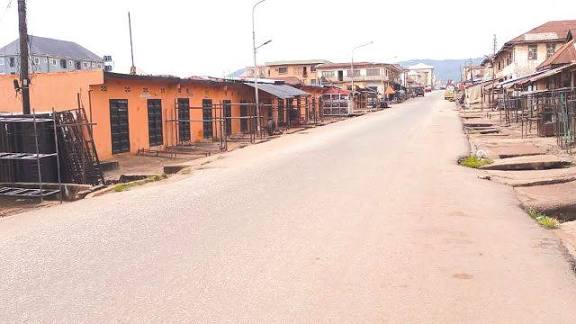
For more than three years, the South East of Nigeria has lived with the economic, social and psychological burden of the Monday Sit at Home directive enforced by the proscribed Indigenous People of Biafra and its sympathisers. What began as a tactic of protest has hardened into a routine of fear and paralysis, one that increasingly harms the very people it claims to protect. Ndi Igbo have become the primary victims of a policy that shuts down their own livelihoods every single week.
Each Monday, markets fall silent, schools close, banks lock their doors and transport disappears from the roads. Traders lose income, artisans miss daily wages, apprentices lose training time and families live under the quiet pressure of uncertainty. Traditional rulers, business leaders, clergy, civil society organisations and elected officials have all warned that the directive is destructive and coercive. Even state governors, including Anambra’s Professor Chukwuma Soludo, have described it as economically devastating. Yet fear still dictates behaviour. Silence persists not because people agree, but because they are afraid.
To understand how damaging this moment is, one must reflect honestly on the historic place of the Igbo in Nigeria. This is not a marginal people. Ndigbo are among the most mobile, educated and entrepreneurial communities in the country. Across Nigeria and the diaspora, Igbo men and women populate universities, hospitals, laboratories and boardrooms. In commerce, the Igbo trading network stretches from Onitsha to Aba, from Lagos to Kano, and far beyond Nigeria’s borders. In culture, music, sport and the creative industries, Igbo talent has helped shape Nigeria’s global identity. In the armed forces and international peacekeeping, Igbo officers have served with distinction. Through inter ethnic marriages and migration, Ndigbo have historically been among the most integrated peoples in the federation.



Perhaps the clearest symbol of this ingenuity is the Igbo Apprenticeship System, known as Igba Boi. It is an indigenous model of mentorship, capital formation and social mobility that has lifted millions out of poverty without state support. It is studied globally as a case study in organic entrepreneurship built on trust, patience and shared prosperity. Yet every Monday, this system is undermined. Markets shut, supply chains break, confidence drains and apprentices lose the daily exposure that makes the system work.
This reality points to a deeper problem. What the South East is experiencing is not simply agitation fatigue. It is a leadership failure. Leadership is not noise or symbolism. It is not bravado. It is strategy, timing, negotiation and institutional thinking. Across town unions, cultural organisations and political structures, hard questions must be asked. Who truly speaks for Ndigbo. Who negotiates on their behalf. Who understands power, alliances and global perception. Without clear leadership, grievance drifts into chaos and chaos consumes its own people.

There is also a dangerous habit of comparison that needs to be challenged. Some voices draw parallels between the Igbo and Jewish experience, often without understanding the structures behind Jewish global influence. Jewish communities operate through disciplined institutions, coordinated lobbying, economic strategy and long term planning. Their power is not loud or impulsive. It is patient and deliberate. Wealth circulates internally through structure, not slogans.
By contrast, the South East economy depends heavily on daily trade. Shutting it down weekly is economic self sabotage. Has anyone calculated what the region loses every year because of Monday Sit at Home. The answer is uncomfortable. The losses run into hundreds of billions of naira, carried not by elites or politicians, but by traders, transport workers, widows, apprentices and small business owners. It is the poorest who pay the highest price.
There is an old saying about a man who people want to burn, and who then pours petrol on himself. That image captures what is happening in the South East today. A people already burdened by insecurity and economic pressure are tightening the noose around their own survival.
At some point, hard questions must be faced. Who truly benefits from this paralysis. Who loses daily income. Who gains psychologically or politically from the chaos. Who is excited by the disruption. No society has ever achieved justice by strangling its own economy. No people have ever prospered by closing their own markets.
Equally important is the South East’s relationship with its neighbours, particularly in the South South. Historically, Igbo prosperity has been built on mobility, cooperation and regional integration. Isolation has never been the Igbo path to success.
In the 1960s, cultural icon Hubert Ogunde warned his people through song, Yoruba ronu. Yoruba think. In 2026, the message for Ndigbo must be just as direct. Ndigbo chee echiche nke oma. Igbo think deeply.
This is not a call to surrender. It is a call to strategy. Not a call to silence, but a call to wisdom. Not a denial of injustice, but a rejection of self destruction. Peoples rise by organising, educating, negotiating and building institutions that outlive anger. They do not rise by burning their own marketplaces.
If this path continues, history will record that at a moment that demanded clear thinking and courageous leadership, emotion prevailed and the cost was paid by innocent traders, teachers and professionals who only wanted to work, learn and live in peace.
Written by Sonny Iroche, the Founder and Chief Executive Officer of GenAI Learning Concepts Ltd and was a Senior Academic Fellow at the African Studies Centre, University of Oxford. He holds a postgraduate qualification in Artificial Intelligence from the Said Business School, University of Oxford and is a member of the UNESCO Technical Working Group on AI Readiness Assessment Methodology.