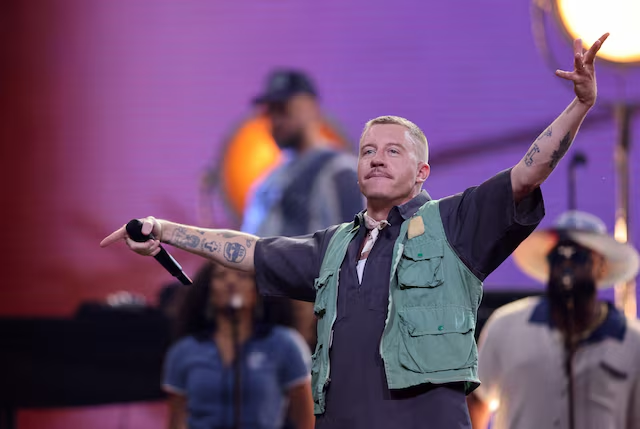
Grammy-winning rapper Macklemore has cancelled his scheduled October concert in Dubai, citing the United Arab Emirates’ alleged involvement in the Sudanese civil war. The artist’s decision to withdraw from the October 4th performance reflects his growing engagement in global activism, sparked by the conflict in Gaza.
Macklemore, known for his socially conscious lyrics, announced his decision on Instagram, condemning the UAE for allegedly supporting the Rapid Support Forces (RSF), a paramilitary group at the centre of Sudan’s ongoing civil war. “The current situation in Sudan is urgent, horrific and it’s going largely unnoticed globally,” he wrote. “I’m following the lead of Sudanese organisers and activists who are trying to be heard.”
The rapper’s stance is particularly striking given Dubai’s prominence as a cultural and tourism hub in the Gulf, where international artists regularly perform, often detached from the host country’s politics. “Until the UAE stops arming and funding the RSF I will not perform there,” Macklemore declared, underscoring his commitment to aligning his artistic endeavours with his moral convictions.
Macklemore’s decision comes amidst growing international concern over the UAE’s alleged role in the Sudanese conflict, which erupted in April 2023. The war began as a power struggle between the Sudanese army and the RSF, both of whom had previously ruled together following a coup. The conflict has since escalated, with half of Sudan’s population now facing severe food shortages.
Although the UAE has officially denied these allegations, reports from United Nations experts suggest that the claims are credible. This tension was evident in a heated exchange at the UN Security Council in June, where Sudan’s army openly criticised the UAE for its purported support of the RSF.
Macklemore’s announcement reflects a broader shift in his career, as he reconsiders his relationship with the global political landscape in light of recent events. His recent release, Hind’s Hall, a protest anthem in solidarity with pro-Palestinian activists, further underscores this new direction. “If I take the money, while knowing it doesn’t sit right with my spirit, how am I any different than the politicians I’ve been actively protesting against?” he questioned, challenging other artists scheduled to perform in Dubai to reconsider their choices.
This decision marks a rare instance of a high-profile artist refusing to perform in the UAE due to its political stance, signalling a potential shift in the way international performers engage with the region.