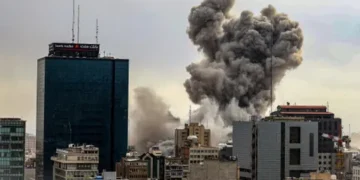
In the early hours of Friday, 13 June 2025, Israel launched an unprecedented series of missile strikes deep into Iranian territory, resulting in the deaths of at least three senior military officials including the Chief of Staff of the Iranian Armed Forces and top commanders within the Islamic Revolutionary Guard Corps (IRGC). The attacks, which Israel claims were targeted at nuclear enrichment and military sites, mark the most significant offensive against Iran since the 1980–1988 Iran-Iraq War.
Iran’s immediate response was the launch of over 100 unmanned aerial vehicles (UAVs) toward Israeli territory. Although many were intercepted by Israel’s multi-layered air defence systems, the attacks triggered rocket sirens across northern Jordan. Jordanian state media confirmed that several drones were neutralised within its airspace, underlining the transnational implications of the confrontation.
The escalation comes at a critical juncture, just days before the anticipated sixth round of nuclear negotiations between the United States and Iran, scheduled to take place in Oman. Those talks are now suspended, with Iranian state media reporting that Tehran has withdrawn its delegation. The decision follows a recent resolution passed by the International Atomic Energy Agency’s Board of Governors, which found Iran in noncompliance with its nuclear safeguards—marking the first such finding in two decades.



In a public address, Israeli Prime Minister Benjamin Netanyahu described the strikes as “very successful,” stating that Israeli forces had struck nuclear scientists, facilities, and senior IRGC personnel. Netanyahu warned that Israel would persist with operations “until the threat is removed,” while advising citizens to prepare for extended periods in shelters. Iran’s Supreme Leader, Ayatollah Ali Khamenei, responded via the social platform X, vowing that Israel would face a “severe punishment.”

From Washington, former President Donald Trump—now a key political figure as the United States approaches its November election—responded via Truth Social, urging Iran to “just do it” and return to the negotiation table. He warned of “even more brutal” attacks if Tehran continues its current trajectory. While U.S. Secretary of State Marco Rubio stated that the United States was not involved in the Israeli operation, Iran’s foreign ministry warned it would hold Washington accountable for its perceived complicity.
The global financial impact was immediate. Brent crude oil surged by over 13% before stabilising around $75.38 per barrel, while U.S. WTI rose to $74.11. Asian and European stock markets experienced sharp declines as investors sought safety in gold and government bonds. Dow futures dropped approximately 500 points as of Friday morning Eastern Time, reflecting deep concern over potential disruptions to oil supplies from a region responsible for roughly one-third of global output.
The escalation introduces profound uncertainty into a region already fragmented by competing interests, proxy networks, and a delicate diplomatic balance. Analysts such as Firas Maksad of Eurasia Group interpret these developments as only the opening phase of a prolonged confrontation. With Iran’s expansive missile arsenal and alliances with non-state actors across Iraq, Syria, Lebanon, and Yemen, the risk of spillover remains acute.
From an African perspective, this unfolding crisis presents a multi-dimensional concern. As global oil prices spike, economies across the Southern African Development Community (SADC)—which are already grappling with inflationary pressures, fiscal strain, and energy shortages—face intensified import costs and budgetary challenges. In South Africa, where over 60% of crude oil is imported, higher Brent prices will likely translate into elevated fuel and transport costs, potentially triggering social unrest.
Diplomatically, the conflict underscores the need for a more assertive African voice in international peace and security fora. As a non-permanent member of the United Nations Security Council for 2025–2026, South Africa holds a strategic platform to advocate for de-escalation and promote a multilateral diplomatic resolution. Additionally, the African Union’s Peace and Security Council could convene an emergency session to examine the wider implications of Middle Eastern instability on African economic resilience and security cooperation frameworks.
Africa’s historical role in non-alignment, coupled with its increasing ties to Gulf states and global powers, positions it uniquely to contribute to mediation efforts—particularly as countries like Algeria and Egypt maintain complex, longstanding relations with both Tehran and Tel Aviv.
What remains clear is that this is not merely a regional matter but a conflict with global reverberations. The militarisation of diplomatic breakdowns, the precarity of energy markets, and the resurgence of high-stakes geopolitical rivalries all suggest that June 2025 could be a turning point in 21st-century international relations.