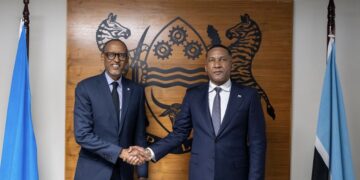
India has formally declared its support for Zimbabwe’s candidature for a non-permanent seat on the United Nations Security Council (UNSC) for the 2027–2028 term. The endorsement was announced on 27 June 2025 during a courtesy visit by India’s Minister of State for External Affairs, Mr Kirti Vardhan Singh, to Zimbabwean President Emmerson Mnangagwa at State House in Harare.
Speaking to the media following the high-level engagement, Mr Singh confirmed the establishment of a reciprocal support agreement between the two nations. “Yes, we are supporting each other in our proposal to become members of the UN Security Council. We have already proposed to give a word of acceptance for Zimbabwe to be a non-permanent member in 2027–2028, and the Government of Zimbabwe and His Excellency President Mnangagwa has assured his support for India to be the non-permanent member in 2029–2030. We will support each other,” Mr Singh stated.
This strategic alignment underscores the enduring cooperation between Zimbabwe and India, particularly within the framework of the Global South. Historically, both countries have maintained consistent support for one another on international platforms, including the United Nations and associated multilateral bodies.



Zimbabwe’s campaign for a non-permanent UNSC seat has garnered increasing international backing. Endorsements have already been secured from Russia, Cuba, Senegal, the Southern African Development Community (SADC), and the African Union (AU), signalling growing consensus for a more representative and inclusive global security architecture.
The United Nations Security Council is composed of five permanent members—China, France, Russia, the United Kingdom, and the United States—with veto authority, and ten non-permanent members elected for two-year terms by the UN General Assembly. Non-permanent members do not hold veto power but participate in all decisions, including those on matters of peacekeeping and international sanctions. A minimum of nine affirmative votes is required for the passage of any resolution, making diplomatic coalition-building critical.

Minister Singh also conveyed that broader discussions took place with President Mnangagwa regarding bilateral cooperation. “We have very active engagements from both sides with ministerial visits and high-level engagements. My visit to Zimbabwe was in that context—strengthening our bilateral relations and exploring trade, investment, and development opportunities,” he said. Mr Singh expressed optimism about future economic collaboration and praised Zimbabwe for the warm diplomatic reception extended during his visit.
India and Zimbabwe enjoy long-standing relations that trace back to Zimbabwe’s liberation movement and subsequent independence in 1980. Since then, India has consistently contributed to Zimbabwe’s socio-economic development through lines of credit, grants, and human capital development initiatives. Notably, India has extended support through training programmes under the Indian Technical and Economic Cooperation (ITEC) framework and infrastructural investment via the Export-Import Bank of India.
The relationship is further strengthened by the presence of a vibrant Indian diaspora in Zimbabwe, many of whom have contributed significantly to the nation’s commercial, health, and educational sectors. This diaspora engagement remains an important bridge for fostering people-to-people connectivity between the two countries.
Also in attendance during the bilateral discussions were Zimbabwe’s Minister of Foreign Affairs and International Trade, Professor Amon Murwira, Permanent Secretary Albert Chimbindi, and other senior government officials. The talks marked a continued deepening of strategic relations between New Delhi and Harare at a time when both nations are advancing their profiles in global governance forums.
India’s backing adds considerable weight to Zimbabwe’s bid and exemplifies a broader shift towards inclusive multilateralism in international affairs, particularly for African nations seeking stronger representation in global decision-making structures.