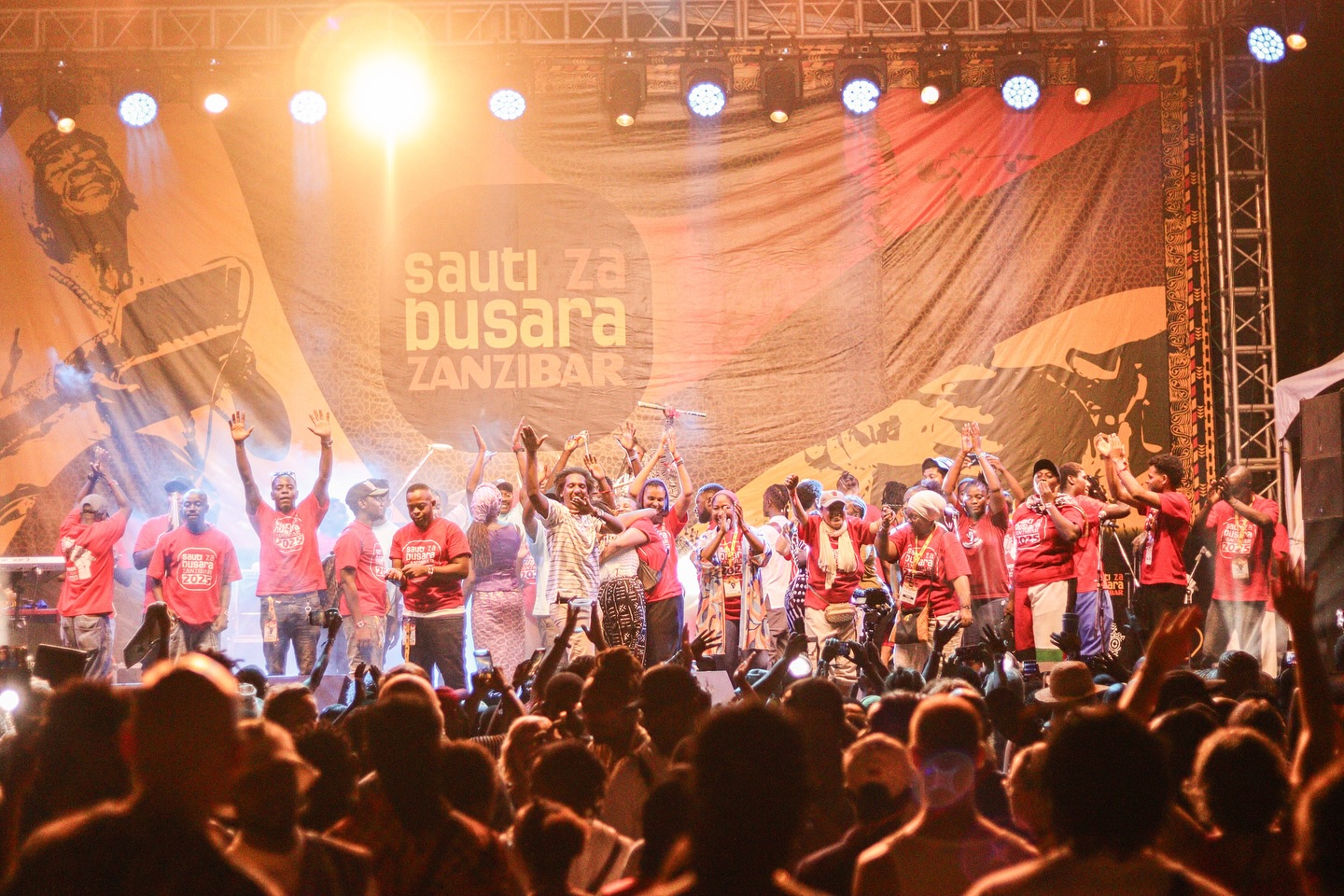
Every February, Zanzibar does more than host a music festival. It activates an economy, rehearses a cultural philosophy, and quietly reminds the continent what long-term creative investment looks like. Sauti za Busara is often described as a celebration of African music, but that framing undersells its real influence. Over two decades, the festival has become an economic engine, a cultural classroom, and a case study in how creativity sustains communities when it is treated seriously.
From its earliest editions in the mid-2000s, Sauti za Busara positioned itself differently. It was never designed as a fly-in, fly-out spectacle. Instead, it embedded itself into Stone Town’s rhythms, spatially, socially, and economically. Held annually in February, traditionally a quieter tourism period for Zanzibar, the festival deliberately countered seasonal slowdowns. Hotels filled. Restaurants extended hours. Taxi drivers, craftspeople, food vendors, sound technicians, security teams, and stagehands found work. Cultural tourism replaced idle downtime.
Over time, the numbers became hard to ignore. Thousands of visitors travel to Zanzibar specifically for the festival, many from within Africa, others from Europe, North America, and Asia. Unlike conventional beach tourism, Sauti za Busara audiences spend locally, on accommodation, food, transport, crafts, and experiences rooted in Zanzibari culture. The result is a circulation of money that reaches beyond resort walls and into neighbourhood economies.



But the economic impact is not only transactional. Sauti za Busara has invested consistently in skills development, creating long-term value rather than short-term profit. Local technicians receive hands-on training in sound engineering, lighting, stage management, production logistics, and event operations. These skills are portable. They move with people into other festivals, events, and creative projects across Tanzania and East Africa. In an industry where technical capacity is often outsourced, Sauti za Busara has helped localise expertise.
This focus on infrastructure extends to artists themselves. For many performers, particularly emerging acts from East Africa, Sauti za Busara is a first encounter with an international audience, professional staging, and pan-African peers. It offers visibility without forcing artists to dilute their sound. Traditional taarab groups perform alongside hip-hop collectives. Singeli DJs share space with jazz musicians. No genre is treated as novelty. All are treated as contemporary.
Culturally, this has had a quiet but lasting effect. Sauti za Busara has helped normalise the idea that African music does not need external validation to be valuable. By insisting on 100 percent live performances, the festival reinforces musicianship as a craft, not a playlist. In an era dominated by algorithms and digital shortcuts, this insistence on live sound is both philosophical and practical. It creates jobs. It rewards rehearsal. It values collaboration.
The festival’s setting amplifies its cultural weight. Stone Town, a UNESCO World Heritage site shaped by centuries of trade, migration, and cultural exchange, is not a neutral backdrop. Its narrow alleys, coral-stone buildings, and ocean-facing courtyards remind audiences that African culture has always been global, long before the term became fashionable. Music at Sauti za Busara doesn’t just perform history; it converses with it.
For over 22 years, the Old Fort (Ngome Kongwe) served as the festival’s symbolic centre. Its thick walls and open courtyard created intimacy without exclusivity. In 2025, the move to Mnazi Mmoja Grounds marked a significant evolution. The new site offers open space, greenery, and sea air, practical advantages for crowd flow, safety, accessibility, and expansion. Economically, it allows more vendors, larger audiences, and diversified programming. Culturally, it signals continuity without stagnation. The festival grows, but its values remain intact.
Beyond the main stages, Sauti za Busara’s fringe programming deepens its impact. The Carnival Parade transforms Stone Town into a moving performance, collapsing the boundary between audience and artist. Swahili Encounters brings musicians from different countries together to rehearse and perform collaborative sets, prioritising process over spectacle. Industry forums such as Movers & Shakers create space for professional dialogue, an often-overlooked component of sustainable creative economies.
There is also Busara Plus, a free community stage hosted in areas like Fumba Town Nyamanzi. This extension matters. It decentralises access and reinforces the idea that culture should circulate, not concentrate. For younger audiences and first-time performers, it offers exposure without financial barriers. Economically modest, culturally significant.

The festival’s gender impact is equally deliberate. Women are visible not only as performers but as organisers, administrators, producers, and technicians. In an industry where women’s labour is often under-credited, Sauti za Busara’s structure quietly models a different standard. Visibility becomes policy. Representation becomes practice.
International recognition has followed, but never dictated direction. Praise from outlets such as the BBC World Service has elevated the festival’s profile, yet programming decisions remain grounded in regional relevance. This balance, global respect without external dependency, is rare and instructive.
Perhaps the most important economic contribution of Sauti za Busara is less measurable but more durable: trust. In a sector often marked by short-lived initiatives and broken promises, the festival’s consistency matters. Even after setbacks, including a cancellation in 2016 due to funding challenges and disruptions during the COVID-19 pandemic, Sauti za Busara returned. That return sends a signal to artists, audiences, sponsors, and communities: cultural work can be sustained if it is rooted, accountable, and patient.
Today, Sauti za Busara functions as both mirror and blueprint. It reflects what African cultural economies already are, resilient, collaborative, locally grounded. And it offers a model for what they could be: professionally run, economically integrated, culturally confident.
In Zanzibar each February, sound becomes labour, labour becomes value, and value circulates back into community. That is the real impact of Sauti za Busara. Not just music in the air, but systems on the ground, quietly proving that culture, when taken seriously, pays dividends far beyond the stage.