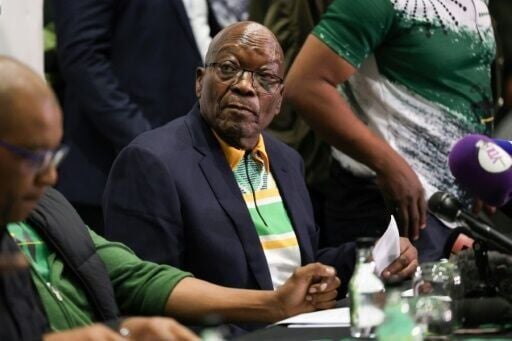
Former South African President Jacob Zuma has sharply criticised the country’s new coalition government, calling for fresh elections to be held. Zuma, who now leads the uMkhonto weSizwe (MK) Party, voiced his concerns at a press briefing in Johannesburg on Sunday.
“There must be a repeat. No, there must be elections,” stated Zuma. The MK Party, which came third in the 29 May elections, has declared that none of its 58 newly elected lawmakers will not join the ruling coalition, although they will still sit in the legislature.
Zuma’s stance is significantly influenced by his animosity towards Cyril Ramaphosa, the current leader of the African National Congress (ANC) and Zuma’s successor as president. Zuma has consistently maintained that his party would not engage in negotiations while Ramaphosa remains at the helm of the ANC.



Ramaphosa was re-elected as president by lawmakers for a second term last Friday, following a dramatic late coalition agreement. The 71-year-old Ramaphosa secured his second term with the support of lawmakers from the Democratic Alliance (DA), South Africa’s second largest party, and several smaller parties.

Zuma condemned the coalition, asserting, “The whole big group of political parties, all complaining simultaneously that we are robbed here. We want this to be looked at.” He further indicated that the affected parties intend to seek recourse through international courts, expressing distrust in the impartiality of the South African judicial system. “We are going to the international court… so that this country does not have the South African judges doing so,” he stated.
Citing irregularities at polling stations, Zuma called for new elections, remarking, “Let us see the votes properly. We have many stories about votes. Some burnt. You don’t even need to listen to what people have to say.”
Zuma resigned as president in 2018 amidst numerous corruption allegations. His successor, Ramaphosa, has now secured a second term as president after the ANC forged a last-minute coalition with the DA during the parliamentary session. This landmark agreement was crucial after the ANC lost its 30-year parliamentary majority in the recent election.
The coalition marks the first time in South Africa’s history that the country will be co-governed at the national level without a single party holding a majority.