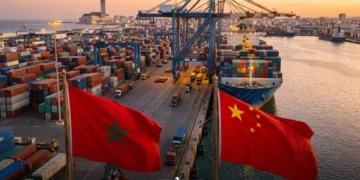
As Donald Trump boarded Air Force One following two hours of closed-door discussions with Xi Jinping on the sidelines of the Asia-Pacific Economic Cooperation (APEC) summit in Busan, he described the exchange as “a 12 out of 10”. While such hyperbole is to be expected from the former US president, the tone differed markedly from the fractious tenor that has long defined US–China relations.
Although no formal agreement was signed, both parties emerged with a raft of interim measures designed to lower the temperature: suspension of rare earths export controls by China, a partial rollback of US tariffs, guarded cooperation on drug enforcement, and renewed AI export restrictions. The summit may be read as an inflection point — not necessarily a reconciliation, but a calculated pause in a long-term confrontation.
For African states, the implications are not peripheral. They are structural. This summit underscores how global economic realignments are no longer confined to traditional power blocs, but now extend to resource-producing, non-aligned economies — especially those with untapped mineral deposits, growing digital infrastructure, and expanding diplomatic ambitions. Below, we examine five core takeaways and what they signal for the continent.




1. Rare earth minerals: a reprieve that raises Africa’s stakes
The most economically consequential development was China’s decision to suspend its October ban on rare earth exports. Though justified domestically on grounds of national security, the ban had threatened to escalate an already volatile commodities market. Rare earths — particularly neodymium, dysprosium, and praseodymium — are essential in the manufacture of electric vehicles, defence technologies, and advanced electronics.
Trump claimed that the “roadblock is gone”, asserting that a one-year bilateral understanding had been reached with China to resume global flow. Beijing, for its part, made no explicit mention of rare earths in its official communique, but state-run media later confirmed a suspension of outbound controls.
Why Africa must act:
African states, particularly Burundi, Tanzania, Namibia and South Africa, possess substantial deposits of rare earth elements (REEs). For years, these reserves have remained underdeveloped due to infrastructure gaps, weak governance, and lack of processing capacity. However, the renewed fragility of Sino-American resource flows gives Africa leverage — but only if it moves quickly to develop transparent regulatory frameworks, build domestic beneficiation capacity, and signal geopolitical reliability to end-users in Europe, North America and East Asia.
If African producers remain passive, multinational buyers will continue to default to known suppliers, regardless of geopolitical risk. If they act decisively, they may become indispensable.
2. Tariffs-for-narcotics diplomacy: new instruments of conditionality
Another subtle yet instructive dimension of the summit was the linking of Chinese action on fentanyl precursor chemicals to US tariff relief. Trump confirmed that the US would halve tariffs on a targeted list of Chinese imports from 20% to 10%, citing China’s “very strong” commitment to clamping down on chemical flows used in the manufacture of synthetic opioids. Beijing’s commerce ministry acknowledged the reduction and pledged to adjust its own countermeasures accordingly.
Though the underlying issue is public health, the mechanism used was trade — a growing practice in bilateral diplomacy where non-trade issues are resolved through economic levers.
Why Africa must note this trend:
This marks the maturing of “coercive diplomacy through economic instruments” — a trend that is likely to shape future engagements between large economies and resource-dependent nations. For African states, this signals that issues such as pharmaceutical compliance, anti-money laundering enforcement, and cybercrime regulation may become directly tied to trade concessions or investment flows.
African negotiators must anticipate conditionalities not just in the form of WTO-sanctioned tariffs but via side agreements that bind policy performance to market access.
3. AI and chip tech: the coming digital bifurcation
One of the more strategically revealing moments in the summit came when Trump confirmed that Nvidia’s new AI chip — the Blackwell B30A — would not be sold to China. He was clear: “We’re not talking about the Blackwell… but a lot of chips.” This signals the continuation of Washington’s policy of selective technology containment, where older or ‘crippled’ chips may be sold to China, but leading-edge technologies are withheld.
These chips are not only relevant to consumer applications, but to military, surveillance and supercomputing capabilities — areas both countries consider core to future power projection.
Why Africa cannot remain digitally neutral:
Africa is undergoing a wave of digital transformation, with governments integrating AI into tax systems, health services, surveillance, and biometric registries. However, the infrastructure behind these systems — from cloud capacity to chips — is largely imported. The summit confirms what many have suspected: the AI ecosystem is bifurcating along political lines, with the US and China offering mutually exclusive stacks.
African digital sovereignty will depend on whether countries can create interoperable systems, source chips and software from multiple markets, and build regulatory frameworks that prevent vendor lock-in. The risk is not just technological — it is diplomatic.
4. Ukraine centre-stage, Taiwan off the table — and the silence speaks volumes
According to Trump, the conflict in Ukraine was “a long” topic of discussion, with both leaders agreeing to “work together” to seek progress. In contrast, the issue of Taiwan — widely considered the most dangerous fault line in global politics — was not discussed at all. “That was not discussed actually,” Trump told reporters on Air Force One.
This selective engagement suggests that both leaders are currently focused on managing tensions, not resolving structural conflicts. The omission of Taiwan from the agenda is, paradoxically, more instructive than its inclusion would have been.
Why this matters for Africa’s foreign policy posture:
African states have historically been the subject of great power influence but not the brokers of its direction. That may be changing. Increasingly, votes cast by African states at the UN, WTO and regional blocs are being scrutinised as indicators of alignment. Silence on Taiwan today does not imply neutrality tomorrow.
As the global order enters a more multipolar phase, Africa must prepare for an environment in which abstention is no longer acceptable and where quiet diplomacy may come at a reputational cost.
5. The illusion of strategic consensus
While the summit ended with conciliatory language, the structural rifts remain unresolved. The long-suspended “phase one” trade deal remains unimplemented. Strategic distrust persists on intellectual property, 5G infrastructure, military posturing in the Pacific, and access to multilateral lending bodies.

The appearance of de-escalation should not be confused with resolution. What has been achieved is delay, not detente.
Why African states must adopt strategic hedging:

This temporary pause affords African states a narrow window to recalibrate. Rather than aligning exclusively with either China or the US, the current environment rewards agility — building regional resilience, strengthening south-south partnerships, and developing industrial ecosystems that reduce reliance on single-market export strategies.
In particular, the African Continental Free Trade Area (AfCFTA) offers an institutional framework to insulate the continent from future global volatility. But it must be activated — not just referenced.
The Trump–Xi summit signals a shift — not in sentiment, but in strategy. The old dichotomy of “East or West” is giving way to a more fluid landscape of tactical agreements, suspended threats, and evolving dependencies. In this environment, African states are not just observers — they are potential arbiters of global leverage.
The choice now is whether to assert agency or absorb impact.