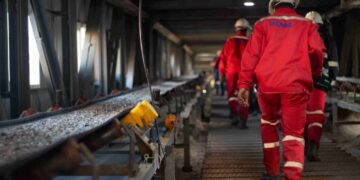
Angola has formally inaugurated a new electrolytic aluminium plant located within the Barra do Dande Free Trade Zone in Bengo Province. The plant is the result of a partnership between the Angolan government and the Chinese enterprise Hebei Huatong Wire and Cables Group, marking a significant step in the country’s long-term ambition to diversify its economy and foster industrial self-reliance across Southern Africa.
The facility, launched in the presence of President Joao Lourenco, is the first phase of a broader multi-stage industrial development strategy. With an initial capital investment of 250 million US dollars, the plant is expected to yield 120,000 tonnes of electrolytic aluminium annually while generating approximately 1,200 jobs across various skill levels. According to official government communication, the overarching project will be developed in five stages, with future phases anticipated to deepen Angola’s participation in the global aluminium value chain and stimulate regional economic corridors.
President Lourenco, addressing journalists at the inauguration event, reiterated the government’s broader vision for economic transformation, stating that Angola is actively seeking private investment in all sectors. He underlined that the challenge is not solely about employment generation for the youth but also about expanding the nation’s capacity to produce a diverse range of goods and services that can enhance local livelihoods and support sustainable development.




In his remarks, Zhang Wendong, Chief Executive Officer of Huatong Angola, described the project as more than an infrastructural investment. He emphasised the company’s commitment to sustainable development and localisation, highlighting that a suite of initiatives is already underway to build local human capital. These include technical training programmes, professional apprenticeships and knowledge transfer schemes designed to integrate Angolan professionals into the heart of the industry.
This development in Angola forms part of a broader continental trend in which African nations are asserting greater agency in shaping their industrial futures. The emergence of industrial zones such as Barra do Dande is not merely an economic policy choice but a strategic expression of Africa’s resolve to construct more equitable global supply chains that recognise African labour, resources and innovation.
While the partnership with Chinese entities such as Hebei Huatong aligns with broader South-South cooperation models, its long-term sustainability will depend on continued alignment with local development goals and equitable participation by host communities. For Angola, the stakes go beyond export volumes or GDP increments. The real metric of success lies in the plant’s capacity to serve as a catalyst for domestic manufacturing, energy integration and regional trade connectivity across the Southern African Development Community.
At a moment when African economies are under pressure to move away from resource extraction towards value addition, this development reflects a deliberate reorientation towards structural transformation. If executed effectively and inclusively, the aluminium industrial park has the potential to serve as a blueprint for similar initiatives in Africa where foreign partnerships are directed towards long-term endogenous growth rather than extractive short-term gains.
This industrial expansion echoes the broader aspirations laid out under the African Union’s Agenda 2063, particularly its emphasis on inclusive growth, industrialisation and skills development. In this context, Angola’s move is not isolated but part of a continental realignment that increasingly centres African agency and narrative sovereignty.

The evolution of such industrial collaborations will require transparency, robust policy alignment and continuous capacity building to ensure that Africa’s role in the global industrial system is both visible and respected. Angola’s latest venture may not be a panacea, but it represents a substantive pivot away from linear economic models and towards a more layered and people-centred industrial trajectory.